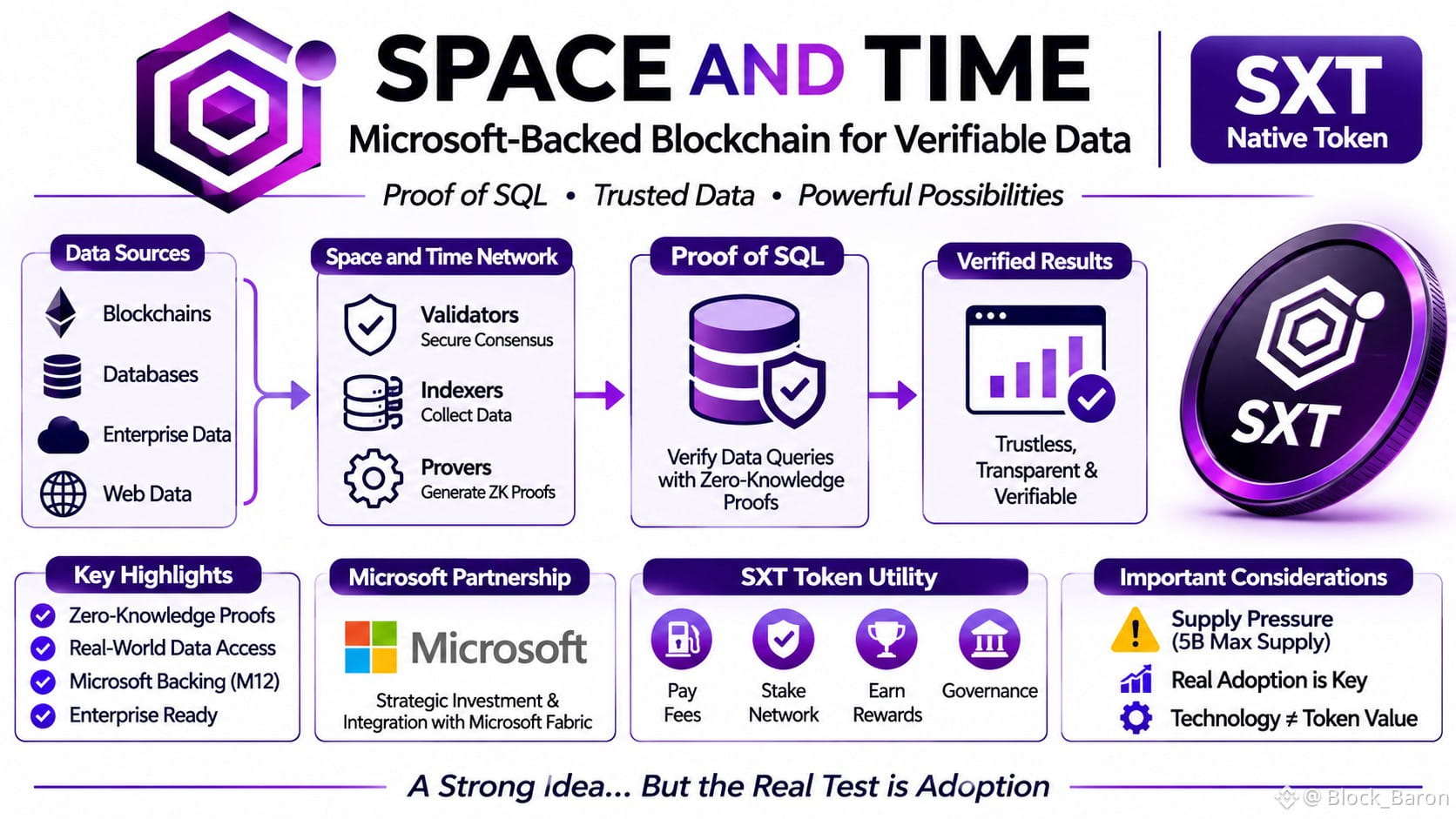

Space and Time ($SXT ): The Technology Makes Sense, But the Token Still Has Questions
After years of watching crypto narratives come and go, I’ve learned to separate interesting technology from convincing token stories.
Space and Time is building something I genuinely find interesting. Its Proof of SQL technology allows data queries to be verified cryptographically, which could become increasingly useful for smart contracts, financial applications, and AI systems that need reliable information.
What catches my attention isn't the Microsoft connection or another ambitious infrastructure narrative. It's the problem itself. Applications shouldn't always have to blindly trust databases or centralized data providers.
But there's another side people rarely discuss.
A useful technology doesn't automatically create a valuable token. Enterprise customers can benefit from verifiable computation without necessarily generating meaningful demand for SXT. That's a distinction worth keeping in mind.
Then there's token supply, network economics, and actual adoption. Partnerships look impressive, but recurring usage, real fees, and developers building products matter much more over time.
I'm not dismissing Space and Time. Quite the opposite. I think the underlying idea deserves serious attention.
I just prefer watching what the network actually accomplishes instead of deciding its future based on what the narrative promises.
Sometimes the most interesting projects are the ones that still have difficult questions to answer.
#sxt $SXT @SpaceandTime