
I’ve been poking around Space and Time’s docs for a few days, and the thing I can’t stop thinking about isn’t the Microsoft logo. It’s a smaller distinction that gets blurred in most crypto data conversations.
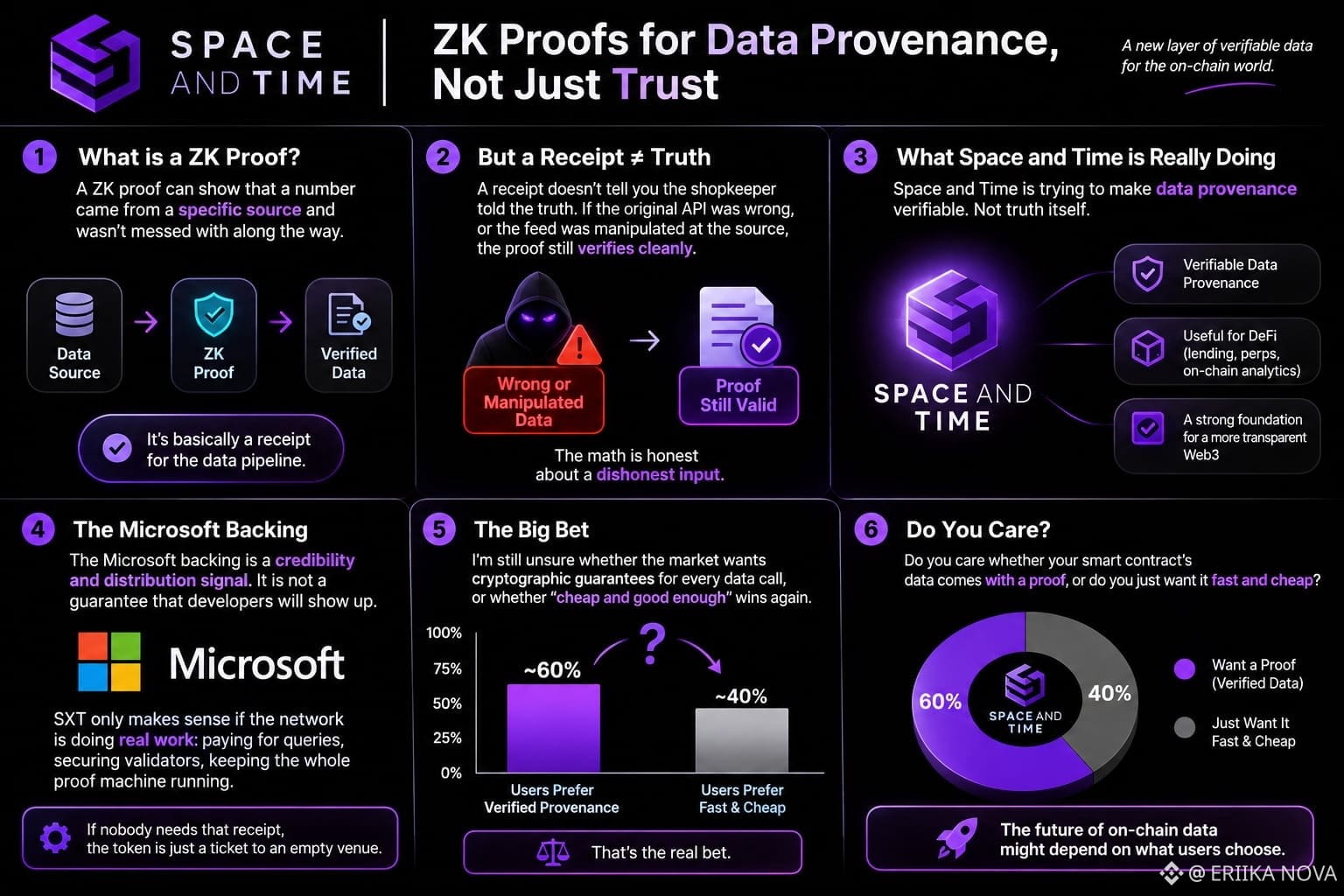
A ZK proof can show that a number came from a specific source and wasn’t messed with along the way. That’s useful. It’s basically a receipt for the data pipeline. But a receipt doesn’t tell you the shopkeeper told the truth. If the original API was wrong, or the feed was manipulated at the source, the proof still verifies cleanly. The math is honest about a dishonest input.
That sounds like a criticism, but it’s really just the boundary of what this thing does. Space and Time is trying to make data provenance verifiable. Not truth itself. And for a lot of DeFi use cases—lending, perps, on-chain analytics—provenance might be the part that actually matters.
The Microsoft backing is a credibility and distribution signal. It is not a guarantee that developers will show up. SXT only makes sense if the network is doing real work: paying for queries, securing validators, keeping the whole proof machine running. If nobody needs that receipt, the token is just a ticket to an empty venue.
I’m still unsure whether the market wants cryptographic guarantees for every data call, or whether “cheap and good enough” wins again. That’s the real bet.
Do you care whether your smart contract’s data comes with a proof, or do you just want it fast and cheap?
#sxt $SXT @SpaceandTime