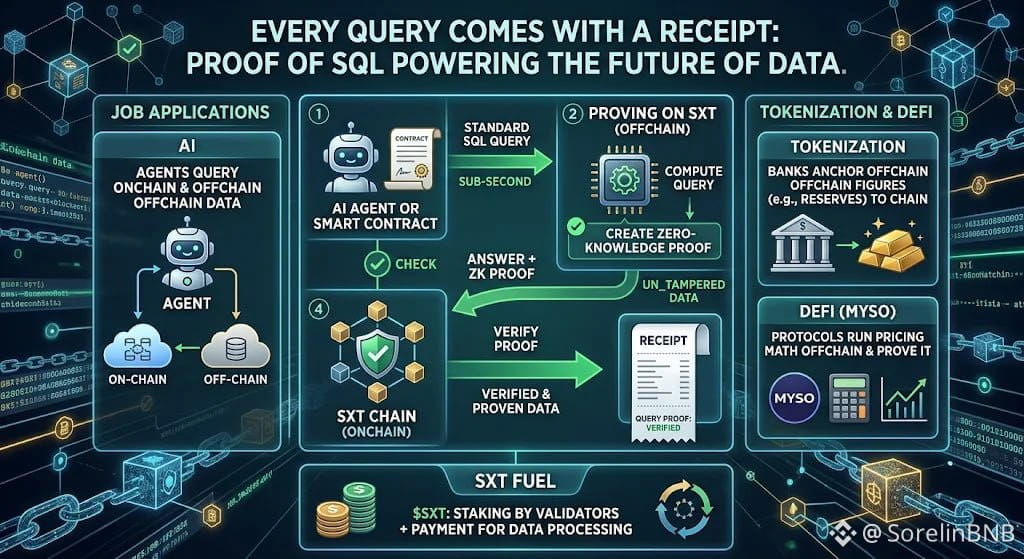
Every query should come with a receipt.
Smart contracts can’t answer a simple question like “which wallets ever touched this pool?” An AI agent that acts on data it can’t check is just a confident guess.
@SpaceandTime fixes that with Proof of SQL. A standard SQL query runs offchain, a zero-knowledge proof shows it was computed correctly on untampered data, and SXT Chain verifies the proof.
The proving is built to be sub-second, so the answer can arrive during a transaction, not half an hour later.
That one primitive covers all three jobs in the campaign narrative:
AI: agents can query onchain and offchain data and prove the result.
Tokenization: banks can anchor offchain figures like reserves to the chain.
DeFi: protocols like MYSO run pricing math offchain and prove it.
$SXT is the fuel: staking by validators, plus payment for data processing.
My question is whether proofs become the default for data the way signatures became the default for transactions. I hold a position to find out.
#sxt $SXT @SpaceandTime