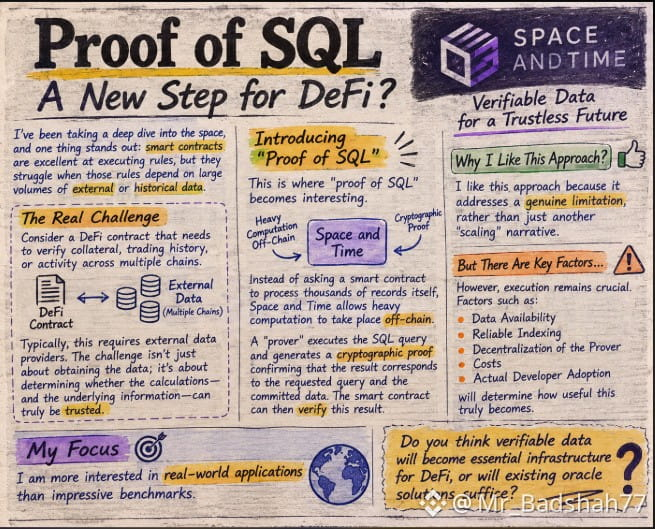

I’ve been taking a deep dive into the space, and one thing stands out: smart contracts are excellent at executing rules, but they struggle when those rules depend on large volumes of external or historical data.
Consider a DeFi contract that needs to verify collateral, trading history, or activity across multiple chains. Typically, this requires external data providers. The challenge isn't just about obtaining the data; it’s about determining whether the calculations and the underlying information can truly be trusted.
This is where "proof of SQL" becomes interesting.
Instead of asking a smart contract to process thousands of records itself, Space and Time allows heavy computation to take place off-chain. A "prover" executes the SQL query and generates a cryptographic proof confirming that the result corresponds to the requested query and the committed data. The smart contract can then verify this result.
I like this approach because it addresses a genuine limitation, rather than just being another "scaling" narrative.
However, execution remains crucial. Factors such as data availability, reliable indexing, the decentralization of the prover, costs, and actual developer adoption will determine how useful this truly becomes.
I am more interested in real-world applications than in impressive benchmarks.
Do you think verifiable data will become essential infrastructure for DeFi, or will existing oracle solutions suffice?
#sxt $SXT @SpaceandTime