
I've been looking at SXT, and honestly, I think there's something about its tokenomics that a lot of people are overlooking.
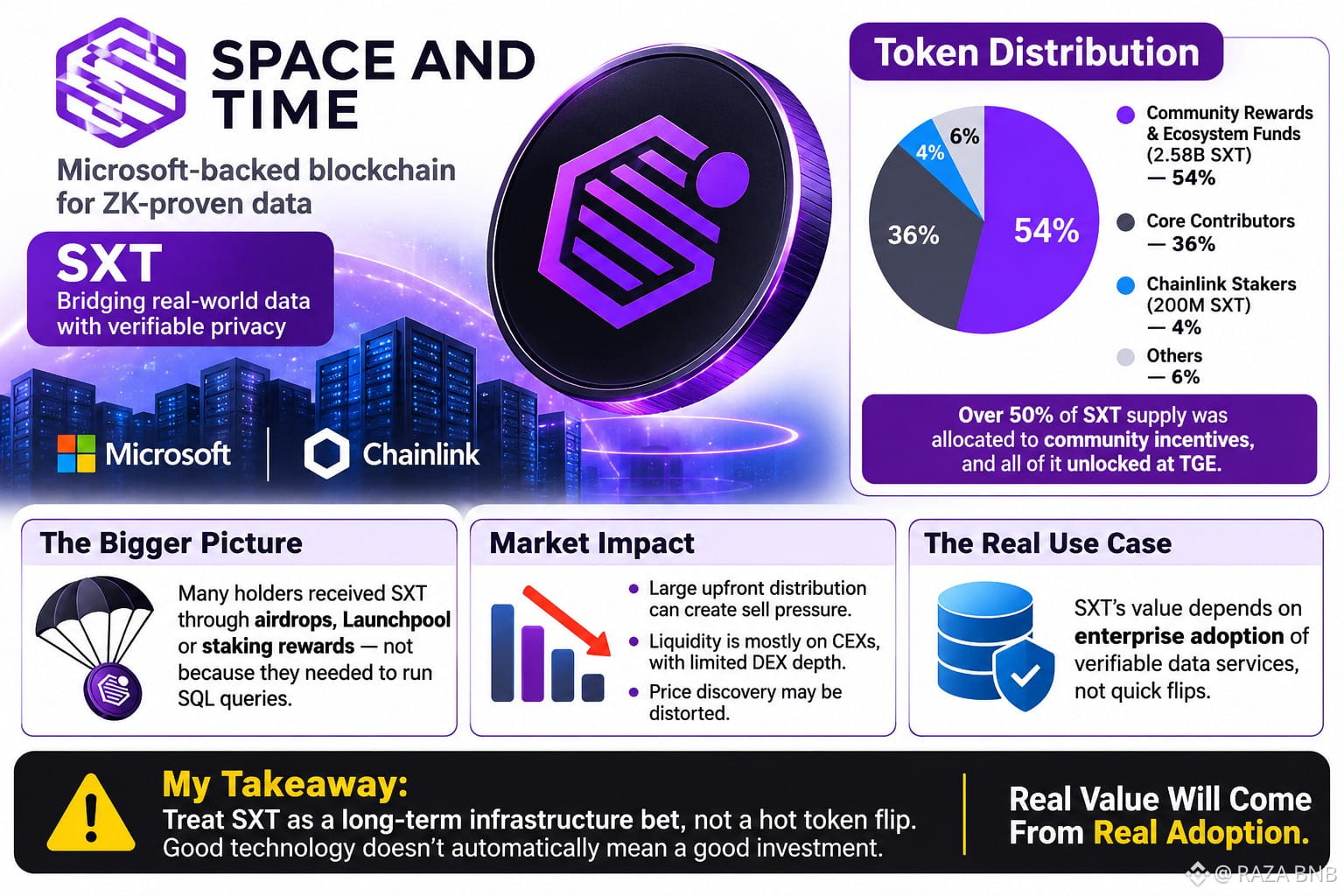
More than 50% of the total supply (2.58 billion SXT) went toward community rewards and ecosystem funds, with all of it unlocked at TGE. Another 4%, or 200 million tokens, was allocated to Chainlink stakers.
Now, here's what I find interesting. A huge portion of holders didn't necessarily buy SXT because they wanted to use Space and Time. Many received it through airdrops, Launchpool or staking rewards. I was one of them. I farmed some SXT through Launchpool and swapped it out pretty quickly. And I'm probably not the only one.
That's where things get a little complicated. When so many tokens land in people's hands for free, not everyone has a reason to hold them. Some will naturally sell at the first decent opportunity. That can create lasting pressure on the market, especially when liquidity is concentrated mostly on centralized exchanges.
But I don't think the technology itself is the problem. Space and Time is working on something genuinely interesting: helping businesses verify data using zero-knowledge proofs. The challenge is that enterprise adoption doesn't happen overnight.
People hear that it's Microsoft-backed and immediately expect massive demand for SXT. I think that's where expectations can get ahead of reality.
For me, the real question isn't how much attention SXT gets today. It's whether developers and businesses will actually use the network enough to create sustainable demand for the token.
I'm interested in the long-term potential, but I'm not ignoring the supply side. Good technology doesn't automatically make a good token investment. Sometimes the hardest part is turning that technology into real usage.
#sxt $SXT @SpaceandTime