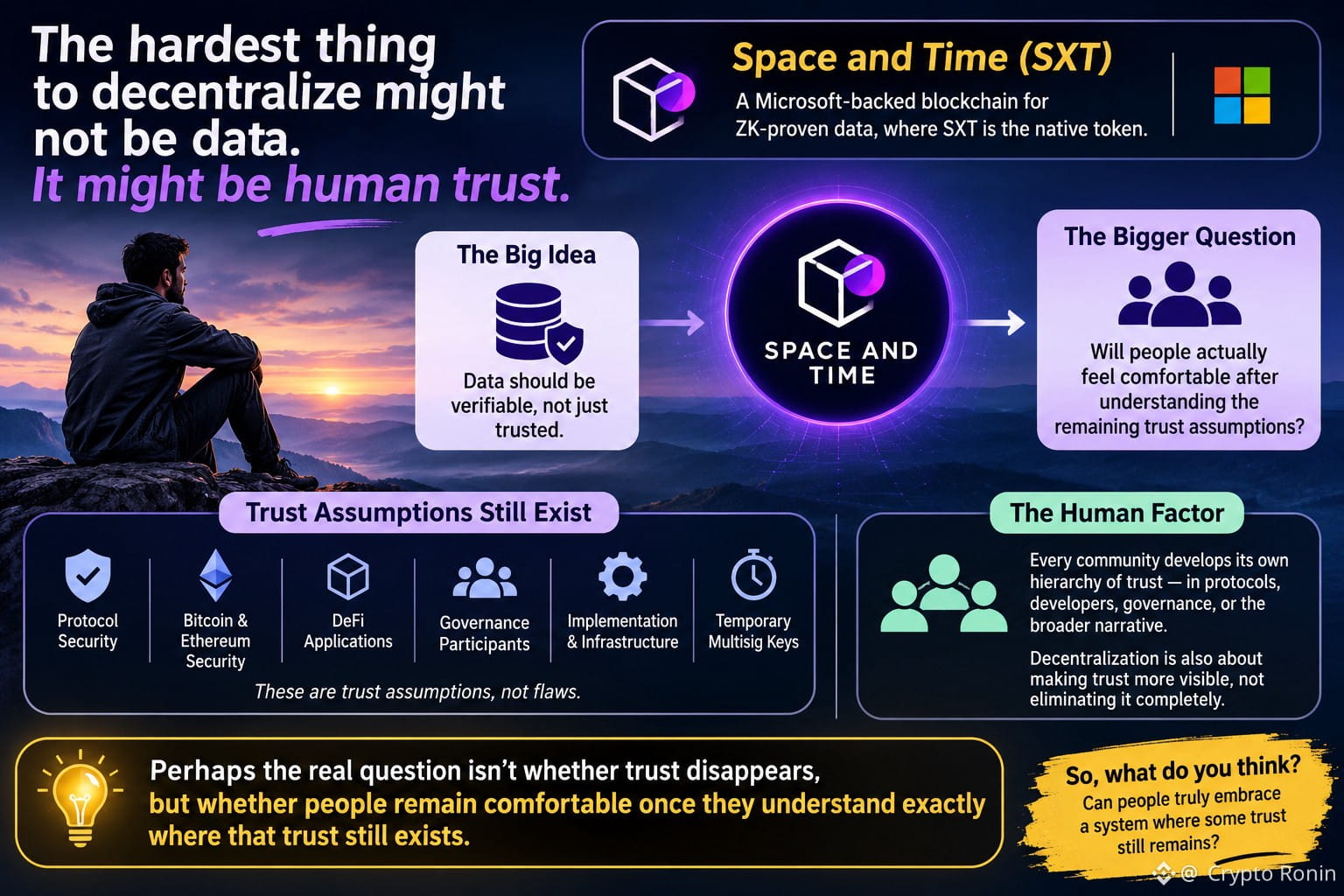

I've been noticing how the conversation around blockchain infrastructure is slowly shifting. It's no longer just about speed, scalability, or decentralization. Increasingly, it's about who controls information, who verifies it, and who gets to decide what counts as truth.
That's where Space and Time becomes an interesting project to observe.
With Microsoft-backed infrastructure and zero-knowledge-proven data, Space and Time is building around an important idea: data should be verifiable rather than simply accepted because someone says it's accurate.
But I've been wondering whether technical verification alone can change how people behave.
Every ecosystem eventually develops its own hierarchy of trust. Some people trust the protocol, others trust developers, governance participants, institutions, or simply the community narrative surrounding a project.
Even when cryptographic proofs reduce the need for blind trust, they don't eliminate every assumption. Implementation, infrastructure, governance, and the people maintaining the system still matter.
I think this distinction is important when looking at SXT, the native token of Space and Time. Beyond its technical role, the broader question is how communities understand the systems they're participating in.
The more I watch blockchain evolve, the more I realize that decentralization isn't simply about removing intermediaries. It's about making power, responsibility, and trust assumptions more visible.
**Perhaps the real question isn't whether trust disappears, but whether people remain comfortable once they understand exactly where that trust still exists.
$SXT #sxt @SpaceandTime