#sxt $SXT
What if an AI agent needs more than just today's blockchain data to make a decision?
That's a question worth thinking about as AI and smart contracts become more closely connected.
A smart contract can access current onchain balances, logs and storage. But what happens when it needs a user's one-year staking history, historical activity or liquidity conditions across multiple chains?
This is where I find Space and Time particularly interesting.
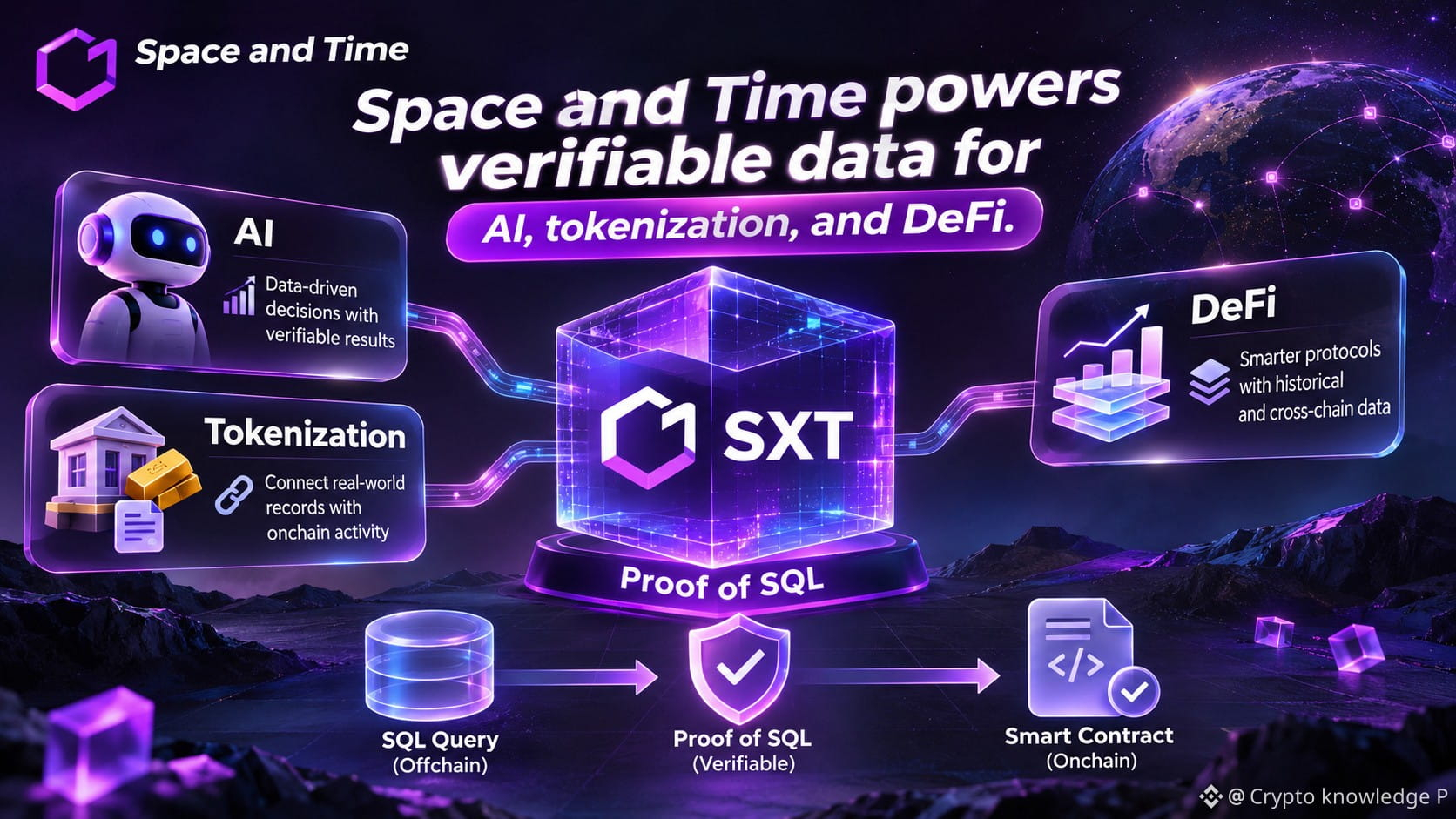
While going through its technical documentation, I came across its AI-agent use case. AI-initiated smart contracts can request historical, aggregate and cross-chain data through SQL queries on Space and Time.
The interesting part is what happens next.
Prover nodes execute the queries offchain against indexed, cryptographically committed tables and generate a Proof of SQL. The smart contract can then verify the proof onchain without needing to process or store the entire dataset.
That distinction matters.
It's not simply about getting an answer from a database. It's about having cryptographic evidence that the requested computation was performed correctly against committed data.
I can see why this matters for DeFi applications that need historical information, AI agents that make data-driven decisions, and tokenized assets that depend on reliable, verifiable records.
Of course, verifying a computation doesn't automatically make every original data source truthful. But being able to verify data integrity and query execution is a meaningful step forward.
Space and Time powers verifiable data for AI, tokenization, and DeFi.
The more I explore this technology, the more interesting its underlying idea becomes: applications shouldn't just receive data; they should have a way to verify it.
#SXT $SXT @SpaceandTime