
#sxt $SXT @SpaceandTime
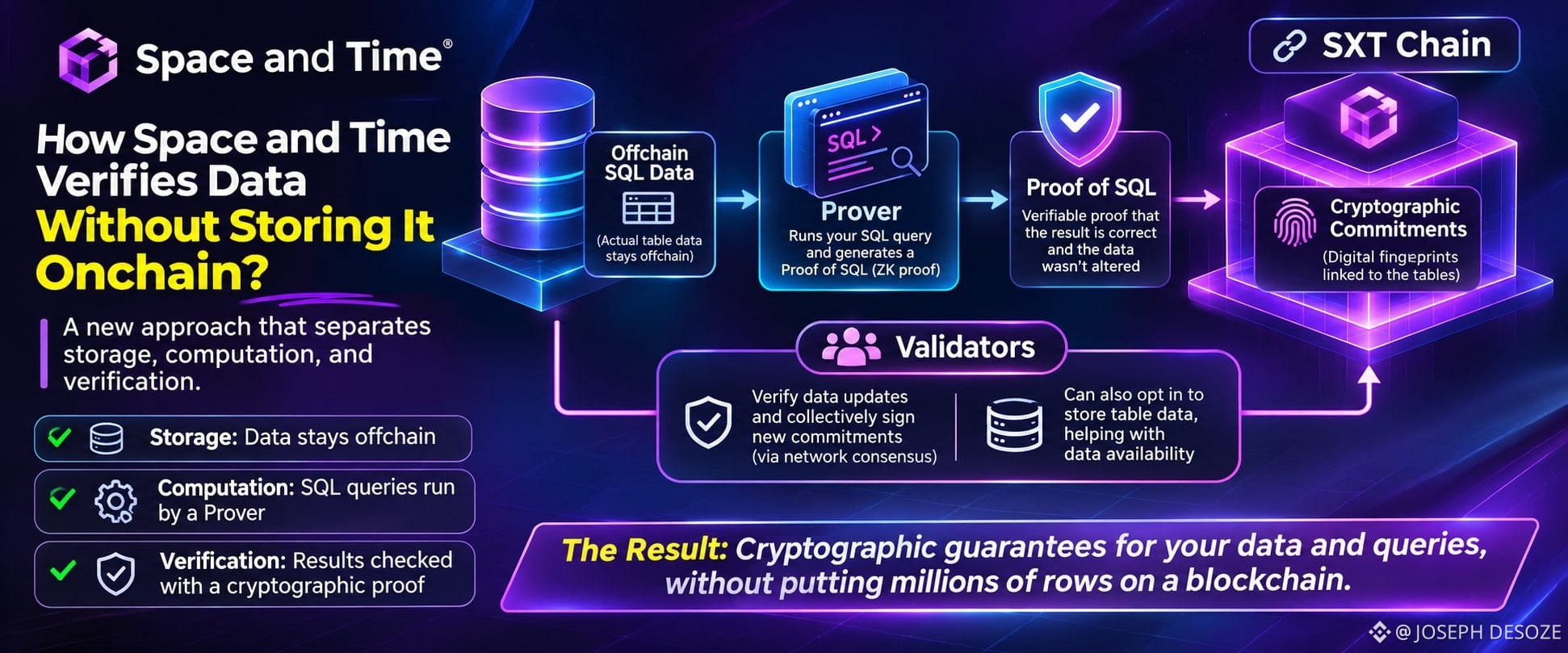
One thing I find interesting about Space and Time is that the data doesn't actually need to be stored on a blockchain for its integrity to be verified.
That might sound like a small detail, but I think it's an important part of how the whole system works.
The actual SQL table data stays offchain, while SXT Chain stores cryptographic commitments linked to those tables. Think of a commitment as a digital fingerprint. It gives the network a way to detect changes without having to put the entire dataset onchain.
There's also an interesting role for validators here. They verify data updates and collectively sign new commitments through network consensus. Validators can also opt in to storing table data, helping support the network's data availability.
When someone runs a SQL query, a Prover executes it against the underlying data and generates a Proof of SQL. This proof allows the result to be checked against the committed data, confirming both that the computation was performed correctly and that the data wasn't secretly altered.
What I like about this approach is the separation between storage, computation, and verification.
The blockchain doesn't need to carry millions of rows of data, yet applications can still get cryptographic guarantees about the information behind their queries.
Of course, cryptographic verification is only one part of the bigger picture. Data also needs to remain accessible when applications actually need it.
That's something I'll be keeping an eye on as the Space and Time network develops further.