

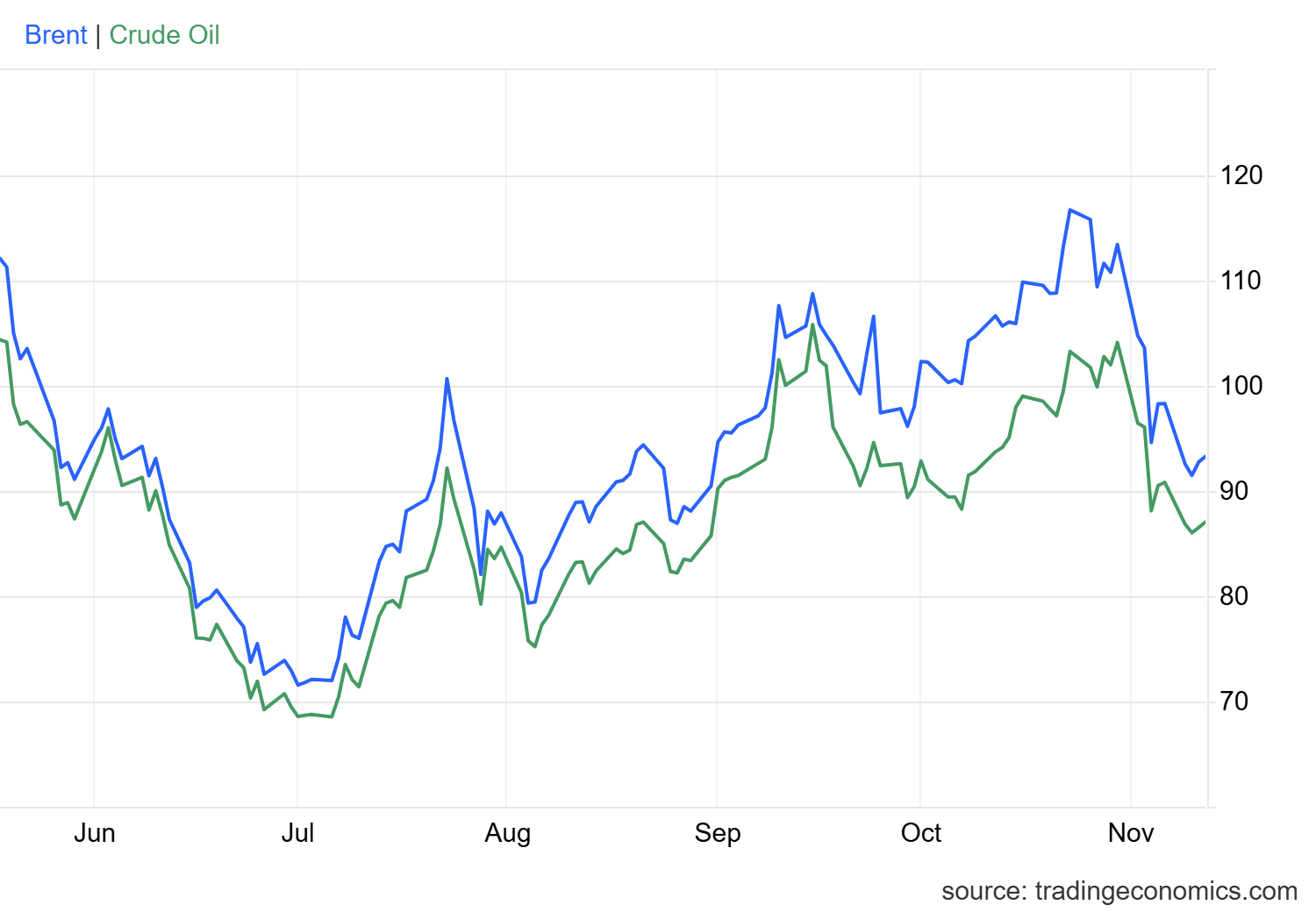
Crude bounced off its two-month lows on Wednesday (WTI gained 0.6%, Brent settled a shade under $93) and continued these gains in Asian trade on Thursday, with Brent futures standing at $93 and WTI at $86.9. Direct fighting between Iran and the US has been muted, with American officials talking down the need for more strikes, but the diplomacy has produced very little, and a lasting peace still looks a long way off.
Tehran's reply came from Mohsen Rezaei, who serves as secretary of Iran's Supreme National Security Council. Speaking to Lebanon's Al Mayadeen, he said flatly that none of the country's enriched nuclear material will be shipped abroad. Washington has said nuclear issues must be part of any first round of talks. Those two positions can't share a negotiating table.
A Price Built for Neither Outcome
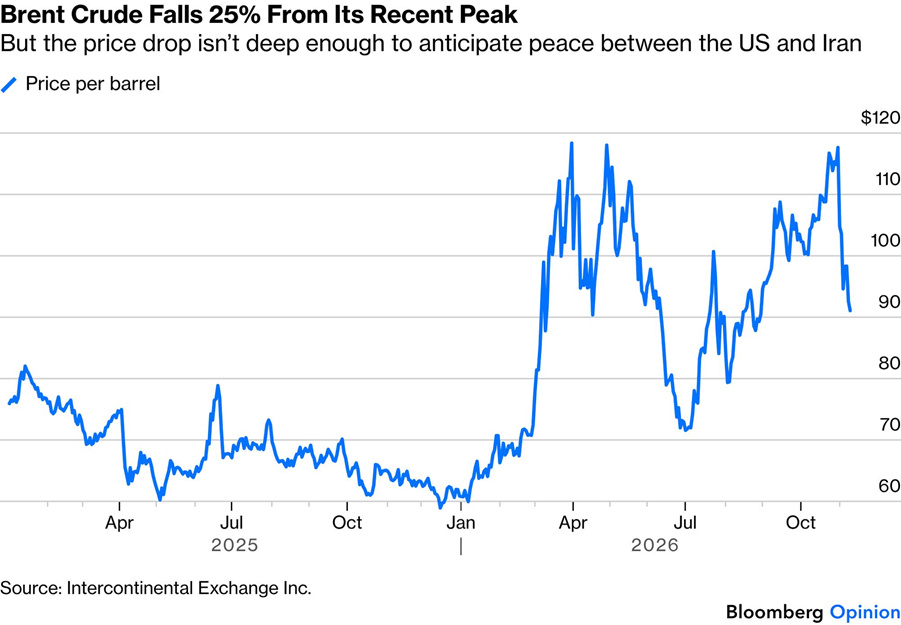
Brent has dropped nearly 25% in ten days, which looks like a market betting on peace. Javier Blas, the Bloomberg Opinion columnist, doesn't read it that way. In his view, the current price, around $90, is wrong whichever direction events take: too cheap if the US and Iran escalate, too expensive if the two sides actually sign a deal. He calls it an oddity produced by the standoff itself.
He also looks at what sits behind the price. About nine months of war, by his estimate, have pulled roughly a billion barrels out of commercial and strategic stocks, leaving something like seven billion available worldwide. Refilling those tanks will create real demand, he says, but he expects buyers to move more slowly than the market assumes.
November Has Been Rough on Crude
Brent is still up more than 50% for the year, but November has not been kind to it. Prices have turned sharply lower as hopes build that the conflict will ease and more energy from the Persian Gulf reaches buyers. Saudi Arabia added to the supply picture by telling OPEC that its October output jumped 26%, to its highest level since before the war began.
Tehran Writes to the UN
Foreign Minister Abbas Araghchi wrote to the UN Secretary-General, the Security Council and the IAEA's director general, asking all three to condemn a US State Department offer. The department is offering up to $20 million, plus possible relocation, for information on Iran's nuclear facilities and program. Araghchi called the offer repugnant.
Critics have already spotted the tension. The US and Israel opened the war in late February with the stated aim of ending Iran's nuclear ambitions, yet Trump has described the program as destroyed.
Washington Owes Tehran an Answer, Iran Says
Iran's parliament speaker, Mohammad Bagher Ghalibaf, told Al Jazeera that Washington still hasn't given an official, specific reply to the message and plan Tehran put forward. Until the US meets Iran's seven conditions, he said, the Strait of Hormuz will not reopen, and talks will not resume. The next move belongs to the Americans. The list includes an end to the US naval blockade and the release of frozen assets, along with a smaller US military presence in the region.
A Threat That Reaches European Bases
The same Al Mayadeen interview carried more. Rezaei said Moscow has already been told that the enriched material stays in Iran, where Tehran needs it for nuclear-powered ships and submarines and, later, perhaps small modular reactors. He added that no negotiations with Washington are underway, and he dismissed reports of a recent meeting in Qatar as lies meant to push oil prices lower.
His hardest line was on retaliation. Any fresh US attack, he warned, will draw strikes on American bases far from Iran, and that includes bases in European countries if they are used to launch the attacks.
Vance Eyes a Sit-Down With Rezaei
The Wall Street Journal reports that Vice President JD Vance is weighing a face-to-face meeting with Rezaei himself. Vance wrote to him last month proposing renewed talks, according to the report, and he is emerging as Washington's lead negotiator. US and Middle East officials say Trump is open to Vance restarting the negotiations, though they stress the idea of a direct meeting is still preliminary.
The Journal describes the effort as a bid to end a war seen as a drag on the Republican Party. Vance has tried this before: talks he led in Islamabad in April ended without a breakthrough.
Congress is feeling the heat too. On Tuesday the House voted 211-204 to send eight articles of impeachment against Pentagon chief Pete Hegseth, focused on the Iran war and military operations, to the Judiciary Committee, which stalls the effort. Eleven Democrats missed the roll call, more than the seven-vote margin, and the absences drew criticism from inside the party.
Meanwhile, the Gulf Is Pumping Again
Saudi Arabia reported October output of 10.56 million barrels a day. That is a few hundred thousand below February, when Riyadh raised production ahead of the war, and slightly above its OPEC quota. Exporters around the Persian Gulf, the Saudis included, have managed to restore flows despite the unresolved conflict and a run of Iranian attacks on tankers.
All that oil is landing in physical markets just as consumption stays constrained, which is squeezing price differentials and hinting at a surplus. By Wednesday, Brent futures were down about 21% for November, at roughly $93 a barrel. Iraq told OPEC it lifted output to a wartime high of almost 4.9 million barrels a day, well above its agreed limit.
Those are self-reported figures, and they deserve some skepticism. OPEC's secondary sources, which estimate output independently, put Saudi October production at 9.19 million barrels a day and Iraq's at 4.49 million. For the kingdom alone, that is a gap of about 1.4 million barrels a day, and traders will argue over which number is closer to the truth.
Covert shuttle runs through the Strait of Hormuz, a tactic the UAE pioneered earlier in the war, explain part of how the oil gets out. Tankers slip through at night, often in convoy or with their transponders off, and pass their cargo to bigger ships waiting outside the strait. Saudi Arabia has also been using its pipeline to the Red Sea coast, even though that route has come under attack.
Watch for three things: whether Vance gets his meeting with Rezaei, whether Washington answers Tehran's demands, and whether Saudi and Iraqi output holds up under independent counting. Until one of them moves, crude will keep trading the gap between a deal nobody has signed and a flare-up nobody can rule out.