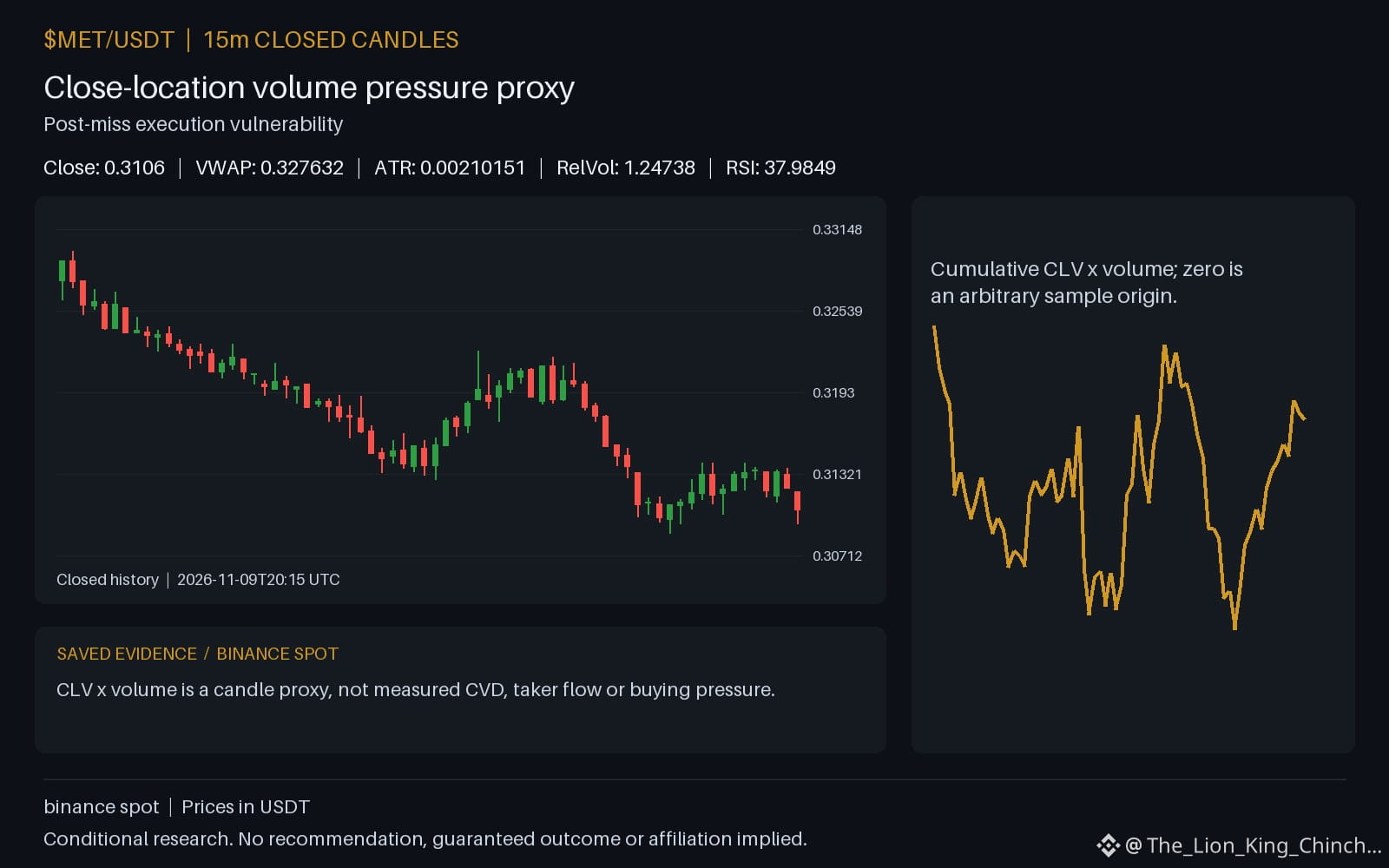

$MET: Executing Through the Lens of Missed Moves
A common assumption suggests that missing a trade you correctly forecasted is harmless because no capital was lost. However, this creates a hypothetical mechanism called post-miss execution vulnerability. This concept explores the trade-off between entry quality and chasing. When $MET trades at 0.3106, a researcher who missed an earlier entry might feel pressure to act now rather than waiting for a defined setup. This trade-off often leads to accepting a poorer entry price simply to avoid the feeling of being left behind.
Consider a thought experiment. If you identified a support level at 0.3088 but failed to execute, your next decision at the current RSI of 37.9849 might be influenced by that previous inaction. The risk is that the distance to a meaningful invalidation point increases as the price moves further away from the original setup. This makes the stop distance wider and less efficient relative to the potential move. For instance, the daily change of -5.65006 might seem like an invitation to join, but the risk profile has shifted significantly from the initial plan.
To reassess the interpretation, one could check if the daily volume of 2.26219e+06 supports a fresh trend or if it suggests a climax. A self-check involves asking if the current entry would still be valid if the previous missed move had never occurred. By isolating the current facts from past omissions, you can determine if the setup is based on today's evidence or yesterday's regret.
Probabilistic market research, not a recommendation or guaranteed return.
Why are we often at our highest risk of taking a sloppy trade right after we analyzed a big winner correctly but didn't take it?
#MET
A common assumption suggests that missing a trade you correctly forecasted is harmless because no capital was lost. However, this creates a hypothetical mechanism called post-miss execution vulnerability. This concept explores the trade-off between entry quality and chasing. When $MET trades at 0.3106, a researcher who missed an earlier entry might feel pressure to act now rather than waiting for a defined setup. This trade-off often leads to accepting a poorer entry price simply to avoid the feeling of being left behind.
Consider a thought experiment. If you identified a support level at 0.3088 but failed to execute, your next decision at the current RSI of 37.9849 might be influenced by that previous inaction. The risk is that the distance to a meaningful invalidation point increases as the price moves further away from the original setup. This makes the stop distance wider and less efficient relative to the potential move. For instance, the daily change of -5.65006 might seem like an invitation to join, but the risk profile has shifted significantly from the initial plan.
To reassess the interpretation, one could check if the daily volume of 2.26219e+06 supports a fresh trend or if it suggests a climax. A self-check involves asking if the current entry would still be valid if the previous missed move had never occurred. By isolating the current facts from past omissions, you can determine if the setup is based on today's evidence or yesterday's regret.
Probabilistic market research, not a recommendation or guaranteed return.
Why are we often at our highest risk of taking a sloppy trade right after we analyzed a big winner correctly but didn't take it?
#MET