

Western Europe’s cryptocurrency industry continues to demonstrate resilience, reaching an impressive $2.08 trillion in transaction activity between July 2025 and June 2026, according to a report by Chainalysis.
Despite a challenging global crypto environment, the region recorded 1.2% growth, strengthening its position as the world's second-largest cryptocurrency economy after Asia.
The European Union recorded 2.2% growth, while the United Kingdom experienced an 8% decline. Nevertheless, the UK maintained its position as Western Europe's largest crypto market, generating $424.5 billion in activity.
Stablecoins Become a Major Growth Driver
One of the most significant developments was the rapid expansion of stablecoins across Western Europe.
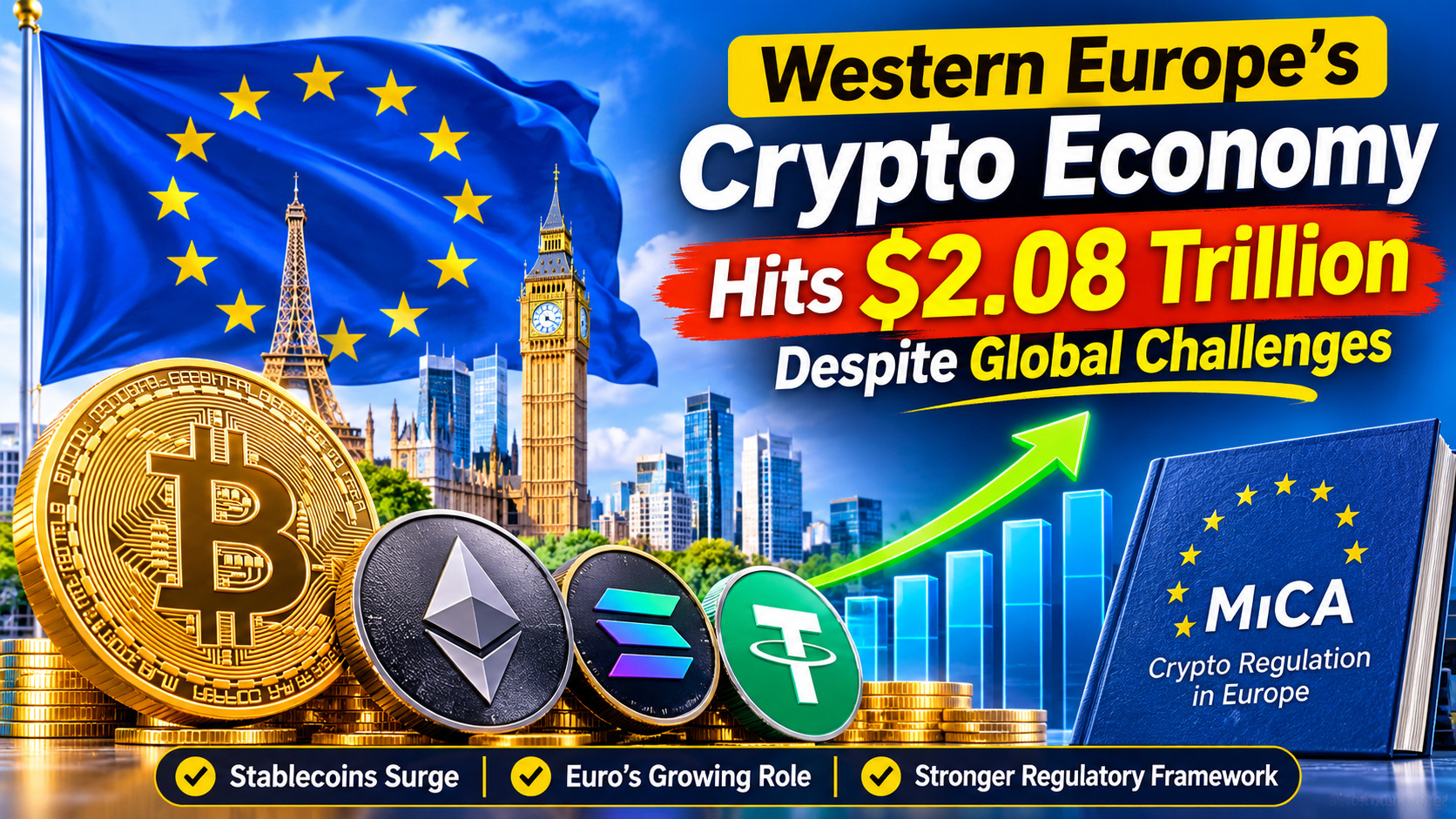 Regional stablecoin holdings increased by 131%, considerably outperforming global growth of 52%. Consequently, Western Europe's share of global stablecoin balances climbed from 3.4% to 5.1%.
This trend highlights the growing importance of stablecoins in digital payments, financial transactions and alternative methods of holding value.
France also experienced a notable shift toward self-custodied stablecoins, with balances increasing by 192%, suggesting greater interest in independently managing digital assets.
MiCA Regulation Strengthens Europe's Crypto Environment
Regulatory developments are playing an increasingly important role in shaping Europe's cryptocurrency industry.
The European Union's Markets in Crypto-Assets (MiCA) framework has introduced more consistent rules for crypto businesses and service providers across member states.
By reducing regulatory uncertainty and establishing common standards, MiCA could encourage institutional participation and support the expansion of regulated digital asset services.
Meanwhile, the euro is becoming increasingly important in cryptocurrency trading, accounting for 11.8% of global crypto trading volume during the reporting period.
Six Countries Dominate Western Europe's Crypto Market
Six major economies account for approximately two-thirds of Western Europe's total cryptocurrency activity.
The United Kingdom leads the region with $424.5 billion, followed by Germany with $288.8 billion and France with $215.8 billion.
The Netherlands, Spain and Switzerland recorded $207.8 billion, $156.1 billion and $132.8 billion, respectively.
Spain and Switzerland experienced growth supported by centralized exchange activity, while the UK and Germany faced declining activity in decentralized exchanges.
What Does This Mean for the Future of Crypto?
Western Europe's latest performance demonstrates that the cryptocurrency industry is gradually becoming more integrated with traditional financial services.
Growing stablecoin adoption, institutional participation, regulatory developments and increased euro-denominated trading are transforming the region's digital asset landscape.
However, regulatory challenges, economic uncertainty and market volatility remain important factors.
The overall trend suggests that Europe's cryptocurrency industry is moving beyond speculative trading toward a more structured financial ecosystem.
Conclusion: Western Europe's $2.08 trillion crypto economy represents an important milestone for digital finance. Although growth remains modest, increasing institutional involvement and stablecoin adoption could play a significant role in shaping the industry's next phase.
#NvidiaInvestigatesAfterHuang’sAffairApology #AnthropicRejectsIPODelayValuationinQuestion #CPITestsDecemberRateOutlook #BitcoinFiveWeeklyLosses #TradFiForBeginners