
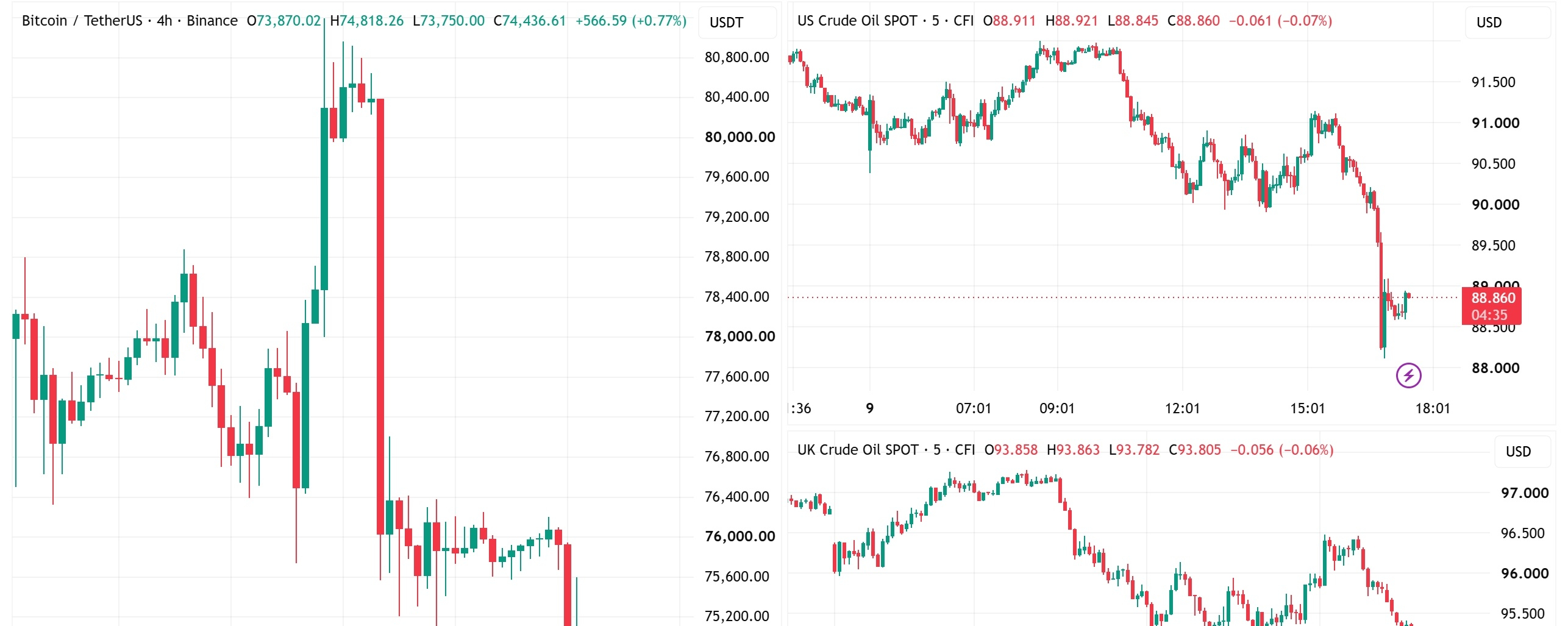


G$lobal macro markets experienced a sharp reallocation of capital on Monday. Brent crude futures plummeted approximately 4.6% following reports that Iran has proposed to restore full transit access through the strategic Strait of Hormuz in exchange for the release of $8 billion in frozen assets.
In traditional finance, a sharp contraction in energy costs typically functions as an economic relief mechanism, reducing inflationary pressures and stimulating risk-on assets.
However, Bitcoin (BTC) diverged from the broader market response. Rather than rallying on the geopolitical de-escalation, BTC extended its corrective phase, declining to approximately $73,600.
This divergence underscores three critical macroeconomic and structural dynamics currently shaping price action.
1. Dissipation of the Geopolitical Risk Premium
Over recent weeks, a measurable portion of Bitcoin’s capital inflows was driven by institutional hedging against supply-chain vulnerabilities and regional escalation. With a diplomatic resolution actively on the table, this specific risk premium has rapidly compressed, prompting a short-term rotation out of defensive digital asset allocations.
2. Multi-Asset Portfolio Rebalancing and Liquidity Squeezes
While lower energy prices benefit the broader economy long-term, a sudden 4.6% drop in oil triggers immediate margin rebalancing across multi-asset hedge funds. When institutional desks face volatility or changing collateral requirements in energy derivatives, they frequently liquidate high-beta, highly liquid assets to preserve cash reserves. Bitcoin's deep, continuous liquidity makes it a primary source for rapid capital extraction during macro shifts.
3. Technical Vulnerability Overriding Fundamental News
From a technical chart perspective, Bitcoin was already exhibiting structural weakness. Having recently breached its critical horizontal support at $74,800, the asset was highly susceptible to automated stop-loss cascades. The geopolitical development did not catalyze the downtrend; rather, it failed to counteract an ongoing technical correction driven by consecutive weeks of spot ETF outflows. BTC is now actively testing its secondary demand zone near $73,200, which aligns with key long-term moving averages.
The Macro Outlook: A Secular Bullish Tailwind
Despite the immediate negative price reaction, a sustained low-oil environment presents a net-positive outlook for digital assets over a medium-to-long-term horizon:
Deflationary Pressure: Sustained lower energy costs accelerate the decline of consumer price indices (CPI), offering global central banks a clear trajectory to resume or accelerate monetary easing cycles.
Liquidity Expansion: Subsequent interest rate cuts inject systemic liquidity back into global financial markets. Historically, this excess capital moves directly into fixed-supply assets, primarily Bitcoin.
While the short-term market reaction reflects defensive positioning and structural liquidations, the underlying macro shifts are establishing an environment highly favorable to risk asset accumulation.
Are you treating this geopolitical correction to $73,600 as an institutional accumulation window, or are you waiting for a confirmed weekly close above the $74,800 threshold?
#NvidiaInvestigatesAfterHuang’sAffairApology #BitcoinFiveWeeklyLosses #AIChipSlumpNasdaq #AnthropicRejectsIPODelayValuationinQuestion #CryptoLiquidationsReach$1.16BIn24Hours