ABRAXAS CAPITAL HOLDS 4X WINTERMUTE’S PERP EXPOSURE ON HYPERLIQUID WITH $451M IN SHORTS — INSIDER LIQUIDITY SQUEEZE?
Institutional market makers are dropping massive footprint signals on-chain, and if you are only looking at surface retail open interest, you are missing the scale of this execution.
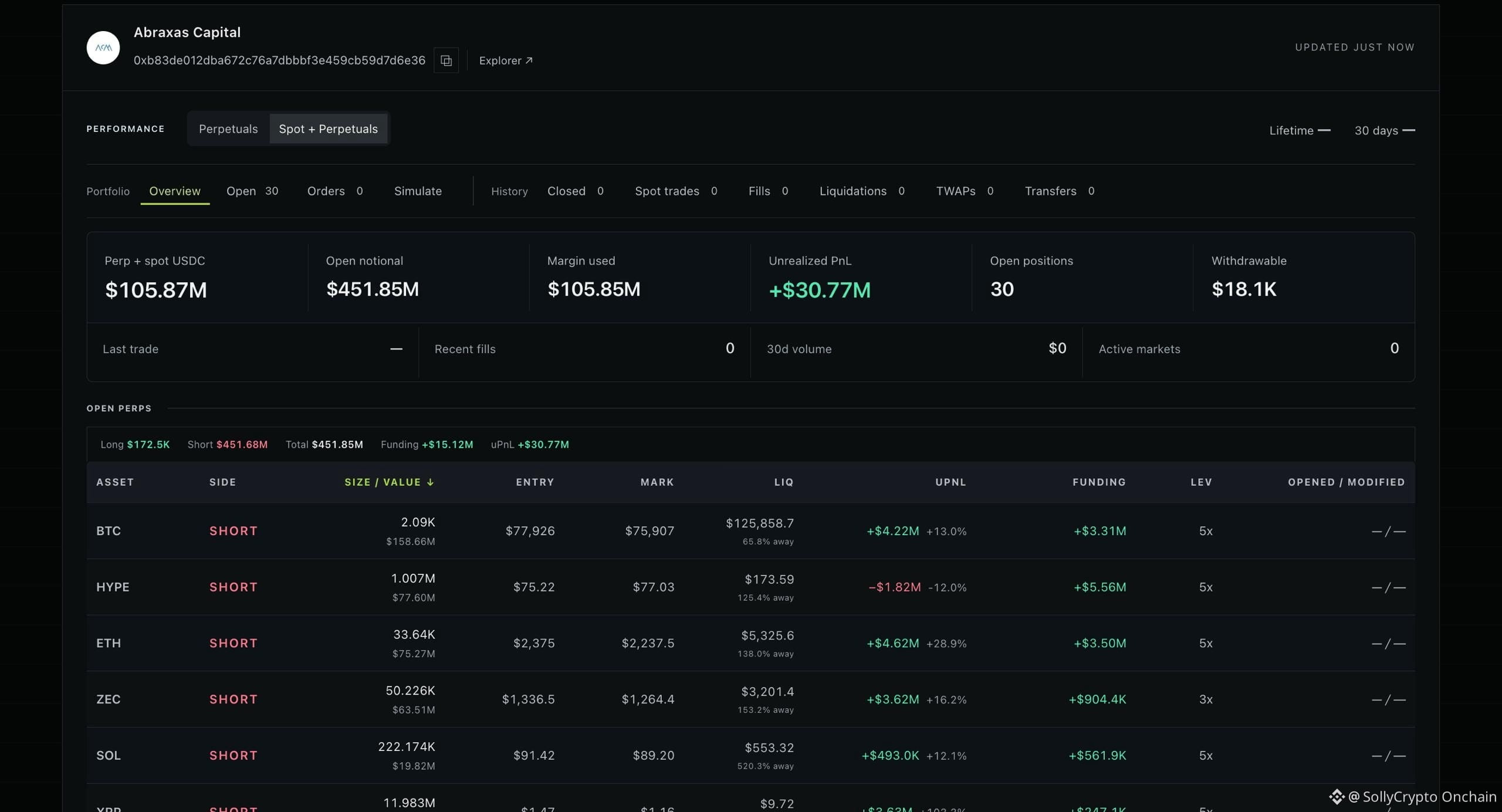
On-chain tracking reveals that digital asset manager Abraxas Capital currently holds a staggering $451.85 million in open positions on Hyperliquid—nearly four times the $107.59 million perp exposure held by Wintermute. Even more striking, Abraxas’ position is almost completely dominated by short contracts, carrying $451.68 million in net short exposure while sitting on +$30.77 million in unrealized profit. Their heaviest short allocations are anchored in $BTC ($158.66M),$HYPE ($77.6M),$ETH (75.27M), andZEC ($63.51M).
This looks like a dump setup on these specific tokens short term, but the underlying execution structure hints at a potential short-squeeze trap if spot demand surges.
Here is the exact detail timeline analysts are completely ignoring: Abraxas is not simply running a directional mega-bearish bet hoping for the market to collapse to zero. Institutional funds of this size typically deploy market-neutral arbitrage or basis trade strategies. They build massive short perpetual positions on decentralized exchanges like Hyperliquid to collect funding fees while holding spot inventory or liquid-staked tokens in private custody or OTC desks.
The structural reveal here is what happens when market momentum shifts against these massive books. Carrying over $450 million in short exposure across four core assets means any aggressive, spot-driven rally in BTC orHYPE forces these funds to either add collateral or gradually buy back their short legs to de-risk. If a sudden surge in buying volume clears out resting ask orders, market-neutral short positions can rapidly transform into forced buy-backs, fueling a violent short squeeze across the entire order book.
Do you think Abraxas will continue farming short funding rates down to lower support levels?