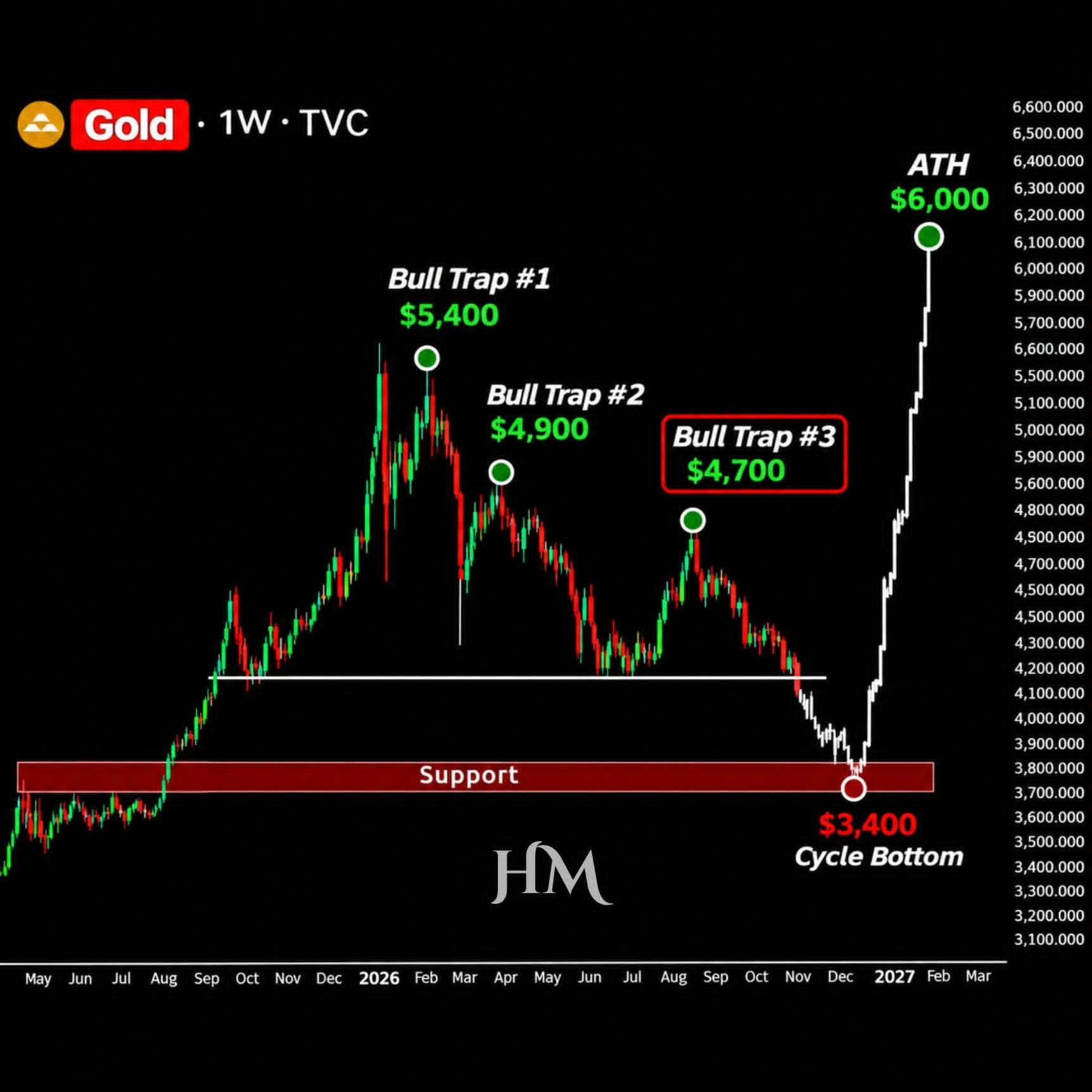
🚨Gold's $3,900 Breakdown Was a Serious Warning.
But Is Another Leg Lower Coming?
The Market Has More Than One Story.
Gold's recent correction has reminded investors that even traditionally defensive assets can experience sharp declines.
After reaching record levels earlier in 2026, the metal fell toward $3,900 per ounce, briefly trading below that level in late October and early November. However, by November 6, spot gold had recovered to approximately $4,074.
So what actually triggered the sell-off?
One major factor was the changing outlook for Federal Reserve policy. Stronger-than-expected U.S. employment data increased expectations that interest rates could remain higher or even rise again. That matters because gold does not generate interest income, making Treasury securities relatively more attractive when yields increase.
The stronger U.S. dollar added another layer of pressure. Since gold is priced internationally in dollars, a stronger dollar can make bullion more expensive for overseas buyers and reduce demand at the margin.
There is also the issue of positioning. After a powerful rally, some investors may choose to lock in profits. When leveraged positions are involved, falling prices can trigger margin calls and forced selling, creating additional downward pressure.
Some market commentators are now watching potential downside levels around $3,900, $3,750, $3,500, and $3,400 before considering a possible recovery. These are speculative technical scenarios, not confirmed price targets or guaranteed turning points.
And this is where investors need to think carefully.
A decline does not automatically mean gold has lost its long-term investment case. Central-bank demand, geopolitical uncertainty, inflation expectations, and the future direction of interest rates can all influence where prices go next.
Personally, the most important lesson here is not to guess the exact bottom. It is to understand why the market is moving, identify the risks, and avoid making decisions based on someone else's confidence.
$XAUT $XAG $BTC