
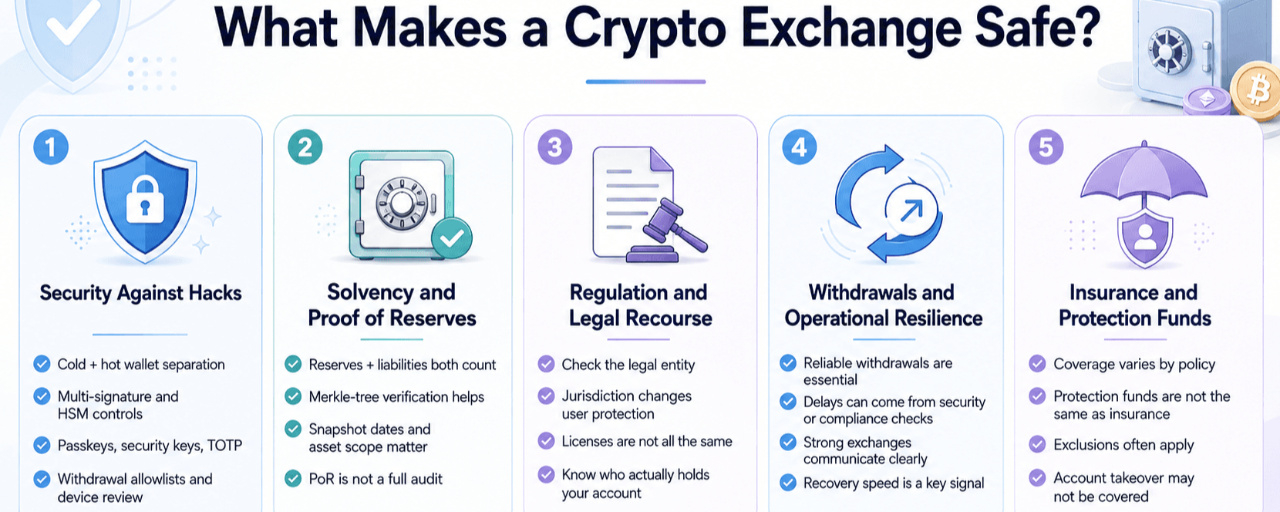

Trust is one of the most important things to consider before choosing a cryptocurrency exchange, but it should never be based on a brand name, a large number of users, or marketing promises alone. A trustworthy exchange should be able to demonstrate how it protects customer assets, how much transparency it provides, how it responds when something goes wrong, and who is accountable when users need support.
The first thing I would look at is reserve transparency. Users should be able to find clear information about the assets an exchange holds on their behalf and, ideally, independently verify that their own account balances are included in its reported liabilities. This is where Proof of Reserves (PoR) becomes important. Binance, for example, uses a combination of Merkle Trees and zk-SNARKs to allow users to verify that their account balances were included in a specific reserve snapshot. You can explore the Binance Proof of Reserves page to review its methodology, available assets, and verification information. However, transparency should go beyond publishing a reserve report. Users should also look for independent security assessments, penetration testing, publicly documented security practices, and clear information about the scope and date of any assessment. It is important to distinguish between a company's own security claims and an independent assessment performed by an external specialist.
Binance's November 2026 security incident response provides a relevant example: in its initial findings published on November 3, Binance stated that it had rebuilt the affected wallet system and internal AI tool, replaced affected devices, revoked related credentials, strengthened wallet-service risk controls, and expanded AI-based behavioural anomaly detection. It also announced that independent cybersecurity experts would be engaged to review the incident and validate its findings. That distinction matters: an independent review being announced is not the same as a completed audit, and users should look for the findings when they become available. Another important factor is regulatory status. A trustworthy exchange should clearly identify the legal entity providing services in each market, the licences or registrations it holds, and the activities those permissions cover. An exchange may operate through different entities in different jurisdictions, so users should never assume that a licence in one country automatically applies to every customer worldwide. Binance, for example, identifies entities regulated by the Financial Services Regulatory Authority (FSRA) in Abu Dhabi Global Market (ADGM), including entities authorised for specific exchange, custody, and other regulated activities. Users can check the Binance regulatory information and confirm which entity and services apply to their own country. Regulation is an important indicator of oversight, but it should be considered alongside the exchange's actual security practices and user-protection arrangements. I would also pay close attention to withdrawal reliability. An exchange should provide clear withdrawal procedures, accurate network information, transparent service-status updates, and explanations whenever withdrawals are delayed or suspended. Reliable withdrawals are not simply about speed; they are also about whether the platform can explain interruptions and restore services responsibly.
This became particularly relevant following Binance's October 29, 2026 security incident, when unauthorized withdrawals from compromised hot-wallet infrastructure affected approximately $6.34 billion in digital assets. Binance temporarily suspended withdrawals as part of its containment and security checks, while deposits and unaffected services remained operational. The company stated that it would absorb the financial impact of the stolen assets rather than pass those losses to users, using SAFU and corporate resources. In its November 4 update, Binance reported that approximately 98% of the impacted assets had been replenished and that it had set aside more than 100% of the funds needed to cover the losses. It also expanded its Proof of Reserves snapshot from 10 to 44 tokens, with the full zero-knowledge proof still being generated at the time of that update. Withdrawal services were then reopened progressively, with additional assets scheduled to resume on November 5 after security and readiness checks. These developments can be followed through Binance's incident recovery updates and its November 5 withdrawal update. The incident itself should not be overlooked or described as proof that the platform cannot be compromised. It was a serious security failure. What users can assess, however, is how the exchange handled the consequences: whether it acknowledged the incident, explained what was known, took responsibility for the financial impact, worked with relevant partners, restored services carefully, and documented the improvements being made.
This brings us to user protection and accountability. Binance's Secure Asset Fund for Users, better known as SAFU, is an emergency protection fund established to help protect users' assets. According to Binance's January 2026 FAQ, SAFU comprised 1 billion USDC at that time, with its wallet address publicly available for verification. The fund's existence is meaningful, but users should understand its actual terms rather than interpret it as unlimited insurance or a guarantee against every possible loss. Binance's published terms state that eligible losses may include cases involving compromised account login credentials resulting from vulnerabilities or deficiencies in Binance's systems or security protocols. Binance retains discretion over eligibility and the use of the fund, and requests for eligible SAFU payments should be submitted through Binance Support within 90 days of the loss. You can read the official SAFU FAQ and check the public SAFU wallet address yourself .
Finally, a trustworthy exchange should communicate clearly, especially during a security incident. Users should receive timely updates, a distinction between confirmed facts and ongoing investigations, realistic explanations of service interruptions, and information about the steps being taken to restore normal operations. Binance's November 2026 incident updates documented the initial containment measures, the ongoing investigation, cooperation with law enforcement and industry partners, asset replenishment, phased withdrawal restoration, and planned independent cybersecurity review. Its initial findings also explained that some technical details would remain confidential to avoid giving attackers information that could be used in future attacks. That is a reasonable security consideration, but it should not replace meaningful accountability or a final explanation once the investigation allows it. Ultimately, when evaluating any exchange, I would ask four simple questions: Can I verify its reserves and my own account balance? Can I find credible evidence of its security practices and independent assessments? Does it clearly explain what protection is available if something goes wrong? And does it communicate honestly and take responsibility when facing a difficult situation? No single certificate, reserve report, emergency fund, or public statement can answer all four questions. Trust is built through evidence, consistency, and accountability over time.
A Personal Note: My Experience With Binance Since 2019
I've been a Binance user since 2019, and after all these years, I can honestly say that my trust in the platform has been built through experience, not just through what the company says about itself. I've seen the platform evolve, introduce new security and transparency features, face difficult moments, and continue improving the way it serves its users. I've also experienced the importance of having access to clear information, account verification tools, and a platform that communicates with its community. Of course, being a long-time user doesn't mean believing that any exchange is perfect or that security risks don't exist. The recent incident was a serious reminder that even major platforms can face sophisticated attacks, and I believe users have every right to ask questions and expect accountability. What matters to me is how a company responds when things become difficult. Seeing Binance publish updates, explain its recovery process, commit corporate resources to cover the affected assets, and progressively restore withdrawals has reinforced the value I place on transparency and responsibility. After years of using the platform, participating in its community, and watching its development from a user's perspective, I don't see trust as something built overnight. It comes from the relationship between a platform and its users, and from what that platform demonstrates through both the good times and the difficult ones. That's what has kept me confident in Binance throughout my journey since 2019.
Frequently Asked Questions
1. How can I tell whether a crypto exchange is trustworthy? Look beyond its reputation and marketing. Check whether it publishes transparent reserve information, allows users to verify their balances, undergoes independent security assessments, clearly identifies its regulatory entities, and provides reliable withdrawal services. Also review its user-protection policies, incident history, customer support, and how it communicates when problems occur. A trustworthy exchange should provide evidence that users can independently examine.
2. Does Proof of Reserves guarantee safety? No. Proof of Reserves is an important transparency tool, but it does not guarantee that an exchange is completely safe or financially risk-free. It generally provides evidence about the assets held against customer balances at a particular snapshot in time. It does not automatically prove that every liability has been disclosed, that the exchange has no other financial obligations, that its systems cannot be hacked, or that withdrawals will always be available. It should be considered alongside independent audits, security assessments, regulatory oversight, user-protection policies, and operational reliability.
3. Can Binance users verify their own account balances? Yes. Binance provides a self-verification process using Merkle Trees and zk-SNARKs. Log in to your Binance account, navigate to Profile → Wallet → Verification, expand the verification data, and check that the verification type is listed as Merkle Tree + zk-SNARKs. You can download your Merkle Tree data and use Binance's official verifier tool to check your account information against the relevant snapshot. Remember that this is a historical snapshot, not a real-time display of your current assets.
4. What is SAFU, and does it cover every type of loss? SAFU stands for Secure Asset Fund for Users. It is an emergency protection fund established by Binance. However, it should not be treated as unlimited insurance or a guarantee that every loss will be compensated. Eligibility depends on Binance's published terms and assessment of the circumstances.
5. Why do withdrawals sometimes get suspended during a security incident? An exchange may temporarily suspend withdrawals to contain suspicious activity, prevent further unauthorized transactions, investigate affected systems, and verify that services are safe to restore. While this can be inconvenient, reopening withdrawals before completing the necessary checks could expose users to additional risks. Users should follow official announcements and check the withdrawal status of their specific asset and network.
#Binance #CryptoSecurity #ProofOfReserves #SAFU #cryptoeducation