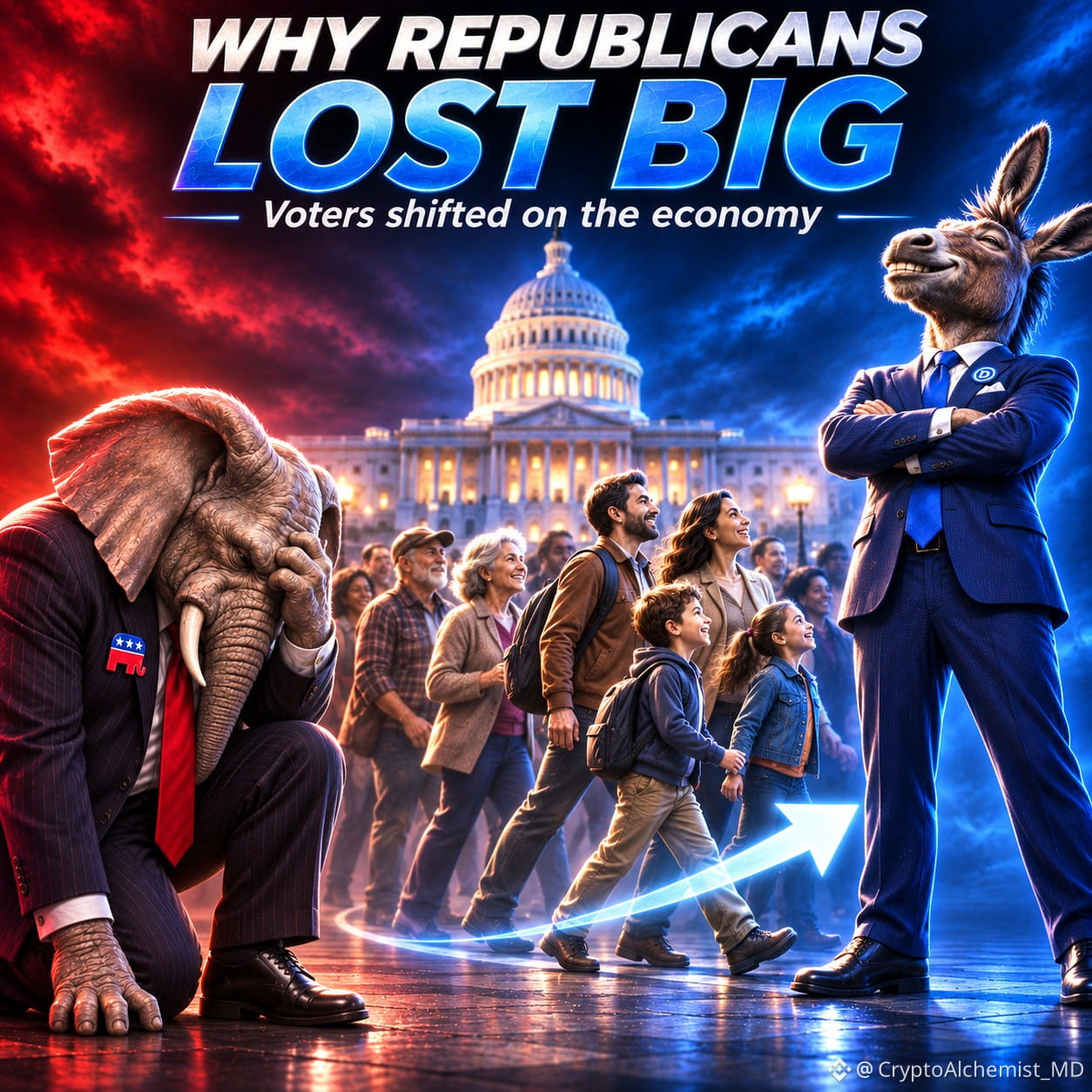
🇺🇸 Why did Republicans lose so much more ground than expected?
The answer may have less to do with ideology and much more to do with the economy people were actually feeling.
Nearly 9 in 10 voters said the cost of living was a crucial or major factor in their vote.
High prices remained stubborn.
Mortgage rates were still painful.
Tariffs kept adding uncertainty.
And many voters simply did not feel better off than they did two years ago.
The numbers show how deep the shift was.
Republican support among voters aged 18–29 fell from above 40% in 2024 to just 25%.
Among Hispanic voters, support dropped from nearly half to roughly one-third.
And Democrats gained ground in almost every type of county rich, poor, urban, rural and even places Trump won comfortably in 2024.
But here’s the part Wall Street found interesting:
The market didn’t crash after the Republican losses.
It rallied.
The Dow jumped more than 1,100 points.
The S&P 500 rose around 1.2%.
The Nasdaq gained about 1.1%.
Why?
Investors appear to be pricing in a Washington with more checks and balances potentially less aggressive spending, fewer major policy shocks and more political gridlock.
At the same time, the election created clear winners and losers:
→ Renewable-energy stocks surged
→ Treasury yields fell
→ Some AI and data-center stocks came under pressure
→ Trump-linked and Musk-linked companies sold off
So maybe the bigger story isn’t simply:
“Republicans lost.”
It’s this:
Did voters punish an economy that looked stronger on paper than it felt in everyday life?
Because if affordability keeps deciding elections, politicians may have a much bigger problem than the stock market suggests.
$SPCXB
$TSLAB
$JPMB
#USMidtermElections #stockmarket #economy