
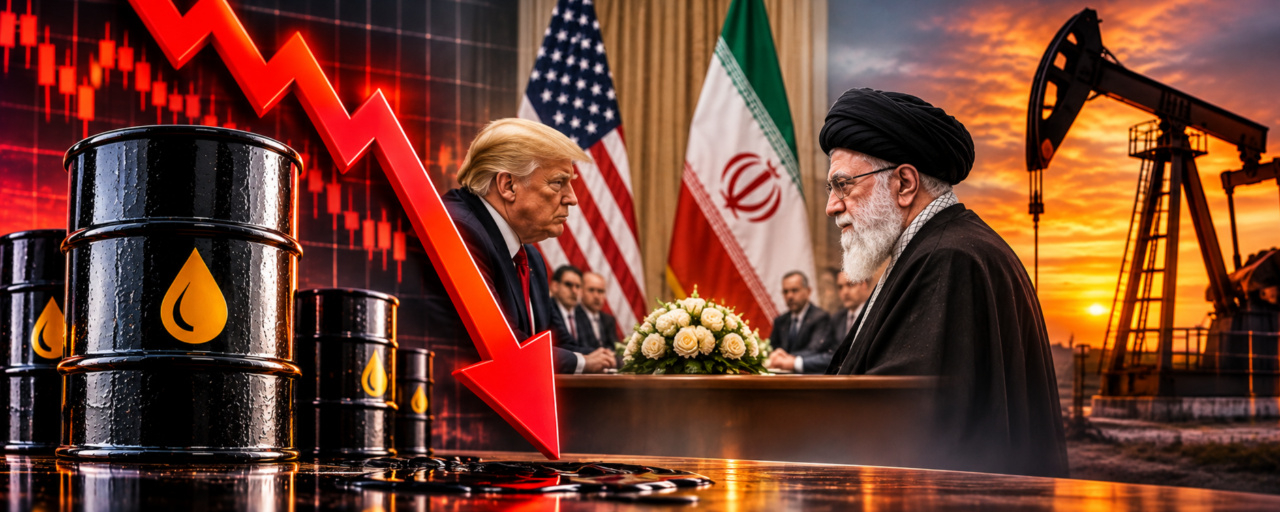

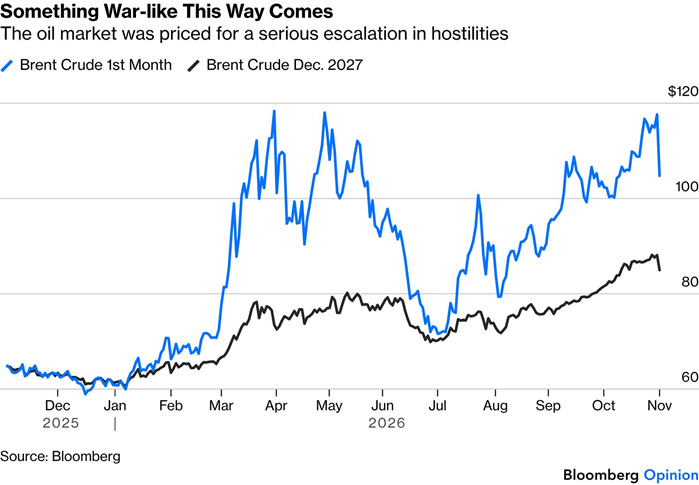
Oil had its worst day in three months on Monday, and the trigger was a run of headlines out of Iran. Brent crude settled at $104.77 a barrel, down 7.6 percent. West Texas Intermediate fell 7.4 percent to $96.46. Neither benchmark had lost that much in a single session since July 27.
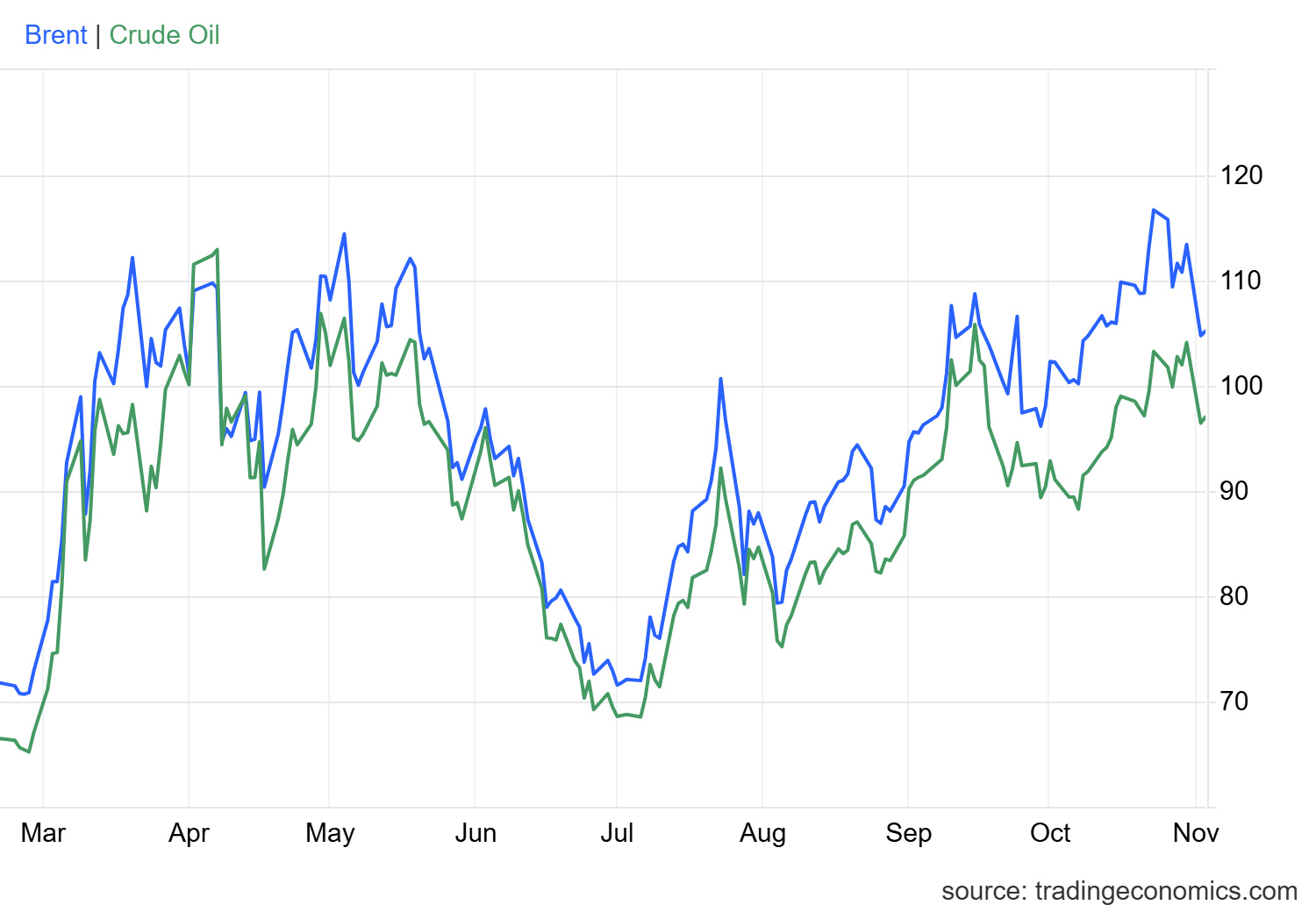
Count the drop in dollars and the lookback stretches further. Brent shed $8.66 a barrel and WTI $7.66, the biggest one-day dollar losses for either contract since April 17. Investors spent the session weighing signs that the Trump administration might find a way out of the conflict without another round of escalation.
Crude has swung on nearly every piece of news from the Persian Gulf since the United States and Israel launched strikes on Iran in late February. Traders have a habit of taking good news at face value, if only for an afternoon. The year's steepest one-day fall came in early April, when Trump announced a two-week ceasefire, and oil also slid sharply on March 10 after he said the war would end soon.
It didn't. The conflict is now in its eighth month.
So what was different on Monday?
Tehran Does the Talking This Time
One difference, arguably, is the messenger. This time the peace talk came from Iran rather than from Trump. Bloomberg reported, citing Iranian state media, that supreme leader Mojtaba Khamenei has approved the government's pursuit of negotiations that could end a months-long conflict that has been disrupting Middle East supply.
President Masoud Pezeshkian backed up the report. Tehran is working to resolve the dispute through dialogue, he said, and the supreme leader has handed the government certain powers to do it.
The announcement built on word from Washington a day earlier. Axios reported that Trump and Israeli Prime Minister Benjamin Netanyahu had a candid call on Saturday about the state of the Iran negotiations and how quickly to return to combat, citing one Israeli and one U.S. source.
Netanyahu is urging a strike right after Tuesday's midterm elections, those sources said. Trump, for now, would rather let the talks play out, and that is the approach Netanyahu finds worrying.
Trump laid out his own view on Sunday in an interview with the Right Side Broadcasting Network. The war will wrap up soon, he said, and the choice is simple: "Either they'll make a deal, or we'll just end it."
After oil had closed for the day, NBC News asked Trump whether he was considering a strike on Iran once the midterms were over. His answer was one word: "No."
Trump on Hannity: “We might have to go after Pickaxe…we can do that in one hour.”
Past episodes argue for caution. CNBC noted that crude has sold off on settlement rumors before, only to climb again once the conflict flared, and TD Securities' Ryan McKay put much of the recent rally down to a risk premium for possible escalation.
Israel's election wrapped up last week, and Americans vote today. Together they feed a worry that Trump could follow through on his threat to take military action against Iran once the ballots are counted. He has said the U.S. will not attack before the vote and that his discussions with Tehran have been productive, but he has not ruled out action afterward.
He has raised the possibility repeatedly. On Thursday, the Journal reported, Adm. Brad Cooper, who runs U.S. Central Command, walked him through the potential military options.
Gulf governments are watching with unease. They fear that a second U.S.-Israeli strike, this one landing on a better-prepared Iran, could set off a far more destructive conflict across the region and leave them to deal with the wreckage. Diplomacy has calmed nerves for now. The risk hasn't gone anywhere.
Doha Keeps the Door Open
Behind the headlines, Qatari mediators sat down with Iranian officials on Sunday for a third straight day, working to restart direct talks between Washington and Tehran. Foreign Minister Abbas Araghchi said no agreement exists yet. Any deal depends on the United States answering Iran's questions, he said, and he hoped the other side would show enough rationality to choose diplomacy over the alternatives.
Blasts on Qeshm Island Cut Across the Diplomacy
Diplomacy was not the only thing moving. Late Monday, Iran's state-run IRNA agency reported five explosions in rapid succession on Qeshm Island, off the southern coast near the Strait of Hormuz, and said witnesses had seen two aircraft overhead. The semi-official Fars agency heard blasts in the port city of Bandar Lengeh too, apparently from the direction of the sea.
American outlets soon tied the explosions to the U.S. military. The Wall Street Journal, citing U.S. officials, reported that some of them called the strikes defensive, meant to limit Iran's ability to attack commercial shipping in the strait, and that Washington had deliberately kept the effort quiet so it would not signal a return to major combat. The Associated Press cited a U.S. official who described the targets as "Iranians using surface-to-air missiles against U.S. assets."
Reporters at Fox News and Axios said the strikes answered a shot by the Islamic Revolutionary Guard Corps at a U.S. aircraft over the strait on Monday. Fox's Jennifer Griffin, citing a U.S. official, added that the episode did not mark the start of broader American strikes.
Barrels Keep Moving Anyway
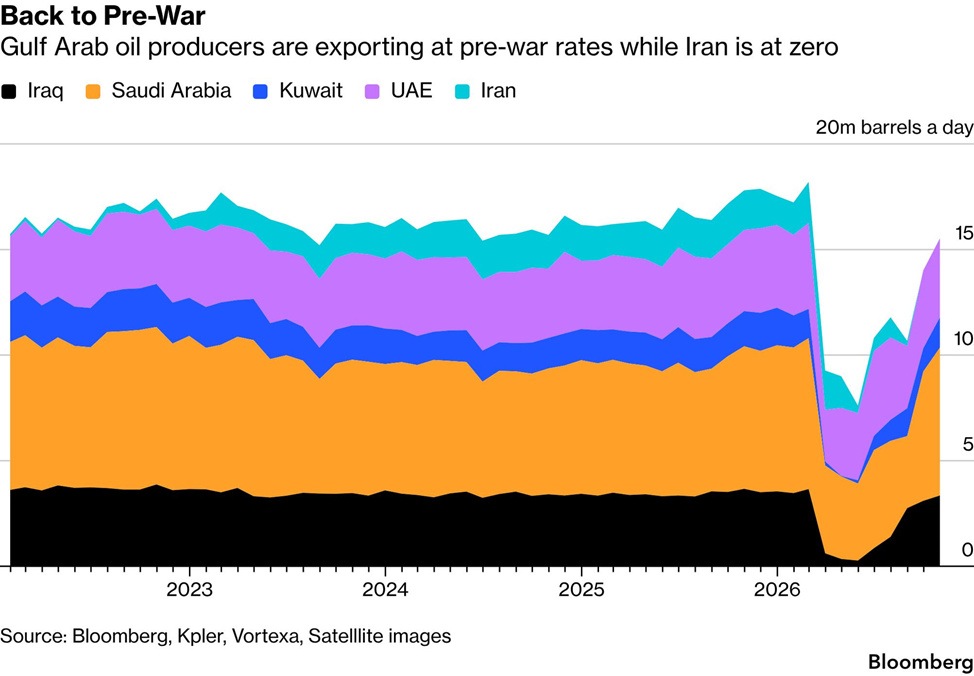
Not every part of the picture is bleak. Shipping across the region continues, even with threats coming from both Iran and Yemen's Iran-backed Houthis, and the leading Arab oil producers are sending crude out at about the same rate as before the war. That has put a steady stream of supply back into the global market. Bloomberg Opinion's John Authers points to official figures suggesting oil really is flowing again despite the disruption around Hormuz.
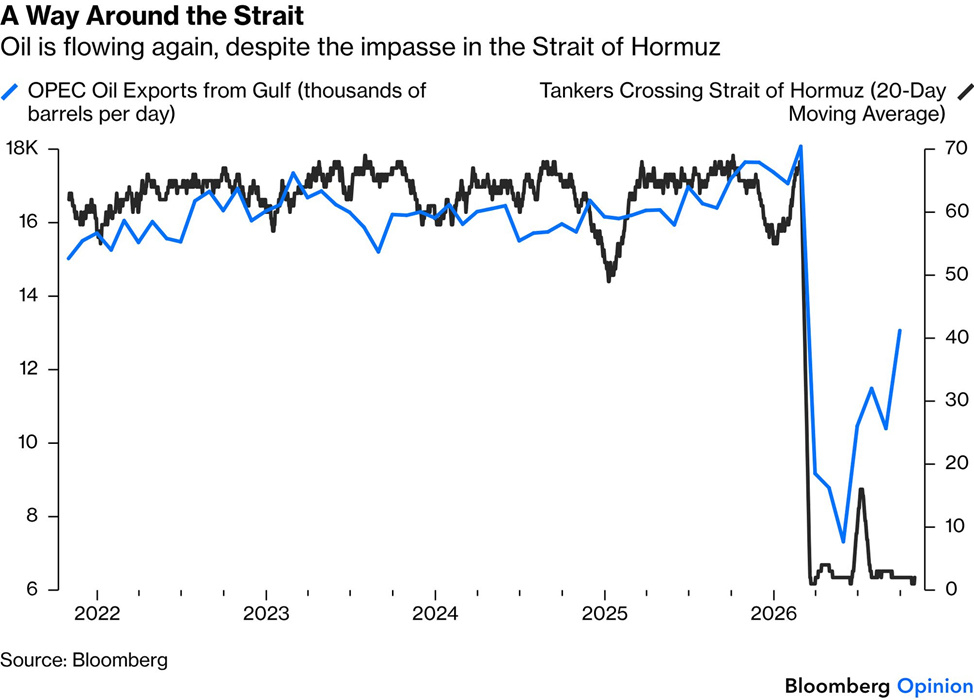
Combined October exports from Saudi Arabia, the United Arab Emirates, Iraq and Kuwait rose 10 percent to 15.53 million barrels a day, according to tanker-tracking data compiled by Bloomberg and energy analytics firms. That is roughly where shipments stood at the start of the year. Iran, under a U.S. naval blockade, exported nothing for a second straight month.
Futures Traders Aren't Convinced
By the physical numbers, conditions look better than they did when crude peaked in April. Brent hasn't behaved that way, Authers observes. The front-month contract came close to setting a new high, and the one for delivery at the end of next year, recently around $87, has never been higher.
Banks Keep Raising Their Forecasts
Goldman Sachs has lifted its oil forecasts for the end of this year and for 2027, pointing to elevated supply risks, and it joins other banks that have moved up after months of war in the Middle East. The firm now sees Brent at $105 a barrel in December, up from $90. For 2027, it expects Brent to average $88, up from $80, and WTI to average $78, up from $73. Goldman calls the risks to its 2027 Brent view more evenly balanced than before, though still tilted to the upside on net.
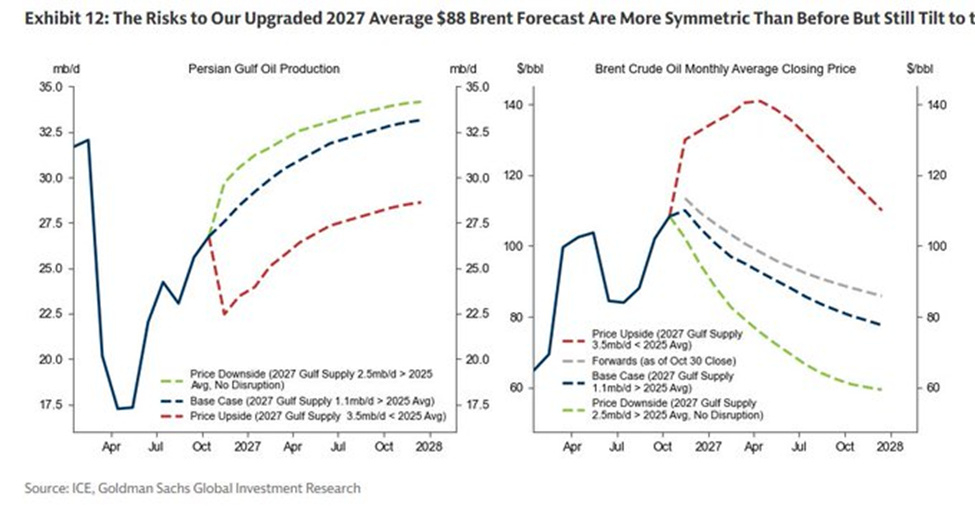
Bank of America's Francisco Blanch drew up his own range in September. If skirmishes that curb oil flows last until year-end, he wrote, Brent could trade between $95 and $120. A wider conflict that damages major energy infrastructure could push it as high as $150.
Ukraine's Drones Add a Second Supply Problem
The Iran war is not the only fight squeezing supply. Russia's war with Ukraine has done the same, and Russia has historically been a major exporter of diesel to the world. Ukrainian strikes have badly damaged its refining capacity, and after a brief halt, Ukraine has gone back to hitting Russian refineries in recent days.
However, diplomacy still has a chance, according to US special envoy Witkoff, who said that the United States will mediate working-level talks between Ukraine and Russia on November 10-11 in Abu Dhabi. The discussions will cover post-war security agreements, de-escalation, humanitarian measures, and ending the war, a U.S. official says. U.S. negotiators will also meet at the working level this week in Brussels with representatives from France, Germany, the United Kingdom, the EU, and NATO to discuss Ukraine’s security guarantees, Europe’s future security framework, and economic support for Ukraine’s reconstruction.
A good headline from Doha can take eight dollars off a barrel of Brent in an afternoon. It does nothing for the refineries that Ukrainian drones keep visiting.