
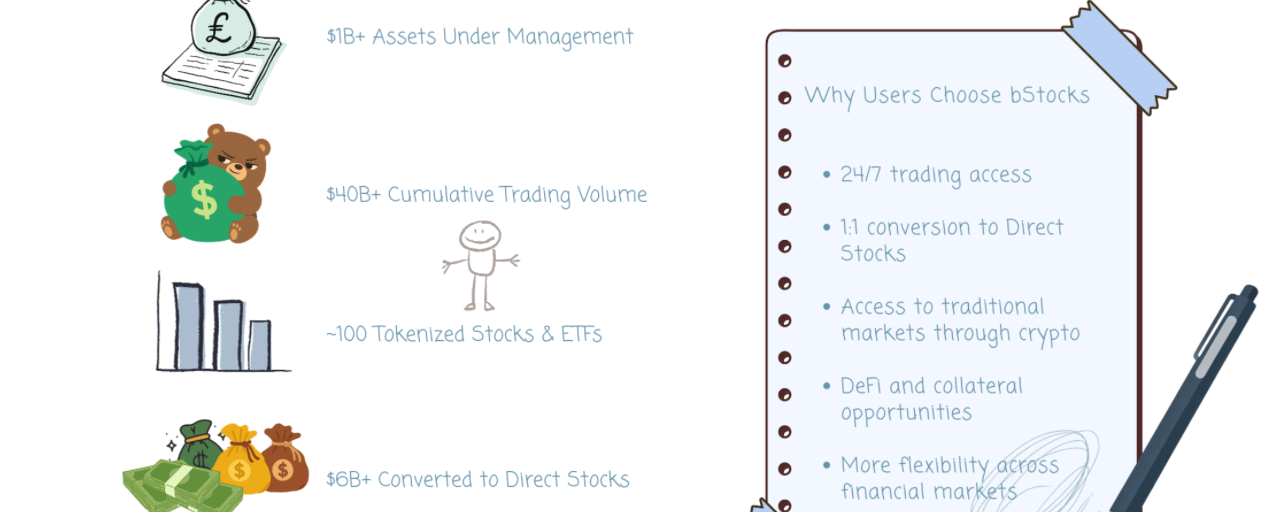

A billion dollars in assets under management. More than $40 billion in cumulative trading volume. Nearly 100 listed assets. And over $6 billion converted between tokenized and direct stock positions.
Those are some of the numbers behind Binance bStocks' latest milestone, reached roughly four months after its launch in June 2026. But I think the most interesting part is not simply how quickly the product has grown. It is what these numbers tell us about how people want to access traditional financial markets.
Users are not just looking for another way to hold exposure to stocks. They increasingly want flexibility, accessibility, and the ability to move between traditional and crypto-native financial environments without having to treat them as completely separate worlds.
Let's look at what is actually happening behind the numbers.
First, what do the numbers tell us?
Before looking at adoption, it is important to understand that AUM and trading volume measure two different things.
Assets under management represent the value of assets held within the product at a given time. Trading volume measures the total value of transactions over a period. One tells us how much capital is held; the other tells us how actively the market is being used.
For bStocks, the latest reported figures are:
$1 billion+ in AUM: Reached approximately four months after launch.
$40 billion+ in cumulative trading volume: More than $300 million in average daily volume since launch.
Nearly 100 assets: Expanded from just five listings at launch.
$6 billion+ in conversions: Value converted between bStocks and corresponding direct stock positions.
11.2% utilization: The share of bStocks deployed in DeFi, according to Binance Research's reported utilization measure.
Each figure tells a different part of the story. Together, they give us a better picture of adoption than looking at AUM alone.
1. From five assets to nearly 100: More choice, broader exposure
When bStocks launched on June 11, 2026, the offering started with five assets. By October, that number had grown to nearly 100, covering a wider range of stocks and ETFs, including sectors such as AI infrastructure and semiconductors.
This matters because access is only one part of the equation. Users also need enough choice to build exposure around their own interests and strategies.
A person interested in technology stocks may have very different priorities from someone looking for broader market exposure through ETFs. Expanding the available range makes the product more relevant to different types of investors.
The growth in listings also shows that tokenized securities are moving beyond a small collection of experimental assets and toward a broader market offering.
2. $40 billion in trading volume: The market is being used
AUM is an important milestone, but trading activity tells us something different.
More than $40 billion in cumulative trading volume since launch suggests that bStocks are not simply sitting in users' accounts. There is substantial activity taking place around these assets.
One of the reasons this matters is the difference in market access. Traditional U.S. stock markets follow defined trading sessions, while bStocks offer around-the-clock trading, including weekends.
According to Binance Research data for August 2026, only 42% of bStocks trading volume took place during regular U.S. market hours. The remaining 58% occurred across pre-market, post-market, overnight, and weekend sessions. For comparison, 89.2% of conventional U.S. equity volume occurred during regular market hours.
Think about what that means in practice. A major company announcement or market-moving development does not necessarily happen when the traditional stock market is open. Crypto-native access gives eligible users more flexibility to respond to developments outside conventional trading hours.
That flexibility is one of the strongest reasons tokenized markets are attracting attention.
3. Adoption goes beyond holding and trading
Here is where the data becomes even more interesting.
A product can attract capital and generate trading volume without necessarily becoming part of a wider financial ecosystem. To understand deeper adoption, we need to look at what users do with their assets after acquiring them.
Binance Research reported that bStocks utilization in DeFi reached 11.2% in early October, approximately 3.8 percentage points above the rate across comparable tokenized equities.
There is also evidence of growing collateral usage. Outstanding borrowing against deposited bStocks collateral increased from 5.5% at the end of June to 46.2% by September 10, 2026. The reported figures included approximately $3.1 million borrowed against $6.8 million of collateral.
In other words, users are beginning to explore ways of putting tokenized securities to work beyond simply buying and selling them.
This is an important distinction. The more useful an asset becomes across different financial activities, the more meaningful its role in an ecosystem can become.
4. The 1:1 conversion: A major difference in user flexibility
If I had to highlight one feature that makes bStocks particularly interesting, it would be the ability to convert between bStocks and corresponding direct stock positions at a 1:1 rate, without conversion fees for eligible users.
Why does this matter? Imagine you want to access a particular stock outside regular market hours. You could use its bStock representation, where supported, and benefit from the crypto-native trading environment.
Later, if you prefer to hold the corresponding direct stock position, you can convert between the two formats through Binance, subject to eligibility and product conditions.
This removes the need to treat tokenized exposure and direct stock positions as completely separate destinations. On platforms without a comparable conversion mechanism, users may have to sell one position and purchase the other separately.
And the scale of this activity is worth paying attention to.
As of October 2026, users had converted more than $6 billion between bStocks and corresponding direct stock positions. That is more than six times the product's reported AUM at the time.
To me, this is one of the strongest adoption signals in the announcement. It shows that users are not only entering the tokenized market; they are actively moving between the two formats.
5. A bridge between crypto-native users and traditional markets
Another interesting detail is the profile of early bStocks users.
According to Binance Research, 58.5% of early bStocks users had already traded perpetual futures, direct equities, or both before buying their first bStock.
This suggests that tokenized securities are becoming part of a wider investment environment rather than operating as an isolated product.
A user may already hold crypto, trade futures, and explore direct equities. Tokenized securities add another way to access selected traditional financial instruments within a connected platform.
That is the bigger idea behind the product: bringing different financial markets closer together while giving users more flexibility in how they access and manage their exposure.
What does this mean for the future of tokenized stocks?
The $1 billion AUM milestone is impressive, but I would not look at it in isolation.
The combination of capital held, cumulative trading volume, expanding asset coverage, DeFi utilization, collateral activity, and billions in conversions tells a much more complete story.
It suggests that users are interested in more than simply putting traditional stocks on a blockchain. They want financial assets that can move between different environments, remain accessible beyond traditional market hours, and become useful across a broader range of financial applications.
That is where tokenization becomes particularly interesting.
We are still early in this transition, and there are regulatory, technical, liquidity, and market risks that should not be overlooked. Tokenized securities are not automatically equivalent to owning the underlying shares directly, and product availability depends on jurisdiction and eligibility.
For clarity, bStocks are tokenized securities classified as certificates representing financial instruments. They do not give holders direct shareholder ownership or shareholder rights in the underlying companies. They are offered through an approved prospectus in the ADGM and are not available in every jurisdiction.
But the direction is worth watching.
The future of financial markets may not be about choosing between traditional finance and crypto. It may be about having more ways to move between them.
And with $1 billion in AUM, more than $40 billion in trading volume, and over $6 billion in conversions, bStocks is showing what that transition can look like in practice.

#Binance #BStocks #TokenizedStocks #Tokenization #realworldassets