$ADA: ADA: Weighing Entry Quality Against Chasing the Move
**The practical trade‑off**
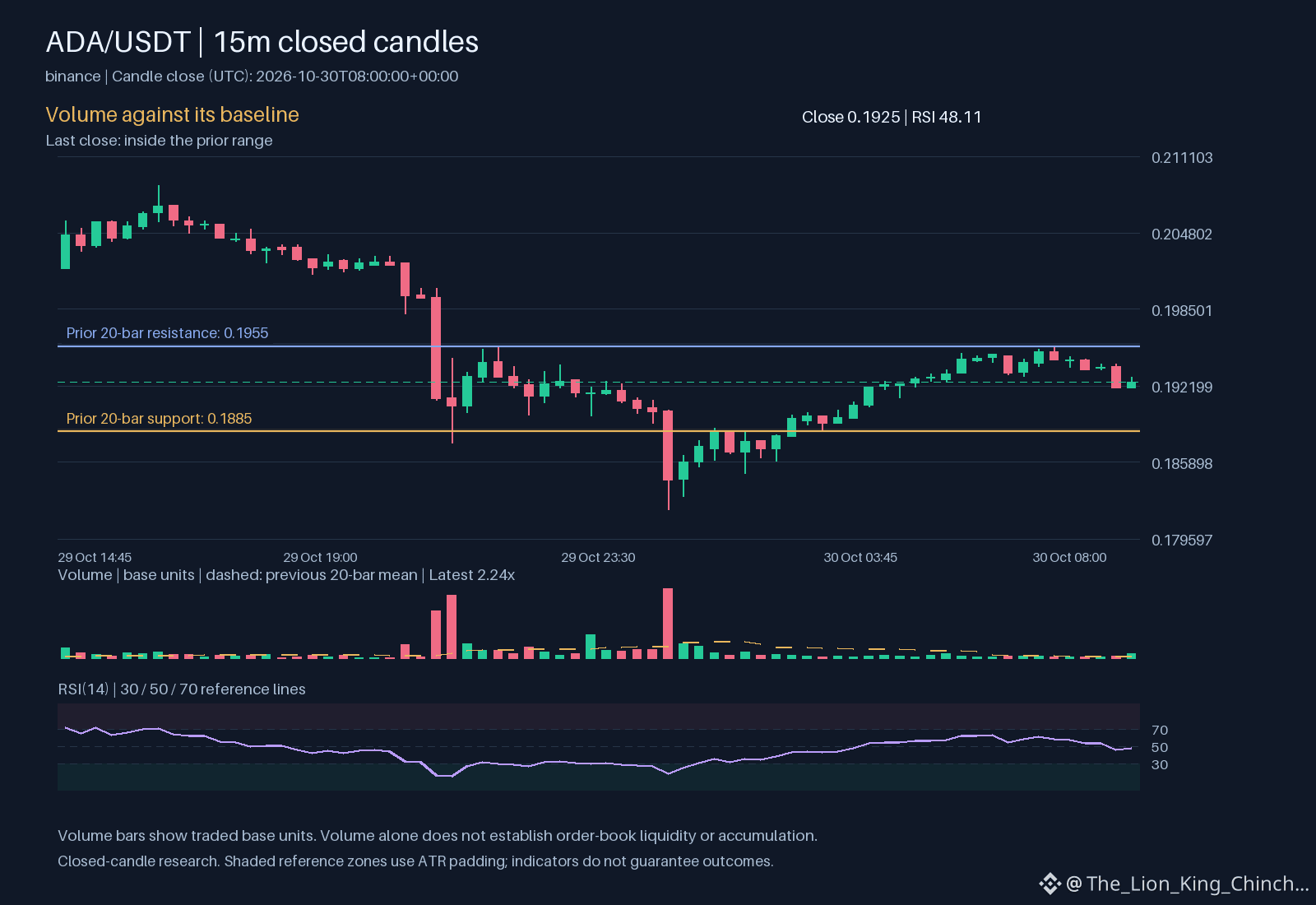
When volume spikes above baseline and the hourly direction is down, the temptation is to jump in early. A thought experiment helps illustrate the cost of chasing. Imagine you wait for the price to break a minor swing low before entering, accepting a tighter entry but risking a larger move that could have been captured earlier. Alternatively, you chase the move as soon as the volume surge appears, gaining immediate exposure but often at a less favorable price and with a wider stop. The balance is between entry quality, measured by how closely the price aligns with the recent structure, and the speed of participation, which can erode potential upside.
**What changes when the assumption fails**
If the assumption that higher relative volume confirms a sustainable downtrend proves false, the trade‑off shifts. A tight entry may become an early exit if the move reverses, while a broader entry could provide a cushion against a quick bounce. In that scenario, the stop distance tied to the average true range 0.00135251 becomes more critical, as it defines the point at which the trade is meaningfully invalidated.
**A decision checklist**
- Does the price respect the nearest support 0.1885 or does it breach it quickly?
- Is the current RSI 48.1115 indicating oversold pressure that could support a bounce?
- How does the recent relative volume 2.236 compare to the baseline and does it justify a tighter entry?
- Can the stop be placed within a reasonable fraction of 0.00135251 without exposing too much capital?
By asking these questions, you can decide whether to wait for clearer structure or reassess the risk before committing.
Probabilistic market research, not a recommendation or guaranteed return.
Would you wait for clearer structure or reassess the risk first?
#ADA #RiskManagement