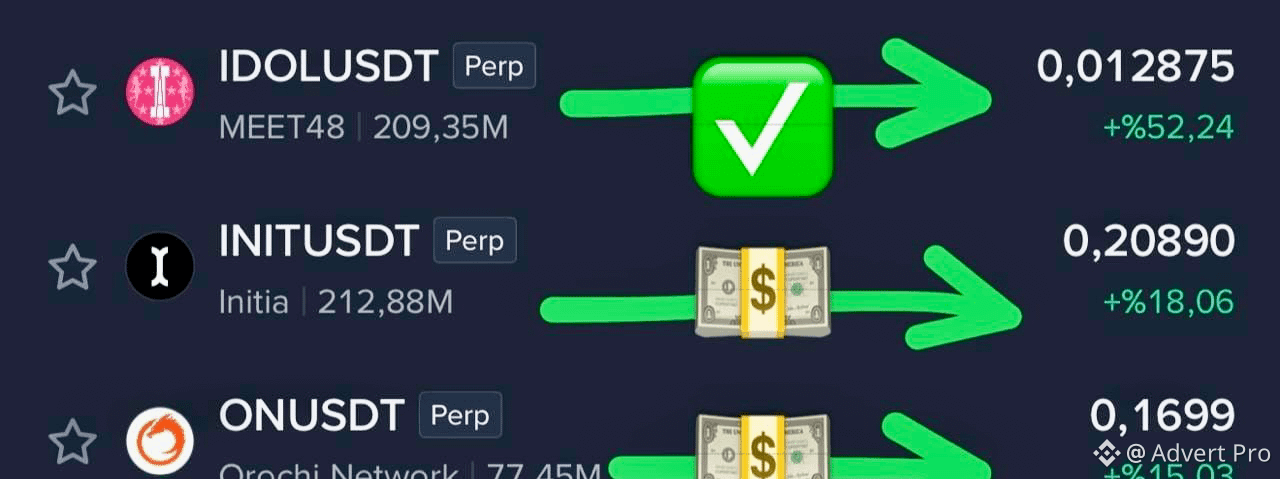
🚨 DECONSTRUCTING "RUNNER" ROTATIONS: AUDITING 🎯🚀
🔥 Your assessment of low-cap liquidity mechanics accurately highlights how market makers and trading desks engineer short-term pumps on illiquid tokens when major assets consolidate.
However, evaluating these three specific setups ($IDOL, $INIT,$ON ) through a strict technical and market structure framework reveals critical execution risks.
🔍 Structural & Order Book Breakdown:
$IDOL (MEET48) — Accumulation Shelf vs. Derivative Squeeze ⚙️
The Structural Thesis: has consolidated within a defined horizontal range following earlier distribution.
The Order Book Trap: While accumulation on spot charts often precedes volatility expansion, derivative markets tell the real story. Perpetual Open Interest (OI) frequently outpaces spot order book depth.
$INIT (Initia) — Token Unlocks vs. Tactical Wicks 🚀
Your Take: Expected 1–2 day short-term rally followed by a drop.
The Supply Mechanics: Modern modular/L1 infrastructure tokens like operate with complex vesting schedules, early investor allocations, and emission cliffs.
$ON (Orochi Network) — Low-Depth Liquidity Trap 🪦
Your Take: Low market cap/volume enables high price impact with small trades.
The Risk Vector: Micro-caps with thin order books carry severe slippage risk. A single $20k–$50k market order can spike price +30%, creating an artificial "green wick." However, exiting that position requires selling into non-existent bid liquidity.
🛑 Trader Risk Warning:
Trading low-depth micro-caps in anticipation of speculative "runners" carries severe illiquidity, slippage, and rapid distribution risks! Protect your trading capital: enforce hard horizontal Stop-Loss parameters, keep leverage conservative, and prioritize capital preservation above all else! 🛡️⚡
📌 Follow & Like for daily technical audits, structural trade management, and disciplined risk-first execution! 🔥
#Binance #CryptoTrading #Altcoins #RiskManagement