

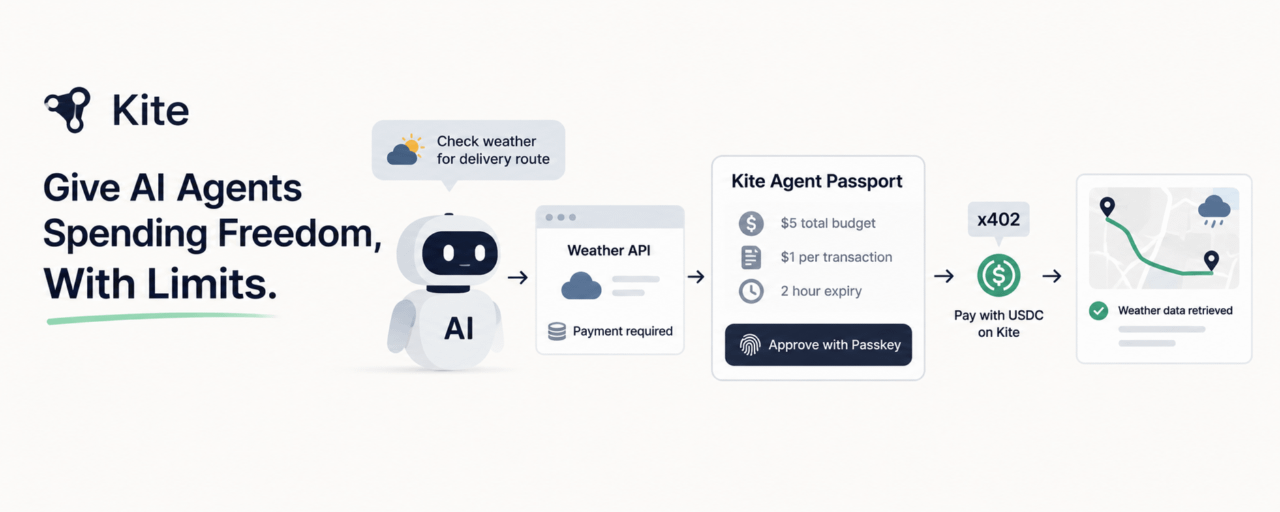


A weather update worth a few cents can stop an entire AI workflow at 2 a.m.
Imagine I ask an agent to check weather conditions for a delivery route before morning. It finds the data it needs, but the API requires payment.
Now I have two bad choices.
Wake up and approve every small payment, or give the agent unrestricted access to my money.
The first choice kills automation. The second turns a simple task into a spending risk, especially if the agent starts retrying failed requests.
This is the part of Kite that caught my attention.
With Kite Agent Passport, I could approve a spending session using a passkey. For example, $5 total, a maximum of $1 per transaction, and a two-hour expiry.
When a paid API sends an x402 payment request, the agent can use that approved session to pay in USDC on Kite and retrieve the response. I can review the payment activity afterward.
But the interesting part isn't the first successful payment.
It's what happens when another request would push the agent beyond my $5 budget.
The agent should no longer have permission to spend. It shouldn't matter how confidently it explains that another API call is necessary.
That's a much more useful definition of autonomy to me.
I don't need an AI agent that can spend indefinitely. I need one that can finish a paid workflow without asking me twenty times and without quietly crossing the limit I approved.
And there's a practical question worth discussing.
Would you trust an agent with a small, time-limited spending allowance, or would you still want to approve every transaction yourself?
For me, the real test of Kite isn't payment number one.
It's whether payment number eleven gets blocked when the budget is already gone.