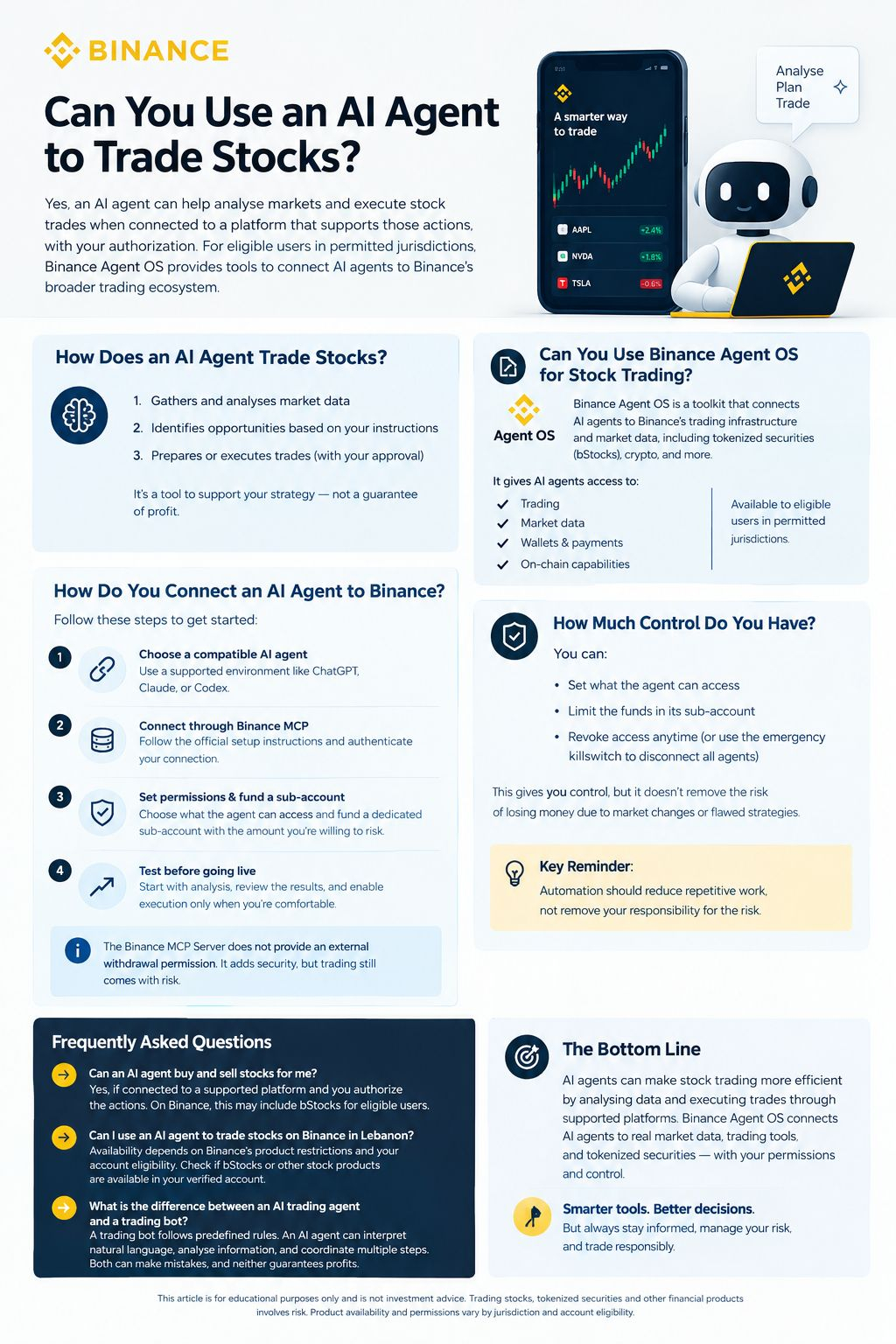
Yes, an AI agent can help analyse markets and execute stock trades when connected to a platform that supports those actions, with your authorization. For eligible users in permitted jurisdictions, Binance Agent OS provides tools to connect AI agents to Binance’s broader trading ecosystem, including supported trading products and market data.
Here’s the interesting part: you don't necessarily need to sit in front of a chart all day, switching between tabs and checking every price movement. You can ask an AI agent to gather market data, compare opportunities, build a strategy, and, where the required tools and permissions are available, prepare or execute a trade. But there’s one very important distinction: an AI agent can help you trade; it cannot guarantee that you’ll trade profitably.
Imagine you're considering buying a stock because everyone on social media is suddenly talking about it. Instead of following the hype, you could ask your AI agent to review the available price data, recent movements, liquidity, and your entry criteria. It might tell you to wait, identify risks you missed, or prepare an order for your approval. That's a much more useful role than having AI blindly buy whatever is trending.
How Does an AI Agent Trade Stocks?
An AI trading agent connects three things: a model that interprets your instructions, data that helps it assess the market, and tools that allow it to perform permitted actions. Depending on the setup, it can research an asset, monitor prices, evaluate conditions against a strategy, and submit an order through a supported trading platform.
For example, suppose you tell your agent: “Track NVIDIA, compare its recent price movement with my entry criteria, and alert me if the setup looks interesting.” The agent could retrieve supported market data, compare it against your conditions, and explain what it finds. If your setup allows trading actions, you could take the workflow further and have it prepare an order or execute one within the permissions you granted.
That doesn't mean the agent knows where the market is going. AI can misinterpret information, rely on incomplete data, overlook an important event, or make a poor decision. A good workflow defines the strategy, risk limits, and approval requirements before money is put at risk.
Can You Use Binance Agent OS for Stock Trading?
Binance Agent OS is a toolkit that connects compatible AI agents to Binance's trading infrastructure and market data. Think of it as the bridge between an AI that can reason through a task and a platform where supported actions can actually happen. It uses the Model Context Protocol (MCP), a standard that lets compatible AI applications discover and use external tools.
For stock exposure, the distinction matters. Binance has introduced bStocks, tokenized securities designed to track the economic performance of specified U.S. stocks. Eligible users in permitted jurisdictions can trade supported bStocks on Binance, but these tokens are not the same as owning the underlying shares directly. Availability depends on your location and account eligibility.
So, imagine you want exposure to NVIDIA. Your AI agent may be able to analyse supported market data and help you trade an available product through connected Binance tools. But you should first confirm that the particular stock product is supported for your account. Connecting an agent does not automatically unlock every stock market or every financial product.
One more important detail: Agent OS is not itself a ready-made trading strategy or an autonomous money-making machine. It provides the infrastructure that developers use to connect AI agents to Binance capabilities. The agent, its instructions, the available tools, and the permissions you grant determine what it can actually do.
How Do You Connect an AI Agent to Binance?
You don't need to build an entire trading platform from scratch, but you'll need a compatible AI environment and the correct account setup. Binance's official documentation describes the following general process.
1. Choose a compatible AI agent
Use a supported environment, such as ChatGPT, Codex, Claude, or another compatible setup listed in Binance's current documentation. Compatibility can vary by integration.
2. Connect through Binance MCP
Follow the official setup instructions at Binance Agent OS and authenticate the connection. MCP provides the link between your compatible AI application and supported Binance tools.
3. Set permissions and prepare the agent account
Choose what the agent can access, such as market data, account information, and supported trading functions. Binance's MCP integration uses a dedicated Agentic sub-account, separated from your main account. You must fund it yourself with only the assets you're prepared to expose to agent activity.
4. Test your strategy before trusting it
Start by asking the agent to retrieve data and explain its analysis. Then test your trading instructions and review order details carefully before allowing real trades. Check the permissions and safeguards in your specific setup before enabling execution.
The official integration documentation says the Binance MCP Server does not provide an external withdrawal permission. That is a useful safeguard, but it does not eliminate trading risk: an agent with trading access can still make losing trades.
How Much Control Do You Have Over an AI Trading Agent?
More than you might think, provided you configure it correctly. You can define the agent's permitted actions, limit the funds available through its dedicated sub-account, and revoke its access if you no longer want it connected. Binance also provides an emergency option to revoke access to all connected agents.
For example, if you have $500 allocated to a strategy, you could keep your remaining funds in your main account and fund the agent's dedicated sub-account with only the amount you're prepared to put at risk. You could instruct it to analyse opportunities and prepare trades for review rather than granting broader trading permissions immediately.
However, don't confuse account controls with a guarantee that the strategy itself is safe. An AI agent can follow your instructions perfectly and still lose money because the strategy is flawed, the market changes, or the order executes at a worse price than expected.
My preferred approach is to start with analysis, move to testing, and enable execution only after you understand exactly what the agent can do. Automation should reduce repetitive work, not remove your responsibility for the risk.
FAQ: AI Agents and Stock Trading
Can an AI agent buy and sell stocks for me? Yes, if it is connected to a platform that supports the relevant product and trade actions, and you authorize the necessary permissions. On Binance, that may include supported tokenized stock products such as bStocks for eligible users. An agent cannot automatically trade every listed stock or access every market.
Can I use an AI agent to trade stocks on Binance in Lebanon? Availability depends on Binance's current product restrictions and your account eligibility. Binance Agent OS does not mean every product is available in every country. Before setting up a strategy, check whether bStocks or another relevant stock product is available to your verified account in Lebanon. Do not assume that being able to connect an AI agent means you're eligible to trade tokenized securities.
What is the difference between an AI trading agent and a trading bot? A traditional trading bot generally follows predefined rules, such as buying when a price crosses a moving average or selling at a specified threshold. An AI agent can interpret natural-language instructions, gather information from connected tools, adapt its analysis to the information it receives, and coordinate multiple steps. Some agents can also execute trades if authorized. Both can make mistakes, and neither guarantees profits.
Final Verdict
AI trading isn't simply about asking a chatbot which stock will rise tomorrow. The more useful idea is connecting analysis to real market data and supported actions, while keeping permissions and risk controls in your hands.
Binance Agent OS gives developers a way to build that connection. Whether you're researching a stock, monitoring a setup, or preparing a trade, the goal should be to make your workflow smarter, not to hand your financial judgment over to a machine.
Because if your AI agent buys the top, the market won't refund you just because the algorithm sounded confident.
This article is for educational purposes only and is not investment advice. Trading stocks, tokenized securities, and other financial products involves risk. Product availability and permissions vary by jurisdiction and account eligibility.