$CELO: Note the Price Anchor Before You Refresh
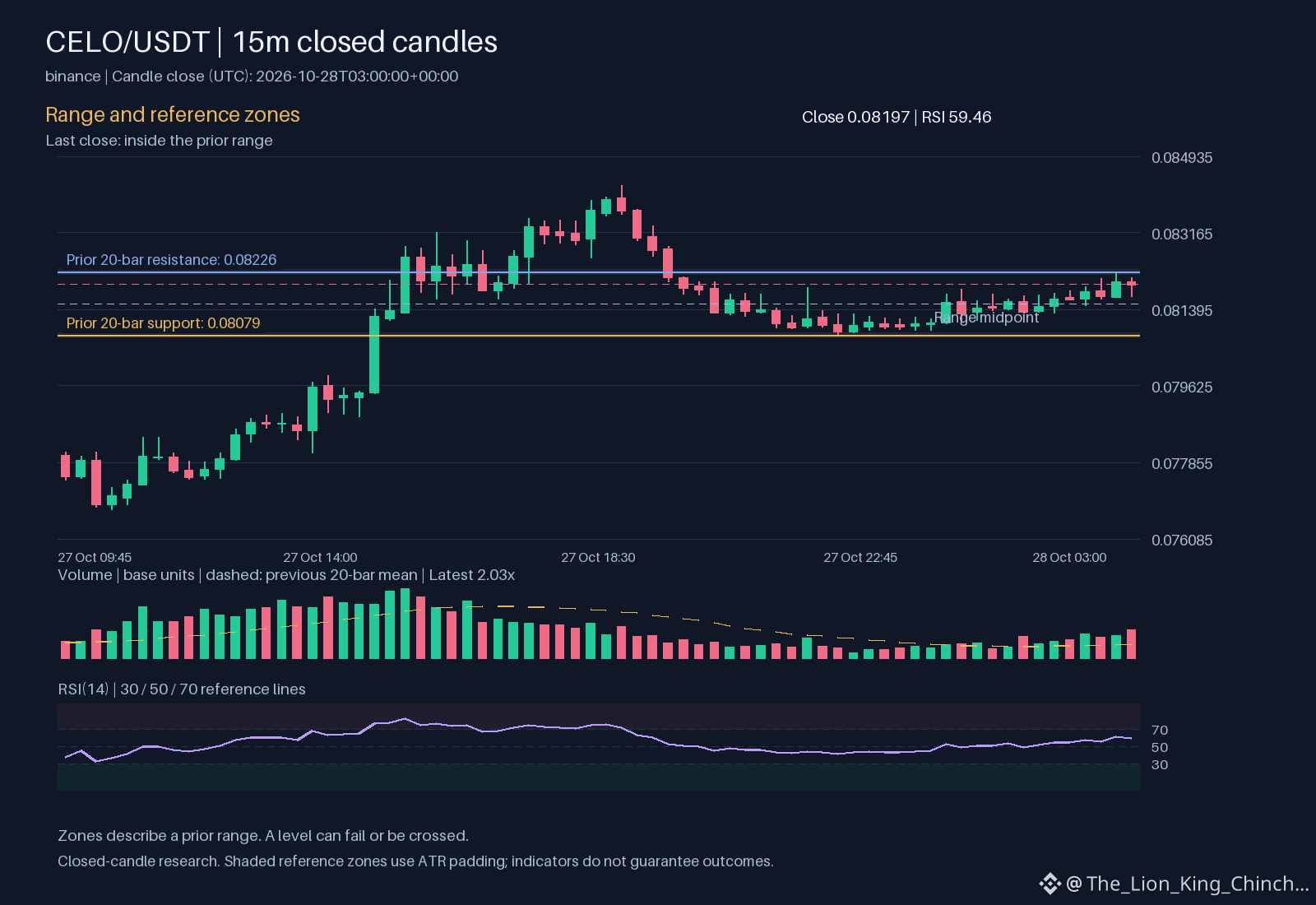
Attention seeks patterns, but anchoring binds those patterns to the first number you see. When $CELO trades inside its recorded range, the mind often fixates on the current level at 0.08197. Whether it sits near 0.0815876 or 0.0812462 matters less than when you first looked.
Consider this thought experiment, not a current fact. If you saw the chart twice today and the price appeared at 0.08197 just once, you might dismiss the rise. If you see it now, you might assume a trend started. The objective data includes volume above baseline and a short term shift of 0.404214. These are facts. Your feeling that the move started at a specific minute is the anchor.
Anchoring changes research by prioritizing confirmation. A researcher might search for why the price hit 0.08226 rather than asking if volume supports the move. This narrows the view. If 0.08197 breaks a level, the mind treats the old level as a broken wall. In reality, liquidity builds. The move is merely a change in the supply and demand balance.
To reduce this bias, use a simple self-check. Identify the number you first considered. Ask if your thesis changes if that first number is ignored. Does the logic stand based only on volume and spacing? If you only know a trade because you missed it, that is regret. If you know it from data, continue. Never assume the market waited for you. Look for the mechanism, not the memory of the first chart view. This keeps the analysis grounded in the visible activity rather than the mind's initial impression.
Probabilistic market research, not a recommendation or guaranteed return.
Would you keep the same rule after missing a move?
#CELO #TradingPsychology #CryptoLearning