
Wednesday's 2 p.m. ET announcement will show whether the Fed hikes for the second time this year. The goal hasn't changed: knock inflation down. In September, the committee added a quarter point to the federal funds rate. That was the first hike in three years, and borrowing got more expensive across the U.S. economy as a result.
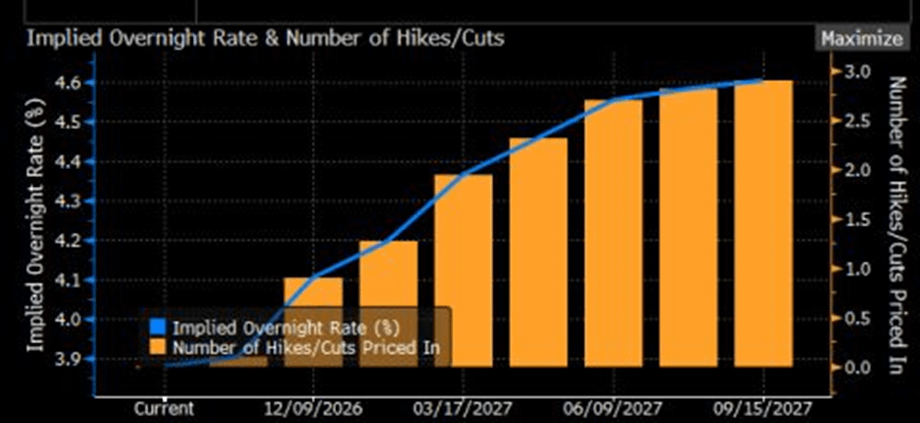
Most economists and investors expect one more hike before the year ends, probably at the Dec. 8-9 meeting, the last of 2026. CME Group's FedWatch tool reads rate expectations off 30-day Fed funds futures. It currently shows an 88% chance of a hold in October and a 71% chance of a December increase. There's no November meeting.
Bloomberg's pricing lines up closely, at about 10% for a move this week and roughly 80% for December. Last month's quarterly projections told the same story, with the committee signaling it expected to raise rates again later this year.
The Fed is working with an awkward set of facts. Inflation is sticky, the Iran war and tariffs are adding pressure, and the AI investment boom is pulling the economy in its own direction. Consumers keep spending despite weak sentiment. Bond yields are rising while stocks soar. The labor market, wages, and inflation all point in different directions (Bloomberg Intelligence, 2026).
Rates can't reopen the Strait of Hormuz or fix chip shortages, either. They're still the main tool the Fed has, so officials are left to weigh the risk of stubborn inflation against the damage that too much tightening could cause.
The Case For Hiking
Inflation hasn't cooled.
September's CPI and PPI both ran hot, and the year is shaping up as a second straight year of lost ground on prices. Increases were broad-based, and energy costs have jumped since the Iran war started. Inflation has been above the Fed's 2% target for more than five years, which feeds the worry that easing off early would repeat the mistake of the pandemic-era surge. Oil prices remain high. A tech-led selloff tied to doubts about AI has also pushed investors out of riskier assets. Ray Attrill, head of FX strategy at National Australia Bank, said the U.S. bond market seems to be steering the dollar more broadly (Reuters, 2026).
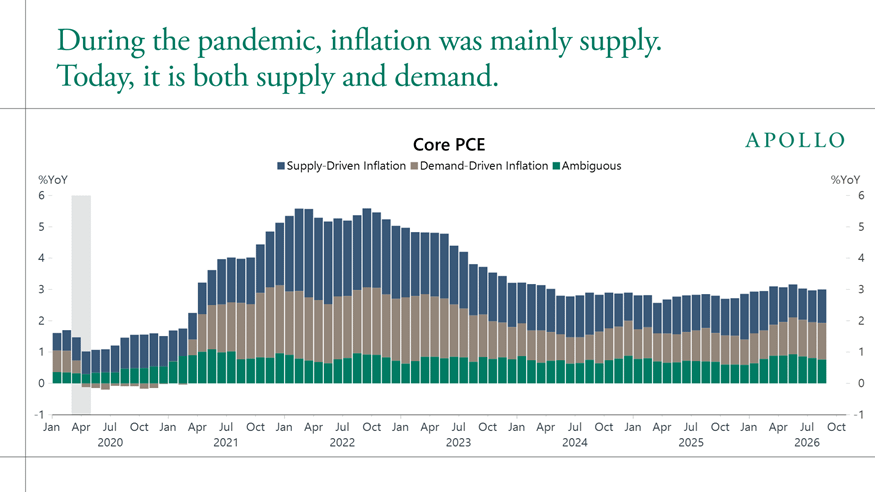
Apollo Research argues inflation can no longer be blamed on supply alone. San Francisco Fed data put core PCE inflation at 3%, split evenly between supply and demand (see chart below). Supply dominated in 2022, but demand's share has been growing since 2024. Rates can cool demand-driven price pressure. They do very little against a supply shock, and that's the point for the Fed.
Waiting has a price.
The debate is whether to push past the current 3.75%–4% range or stop and see what the earlier hikes have done. Hawks say more tightening would show the Fed is serious about inflation. With a December move widely expected, they'll argue that six weeks of waiting gains little and risks falling further behind. The cautious camp will answer that higher borrowing costs could hurt households and small businesses and slow activity (Bloomberg Intelligence, 2026).
Policy doesn't look restrictive.
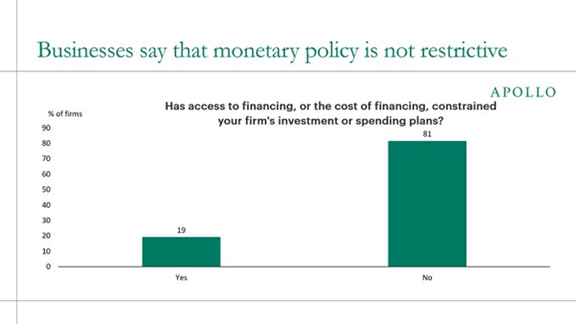
Apollo Research puts it bluntly: monetary policy isn't restrictive. In the Fed's Q3 2026 survey, only 19% of firms said financing costs or credit access limit their investment and spending. The other 81% reported no constraints.
Financial conditions don't look especially tight by most other measures either. The Chicago Fed's NFCI did climb to –0.50 for the week ending October 9, which points to loose financial conditions. The St. Louis Fed's stress index dropped to -0.81 in the week ending Sept. 25, from -0.70 the week before, and anything under zero means markets are calmer than usual. Goldman's US Financial Conditions Index has also moved higher in recent weeks, but the move is small and hard to call a dramatic tightening.
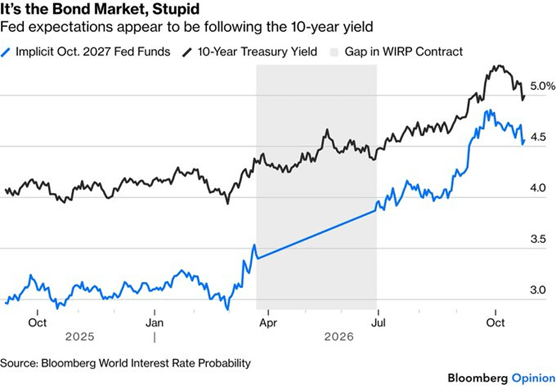
Then there's the bond market. Investors who like to police policy, the so-called bond vigilantes, have been selling Treasuries. Governor Christopher Waller has said the sharp climb in long-term yields is cooling demand and doing "a little bit of the work" that tighter policy would otherwise have to do.
The 10-year yield now sits close to the top of its 4.0%-5.0% "old normal" range, the highest since 2007. It's also tracking projected Fed funds rates a year ahead. So the Fed has to prove its inflation credibility by keeping policy tight, even though Warsh keeps telling traders to watch the data.
A resilient economy.
AI muddies things further. The rush to build data centers and computing capacity is propping up growth and creating demand for capital and memory chips. Down the road it may raise productivity and help cool prices, but right now it's pushing costs up. Barclays found that hyperscalers spend over 90% of their operating cash flow on AI infrastructure, which means higher rates could have less effect on some of that spending.
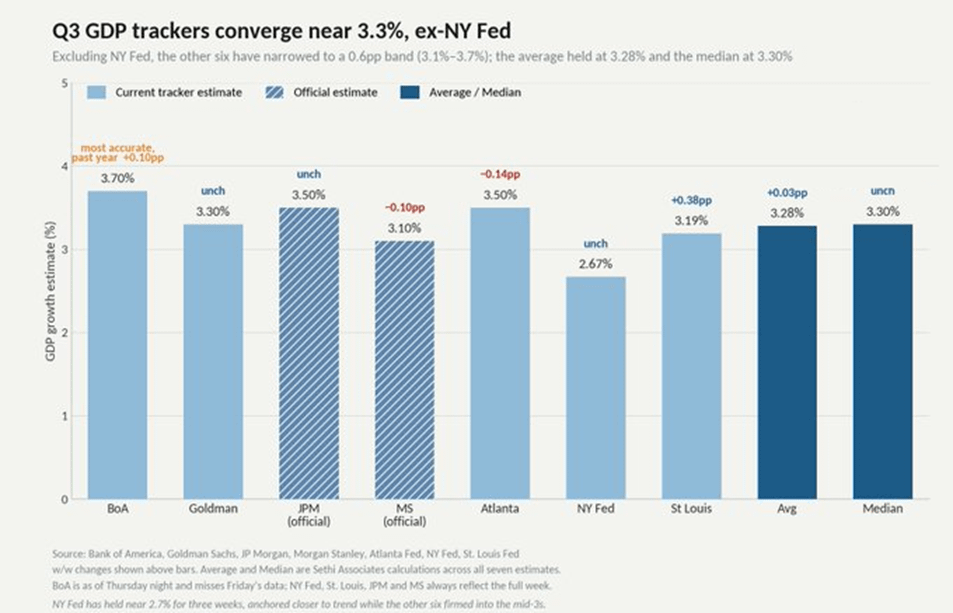
Q3 GDP forecasts are holding up ahead of Thursday's release. The average estimate edged up to 3.28% from 3.25%, and the median stayed at 3.30%. A St. Louis Fed upgrade helped, and only the NY Fed is below 3.1%.
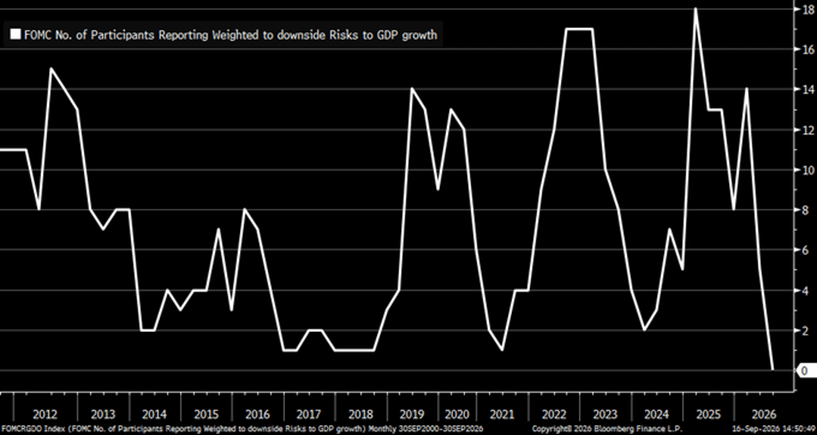
Bloomberg also notes that for the first time since the Summary of Economic Projections began, not a single member sees downside risks to GDP growth. The Fed's tone is hawkish too.
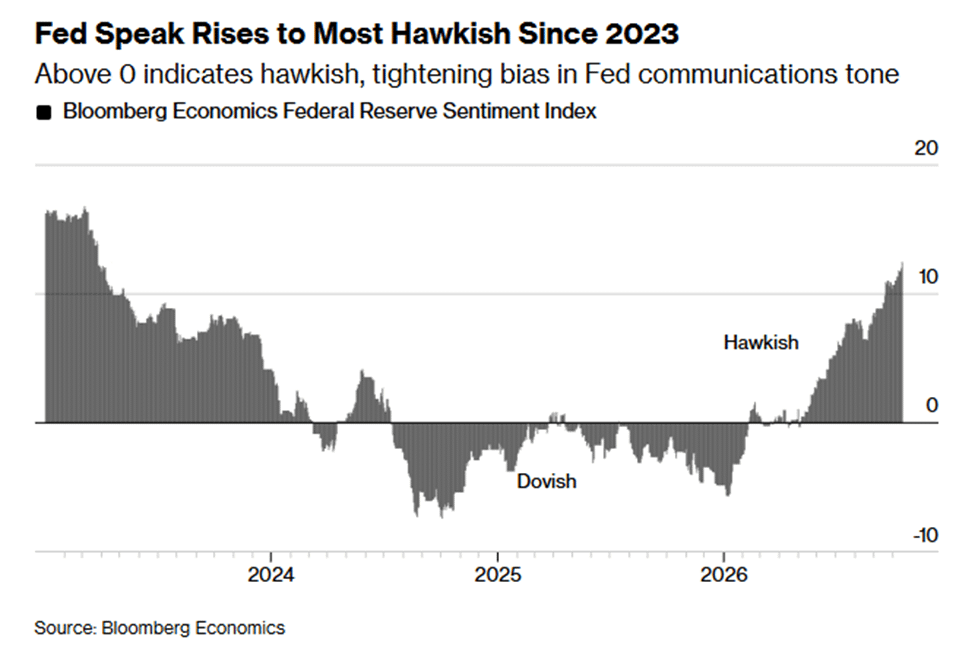
Bloomberg's Fed Speak Index has reached its highest level since March 2023, even as market expectations for hikes softened this week. Officials are talking tougher than markets are pricing.
The Case for Holding
Spacing out hikes is cheap.
If officials still see this as a recalibration of two to three hikes, stretching out the remaining moves costs little. "Being six weeks late is a manageable risk," says Rob Kaplan.
Claudia Sahm described September's hike as "risk management" rather than the start of an aggressive cycle. The committee is centered on one more hike this year, which suggests the Fed is hedging its bets on inflation.
Back-to-back moves could look like a faster cycle than intended:
Most officials say rates need to go higher, just not at consecutive meetings. Federal Reserve Vice Chair Michelle Bowman sees no urgency to hike rates further, saying policymakers have time to assess how the economy evolves before considering additional tightening. Her remarks signal a wait-and-see approach to monetary policy
Daly says more hikes are more likely than not, but timing is still under discussion. She sees no urgency to act on limited information and would rather stay deliberate with more meetings ahead. September CPI showed gas prices lifting headline inflation and core staying stubborn, so the risk of above-target inflation remains high.
Governor Christopher J. Waller votes on the FOMC in 2026 through his permanent Board seat, and he also said more hikes are coming. He left himself room on timing. They don't have to come at consecutive meetings, he said, but he wants them in place within an acceptable period.
Governor Jefferson: the Fed "may take more time" to decide its next rate move. Future changes should be driven by the data.
A surprise before the midterms would jar.
Several officials have signaled there's no rush, and Warsh's silence has let hold odds build. A surprise hike days before the midterms would rattle markets. The Fed has raised rates ahead of elections before, just never by surprise. After the September hike, New York Fed President John Williams told an audience at the University at Buffalo: "With the policy action we took at our September meeting, there is no need for urgency, and we have time to gather more information."
The labor market.
Employment has held up and is at maximum employment, but the FOMC has no wish to weaken it. The last time the job market showed strain, the Fed delivered a 50-basis-point "jumbo" cut on September 18, 2024, taking the federal funds rate to 4.75%–5.0% as the labor market cooled and unease grew.
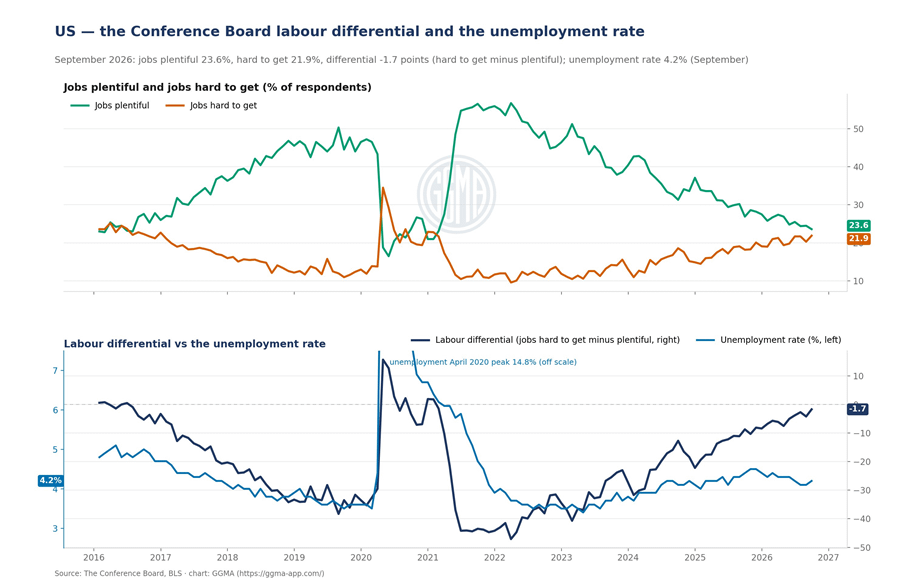
Sentiment is slipping again. The Conference Board's jobs differential fell to -1.7 in September, the weakest since February 2021, and confidence is expected to dip to 81. If things deteriorate further, the 78% odds of a December hike could come into question, even with unemployment at 4.1%–4.3%.
AI spending is a pillar and a weak spot:
Corporate outlays on data centers, chips, and power-grid capacity have become a major support for U.S. growth, and they've created a systemic vulnerability along the way. Economists estimate that tech and AI-related capital spending drove an outsized share of real GDP growth. Information processing equipment and software accounted for as much as 92% of growth in the first half of 2025, while manufacturing and services mostly stagnated. Some macroeconomists argue the broader economy would have grown at a near-zero or recessionary pace without the surge. Soaring AI stock valuations have also swelled household wealth, adding an estimated $180 billion, a fraction of the overall rise in consumer spending.
Q2 GDP was revised up 0.7 percentage points from the second estimate, mostly on higher investment, consumer spending and government spending.
Surging Yields:
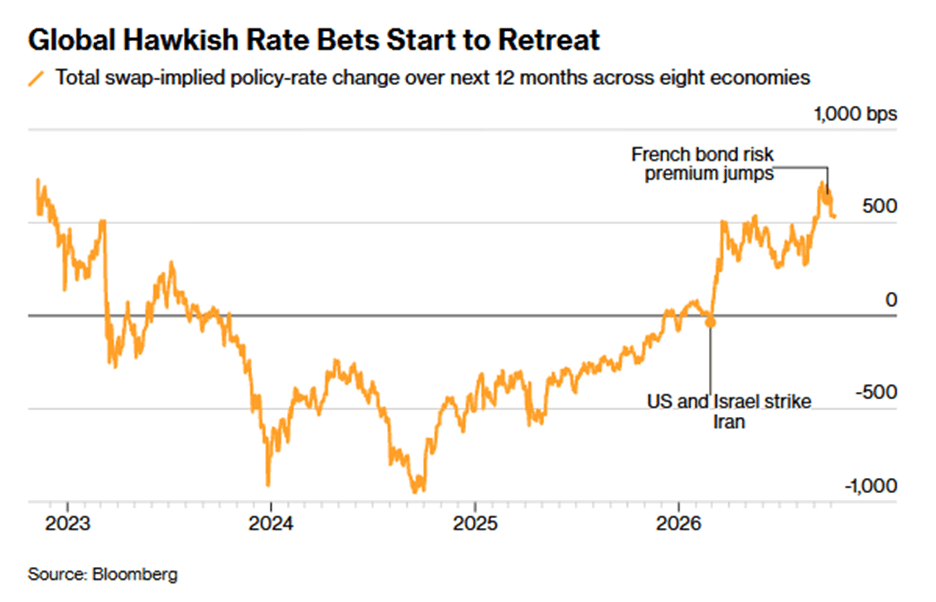
Global bond yields have surged to multiyear highs. That tightens financial conditions and could reduce the need for more central bank hikes. Markets have cut rate-hike pricing across eight major economies by nearly 200 basis points since mid-September.
The press conference
Fed Chair Kevin Warsh will speak after the decision. Investors shouldn't expect hints beforehand, since he has argued against forward guidance on rate moves.
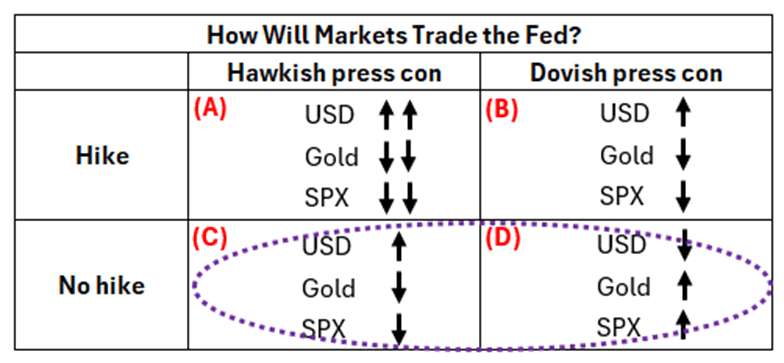
What can we say about Wednesday? For one, the Fed won't hike given where market pricing stands, and that puts a natural ceiling on how hawkish the press conference can get. If Warsh sounds all-out hawkish, someone will ask why the committee didn't just hike, and he'll want to steer clear of that conversation.
He also did a good job in September explaining the shift from July, citing three reasons: growth had been stronger than expected, inflation hadn't come down fast enough, and oil prices were rising (the meeting came just after the attack on the Saudi East-West pipeline). The growth outlook is weaker now, with more worry that AI is a bubble.
Robin J. Brooks of the Brookings Institution takes that question on with his two-by-two matrix for how he's approaching the meeting. Stubborn inflation and oil prices above where they were heading into September 16 offset that. In the two-by-two matrix above, we land on the lower row between the left (C) and right (D) quadrants, so the press conference should be broadly neutral for markets.
When the Fed held at its July 29 meeting, markets threw a tantrum. The U.S. yield curve bear-steepened, and talk of lost Fed credibility spread fast. It clearly struck a nerve. The Treasury announced a surprise buyback on August 19, and Warsh turned hawkish at Jackson Hole, which set up the unanimous hike on September 16.
Given how hard markets went after Warsh this summer, their calm now is surprising. Heading into July 29, they were pricing ten basis points of hikes, off a core CPI reading that had been flat just two weeks earlier. Now they're pricing only three basis points for tomorrow (the orange line in the chart below), even though CPI surprised to the upside two weeks ago and the midterms are close.
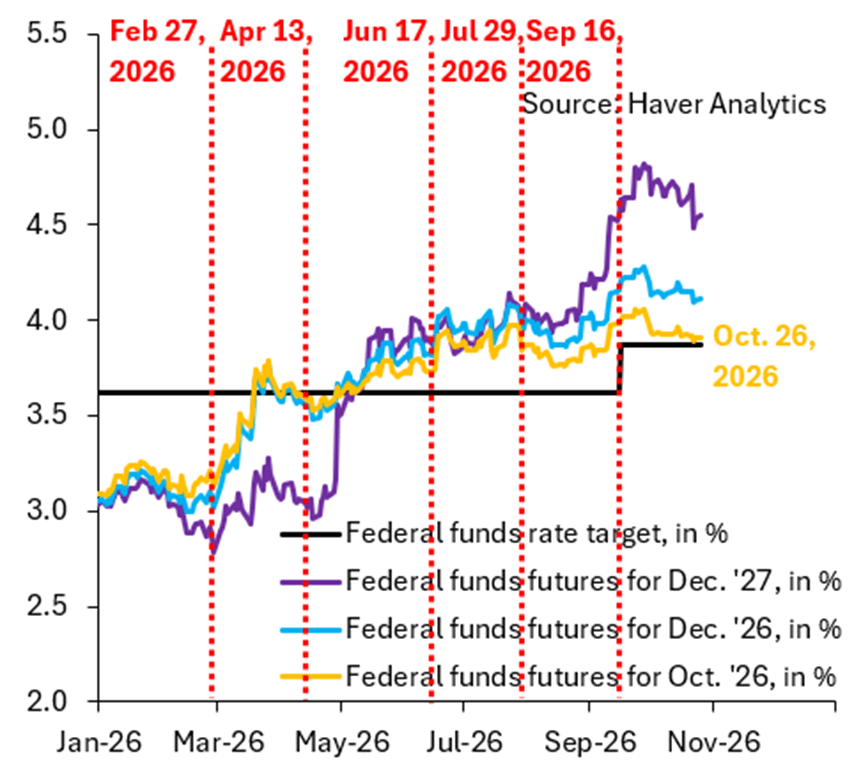
If markets feared political capture of the Fed, this is the meeting where they'd test Warsh. What really matters is how fragile the truce between markets and the Fed is, and whether anything on Wednesday could break it.
Conclusion
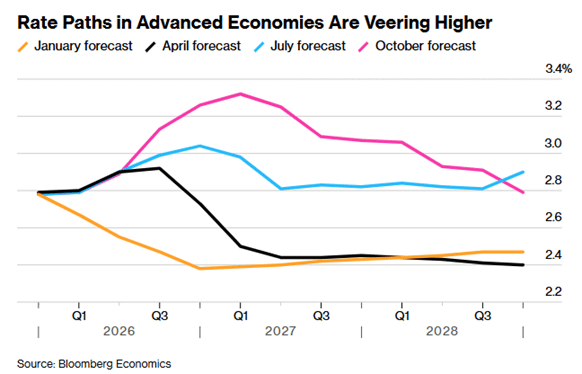
Rates are going up. Timing is the open question. Global rate-cut hopes are fading, and Bloomberg Economics' gauge now prices in almost 25bp of hikes across advanced economies, with rates staying high as the Middle East war, resilient growth, the AI boom and government spending feed inflation.