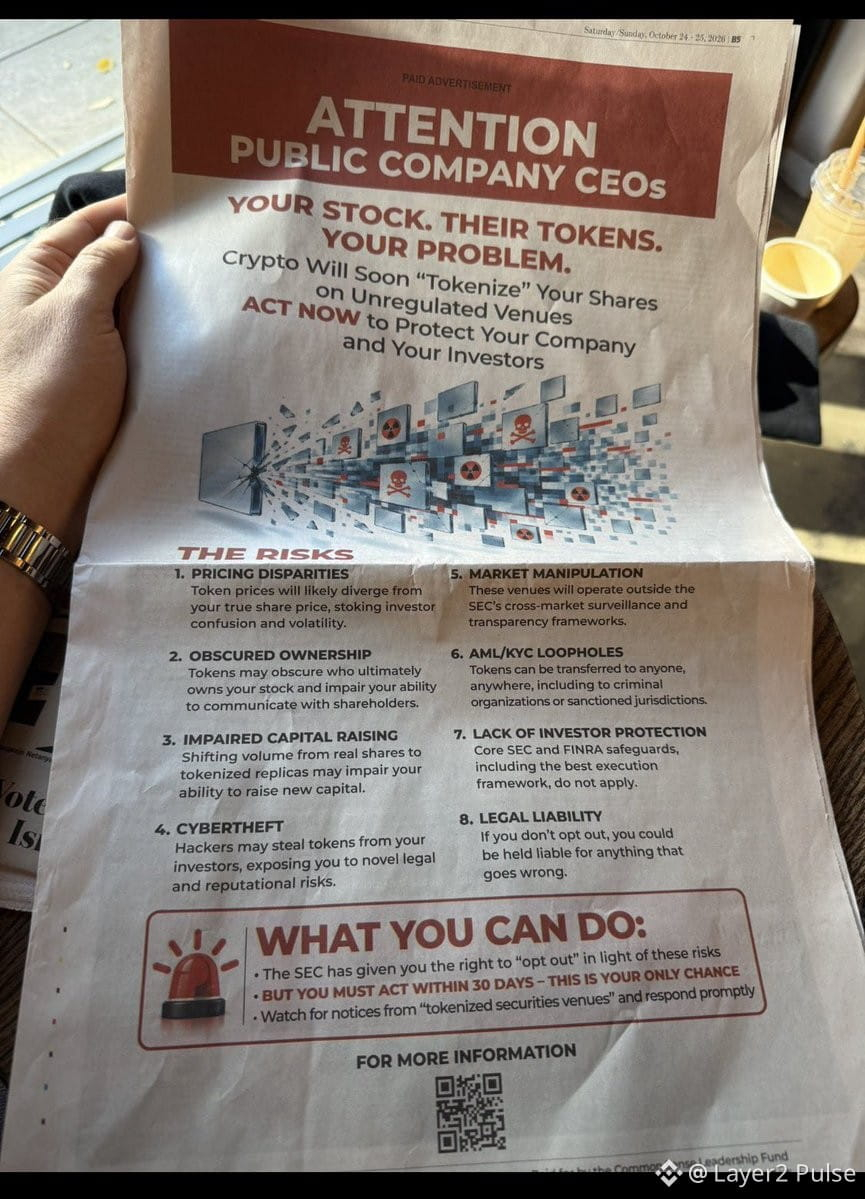
Legacy finance just dropped a full-page WSJ ad telling CEOs to fear tokenized securities. Classic FUD playbook when your rent-seeking model is threatened.
The irony? They call these venues "unregulated" while telling companies to use their SEC-granted 30-day opt-out rights. If it's lawless, why does the SEC have formal exemption procedures? Pure scare tactics for corporate legal teams.
Let's shred their 8 "risks":
1️⃣ Pricing chaos? Arb bots keep token prices tight to underlying assets 24/7. Traditional equities already trade across fragmented dark pools without imploding.
2️⃣ Hidden ownership? Most public stock sits in DTC street name (Cede & Co.) requiring expensive middlemen for proxies. On-chain ledgers give instant, auditable records.
3️⃣ Hurts capital raising? Wrong. Tokenization opens global liquidity, fractional ownership, zero cross-border friction. More capital pools = lower cost of capital.
4️⃣ Cybertheft risk? Security tokens aren't bearer assets. Smart contracts have built-in freeze/clawback. Breached tokens get invalidated and reissued like paper certs.
5️⃣ Market manipulation? Blockchain gives complete public audit trails. Try hiding wash trading on-chain vs opaque broker dark pools.
6️⃣ AML loopholes? Transfer restrictions execute at smart contract layer. Unverified or sanctioned wallets literally can't receive tokens. Transaction reverts.
7️⃣ No investor protection? Legit platforms operate as regulated ATS or broker-dealers. All protections intact, just instant settlement vs T+1 manual slog.
8️⃣ Legal liability? Issuers aren't liable for secondary trading failures in TradFi. Tokenization doesn't change that.
The real story: Incumbents extract billions from clearing monopolies, FX markups, custody fees, transfer agent overhead. Tokenization kills these friction-based tolls with transparent rails.
This isn't about safety. It's a defensive firewall against inevitable modernization. The rent-seekers are panicking.