

AI Agents Don’t Just Need Intelligence. They Need a Way to Operate Economically.
I keep coming back to one question about the agent economy: if AI can already analyze a market, plan a workflow, and choose the next step, what stops it from completing the whole job on its own?
The answer often has little to do with intelligence.
An agent might know which data it needs, which API to call, and how to interpret the results. But if it cannot access a paid service, prove who authorized it, or pay for each request within a defined budget, the workflow still depends on a human stepping in.
That gap matters. Today’s digital systems largely assume that a person will log in, manage credentials, approve access, and settle payments. Autonomous agents need to handle these actions under rules that their owners can verify and control.
Three pieces are missing from many existing setups.
Identity: A service needs to know which agent is making a request, who owns it, and what authorization it carries. Managing API keys and OAuth tokens across multiple agents and platforms becomes difficult when there is no clear, verifiable link between the user, the agent, and its active session.
Authority: Giving an agent broad access can expose the owner to unnecessary risk. Requiring manual approval for every action makes automation cumbersome. Users need enforceable limits, such as a daily budget, a maximum payment per transaction, approved services, and a defined session duration.
Payments: Agents may need to pay for data or computing services one request at a time. Traditional payment methods can make these small transactions uneconomical when fees are too high. Without programmable payments and practical micropayment mechanisms, an agent may be able to identify the right service but still be unable to use it independently.
For me, these are connected parts of the same problem. An agent needs a verifiable identity to establish trust, limited authority to control what it can do, and a payment mechanism that allows it to act within those boundaries.
This is the problem Kite is trying to address with infrastructure designed for the agent economy.
Its SPACE framework brings together five elements: stablecoin-native payments, programmable spending constraints, agent-first authentication, compliance-ready audit trails with selective disclosure, and micropayments that can make pay-per-request services economically viable.
The identity architecture has three layers:
User (Root Authority): The owner retains control of the root key, which is protected in a secure enclave and is not exposed to the agent.
Agent (Delegated Authority): Each agent receives a distinct identity derived from the user’s wallet, following a BIP-32-style approach. Its relationship to the owner can be verified without giving the agent access to the root key.
Session (Ephemeral Authority): A temporary key is used for a specific session and can expire afterward, limiting the scope of exposure.
The separation between these layers is the part I find most interesting. An agent can receive permission to perform a task without being given unrestricted control over the owner’s wallet.
Kite Agent Passport is designed to put this model into use. The user creates a Passport, funds it with USDC, and approves a spending session using a passkey. The session defines the total budget, the maximum amount per transaction, and the permitted time window.
Once authorized, the agent can discover services through a catalog supporting x402, request paid services, and make payments within its signed limits without asking the user to approve every transaction individually. The authorization evidence links each transaction to the relevant user and agent, creating a trail that can be verified.
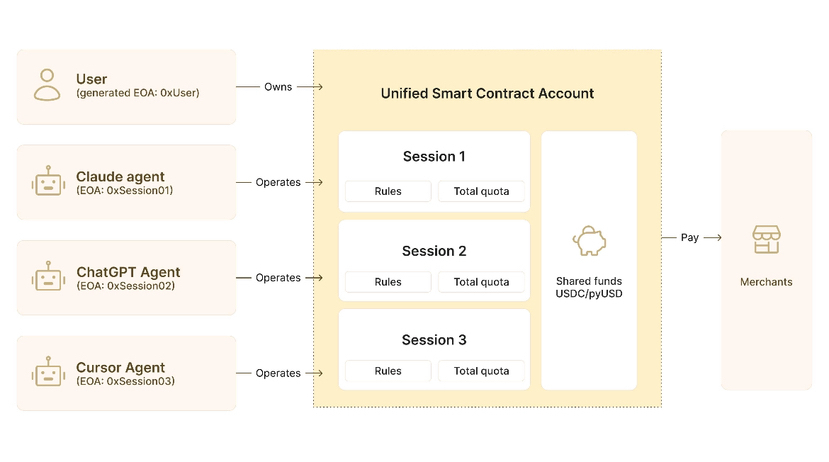
Consider a market research task.
Suppose an agent is asked to study the tokenization of real-world assets across Asia over the next 48 hours, using at least five paid data sources and two specialized analytical models.
A conventional assistant might produce a report from public data and its existing knowledge. Completing the task as specified is different. The agent must access paid on-chain and off-chain data APIs, obtain specialized analysis, and pay for those services along the way.
Without verifiable authorization, service providers have little basis for accepting payments from an unknown agent. Without a spending budget and session limits, the owner has little reason to let it spend money independently. Someone ends up handling the transactions manually, and the workflow loses much of its autonomy.
With a setup like the one Kite describes, the agent could operate within a pre-approved budget, discover compatible services, pay for the necessary data, and continue its analysis. The user establishes the boundaries first; the agent handles the permitted actions afterward.
There is still a distinction between a sound design and a system that performs reliably in practice. Key protection, enforcement of spending limits, compromised sessions, and payment verification all matter. The architecture needs to hold up under real usage, not just look reasonable on paper.
Still, I think the underlying problem deserves more attention than another discussion about how intelligent AI models can become.
An agent that can reason through a task but cannot safely pay for the resources needed to finish it is still dependent on someone else to act.
Kite’s approach is to connect identity, delegated authority, and USDC payments so agents can participate in economic activity within rules set by their owners. If that infrastructure works as intended, the result could be AI that does more than recommend the next step. It could carry out the task itself, with spending limits and verifiable authorization in place.