
#nil $NIL @Nillion
One thing I’ve noticed about transparent blockchains is that seeing everything isn’t always an advantage. If a trading strategy becomes visible before an order is executed, others may get the chance to react before it plays out.
That’s what makes Nillion’s Covenants interesting to me.
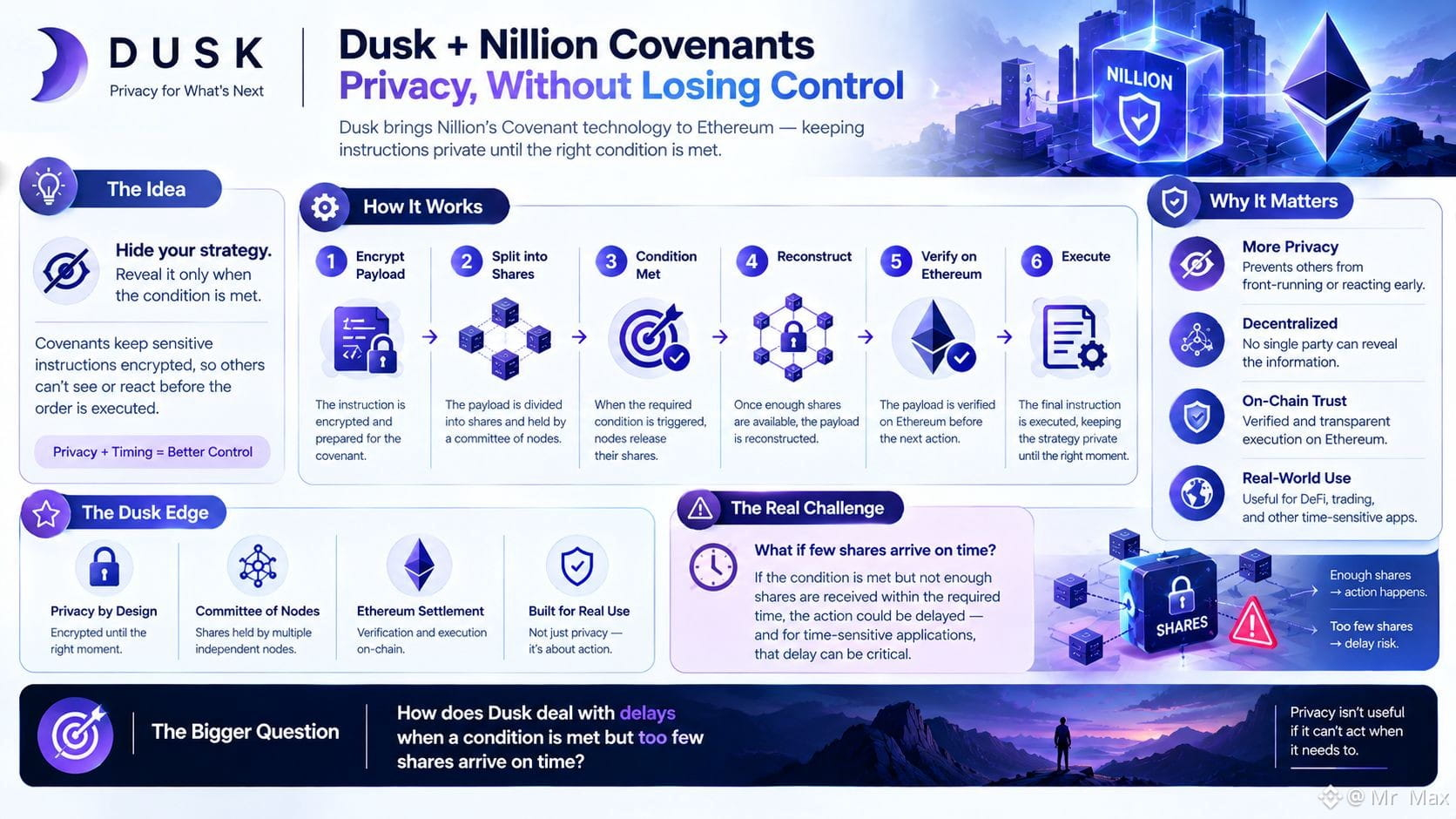
The idea is to keep instructions encrypted until a specific condition is met. But I think the real challenge is making that work without relying on one party to reveal the information at the right time.
Dusk brings this approach to Ethereum. According to Nillion, a Covenant’s encrypted payload is split into shares held by a committee of nodes. When the required condition is met, the nodes release their shares. Once enough are available, the payload can be reconstructed and verified on Ethereum before the next action takes place.
There’s one part I’m particularly curious about, though. What happens if the condition is met but enough shares don’t arrive in time? For applications that depend on timing, even a delay could become a real problem.
To me, privacy only goes so far if the application can’t act when it needs to. The way Covenants handle that trade off will be worth watching.
How does Dusk deal with delays when a condition is met but too few shares arrive on time?