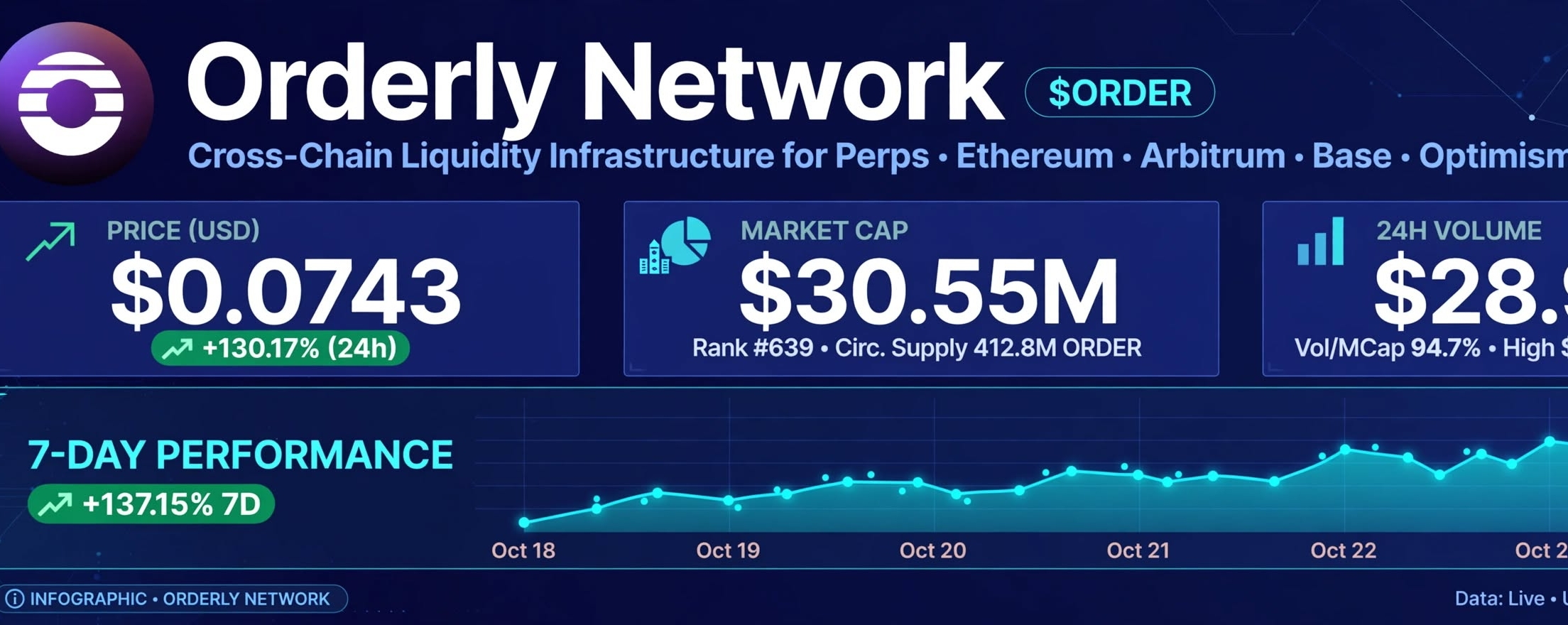

What is Orderly Network ($ORDER)?
Orderly Network is a permissionless, omnichain liquidity layer for Web3. In simple words, it's not just another DEX — it's the infrastructure behind DEXs.
Most DeFi trading today is fragmented. Liquidity is split across Ethereum, Arbitrum, Base, Optimism, Polygon, Solana and dozens of other chains. Traders get high slippage, builders have to build their own orderbook from scratch, and liquidity providers earn less.
Orderly solves this by combining:
A shared central limit orderbook (CLOB) across all chains
A high-performance matching engine
Unified liquidity — one orderbook that every integrated app can tap into
Any wallet, DEX, or dApp can plug in Orderly's SDK and instantly offer spot and perpetual futures trading with deep liquidity, without building their own exchange.
It was born out of the NEAR ecosystem and is built on Orderly Chain, a Layer 2 built on the OP Stack.
What is $ORDER Coin?
$ORDER is the native utility and governance token of the ecosystem.
Basic Info:
Ticker: $ORDER
Type: ERC-20 on Ethereum + Omnichain Fungible Token (OFT) on other chains
Max Supply: 1,000,000,000 ORDER
Circulating Supply: ∼400M+ (varies with unlocks/staking)
Mainnet: Orderly Chain + Ethereum
Utility of $ORDER:
Staking: Stake ORDER to earn VALOR, which gives you a share of protocol fees — paid in USDC. 30% of net protocol fees go to the treasury for stakers.
Governance: Stakers can vote on proposals via Snapshot on protocol upgrades, fees, and future direction.
Boost Rewards: Holding/staking boosts your share of trading rewards and market-making rewards.
Incentives: Aligns traders, builders, and liquidity providers with long-term growth.
How Orderly Works
A user trades on any app built on Orderly — e.g., a perp DEX on Base.
The order goes into Orderly's unified orderbook.
It gets matched against liquidity from all chains, not just Base.
Settlement happens fast and cheap via Orderly Chain.
Builders get: SDKs, orderbook, liquidity, and risk engine out of the box.
Traders get: CEX-like speed, low slippage, and no need to bridge funds constantly.
Pros of $ORDER
1. Real Infrastructure, Real Revenue: Unlike meme coins, Orderly earns real trading fees. More trading volume = more fees = more value for stakers.
2. Omnichain Narrative: The future is multichain. Orderly is positioned as the liquidity layer for that future — a bet on the whole ecosystem, not just one chain.
3. CEX-Level Performance in DeFi: Orderbook model, low latency, advanced order types like limit, stop-loss, etc. This is what professional traders want.
4. Strong Builder Adoption: Dozens of DEXs and trading apps are already building on it. The more builders, the more volume, the stronger the flywheel.
5. Low Market Cap vs Utility: Compared to larger infra projects, ORDER has historically traded at a relatively small market cap (∼$30M-$50M range in recent moves), giving it room for upside if adoption continues.
6. Staking Yield in USDC: You don't just get more ORDER — you get real USDC from fees. That's attractive for long-term holders.
Cons & Risks
1. High Competition: It's competing with Hyperliquid, dYdX, GMX, Vertex, and CEXs like Binance. The perp DEX space is brutal.
2. Token Unlocks & Supply Pressure: With 1B max supply, ongoing unlocks for team, investors, and incentives can create selling pressure if demand doesn't keep up.
3. Low Liquidity & High Volatility: $ORDER is a small-cap. It can pump 100%+ in 24h (as seen recently) and dump just as fast. Price is heavily sentiment-driven.
4. Dependence on Volume: If trading volume drops in a bear market, fee revenue drops too, which hurts staking rewards and token demand.
5. Complex Technology Risk: Omnichain settlement, bridges, and shared liquidity add technical complexity and smart contract risk.
6. Regulatory Risk: Perps are a regulated product in many countries. Future rules could affect Orderly's partners and users.
Future Outlook — What to Watch
Bullish Case:
If Orderly keeps onboarding new trading apps, expands to more chains (especially Solana and new L2s), and perp trading keeps moving on-chain, ORDER could become the default liquidity backend for DeFi. The recent volume spike shows it can re-rate very quickly when interest returns.
Bearish Case:
If Hyperliquid or other competitors dominate, or if volume dries up, ORDER could stay a niche infra token with limited price appreciation despite good tech.
Key things to track in 2026-2027:
Total trading volume on Orderly-powered apps
Number of new builders integrating Orderly
Fee revenue and VALOR staking APY
Token unlock schedule
Any major exchange listings or partnerships
Final Verdict
$ORDER is not a meme — it's a fundamental infrastructure play. It has real product, real fees, and a strong narrative around omnichain liquidity.
But it's also high-risk, high-volatility. It's best suited for people who understand DeFi infra, can handle 50-100% swings, and are betting on the long-term growth of on-chain perp trading.
Disclaimer: This is for educational/informational purposes only — not financial advice. Always DYOR and never invest more than you can afford to lose.?