

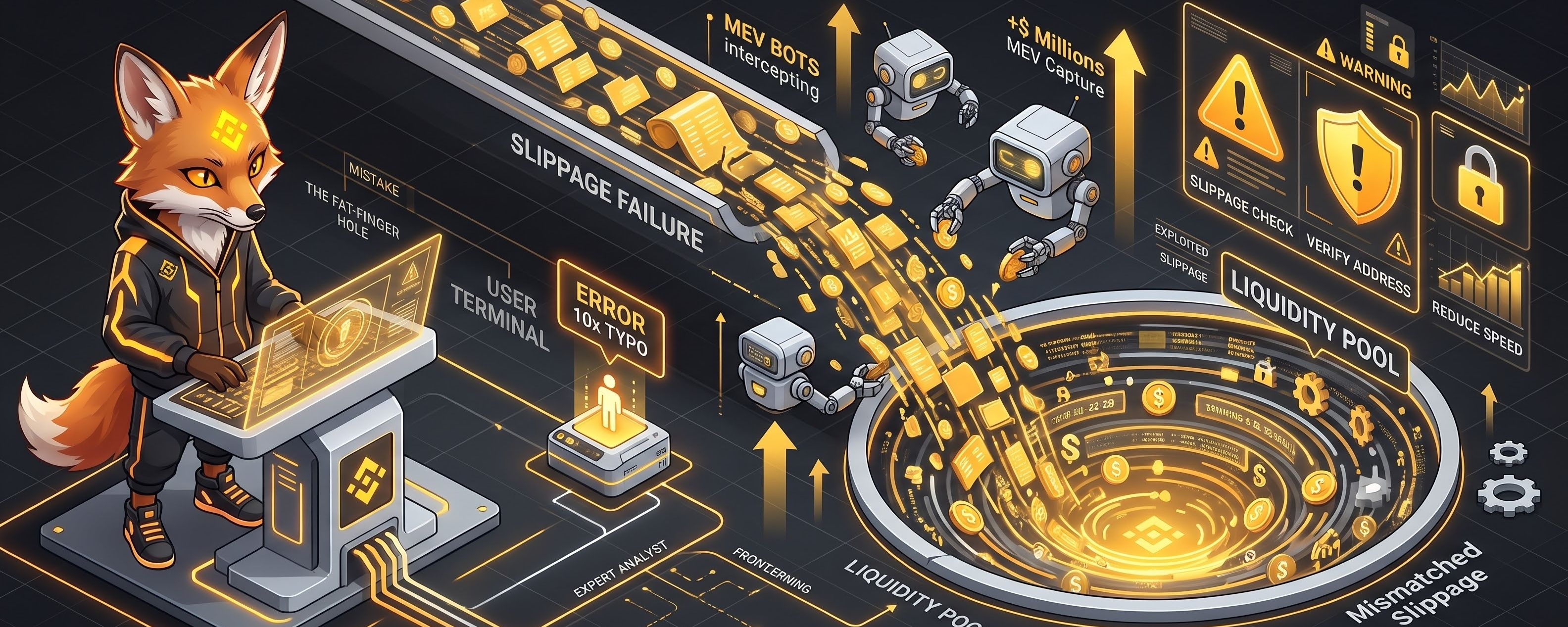


i woke up at 3:00 AM, my screen glowing against a pitch-black room, watching the kind of on-chain event that makes your heart sink—even when it isn't your capital on the line. Somewhere, in a high-stakes transaction that took less than thirty seconds, an address belonging to a high-tier participant routed a major liquidity movement directly through an unvetted pool. In the blink of an eye, what was supposed to be a standard portfolio rebalancing instead triggered a devastating slip, losing millions to MEV bots that instantly devoured the difference. My feeds are still on fire, half the community in absolute disbelief, while others are calling it a deliberate exploit or a botched transaction. But the cold, hard reality is much simpler, and far more terrifying: a single, micro-second human error can delete generational wealth in this space, with zero recourse.
Years ago, during my first major cycle, I had my own brush with a "fat-finger" near-miss. I was rushed, trading on too little sleep, tryng to secure a fast-moving allocation while panic-clicking between three different open browsers. I input an incorrect digit in a slip tolerance field, failing to verify the exact pool depth on a low-liquidity DEX. When I clicked confirm, I got incredibly lucky—the transaction failed because my gas limit was too low, but that brief panic taught me a lesson I have never forgotten: the blockchain is an unfeeling, automated machine that does not care about your intentions, your tiredness, or how many years it took you to earn your capital. It only cares about what you execute, and once you send a command, there is no support desk, no "undo" button, and absolutely no mercy.
What this latest millions-of-dollars disaster exposes isn’t a failure of the technology, but our own growing, dangerous complacency. As interfaces get sleeker, mobile apps make swapping look like a video game, and trading bots execute complex moves behind friendly "one-click" buttons, we forget the underlying complexity we are playing with. We treat highly experimental, multi-layered protocols like a traditional online banking app where a typo is just a minor inconvenience. But every time you sign a contract, interact with a bridge, or approve a custom swap limit, you are interacting directly with raw code. One tiny typo, one misunderstood slippage setting, or one lapse in focus is all it takes to trigger an irreversible liquidation of your life's work.
This is exactly why the most successful, veteran traders I know are agonizingly slow with their operations. They use multiple verify-before-send steps, test transaction protocols with small fractions first, and use entirely separate hardware environments for major moves. They are not chasing the fastest click; they are obsessing over the safest one. The market might feel like a fast-paced playground when the charts are trending green and everyone is making quick wins, but never forget that you are operating on a completely permissionless, adversarial network where a tiny slip is forever.
Stop rushing, verify every single decimal point, and treat every transfer with the absolute respect your hard-earned capital deserves. Speed is a terrible trade-off for survival.
Have you ever had a heart-stopping moment where you almost sent a transaction to the wrong address or set the wrong slippage? Drop your closest calls below—let’s remind everyone why double-checking is everything.
#Crypto #TradingStory #OnChain #RiskManagement #SecurityFirst