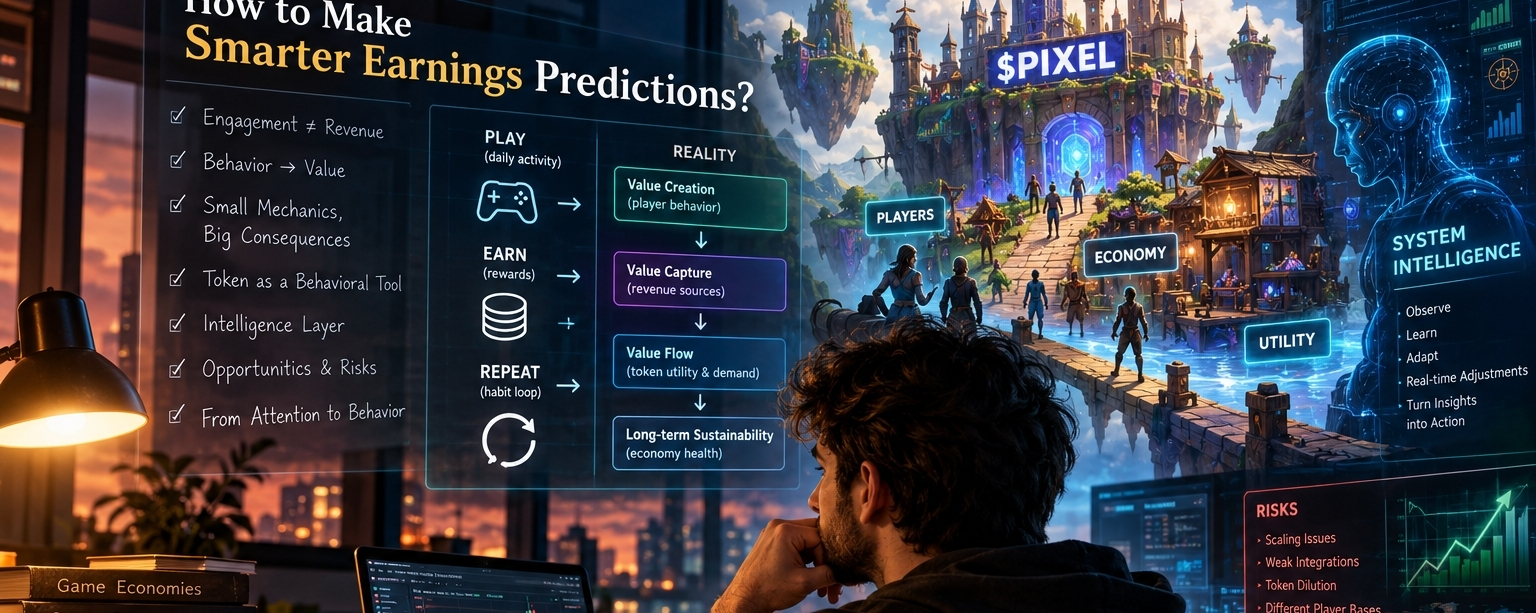


remember looking at a game economy one evening and feeling that something about the numbers no longer made sense. Players were logging in, completing familiar tasks, collecting rewards, and returning the next day. Nothing looked broken. The loop was simple enough to understand, and the activity seemed healthy. Yet I kept wondering whether the system was actually becoming stronger or whether people had simply learned how to extract value from it more efficiently.
That distinction has stayed with me. After spending years watching crypto markets, game economies, and the behavior surrounding digital ownership, I have become less interested in what a project says it will become and more interested in what people gradually learn to do inside it. Systems don't change loudly. They reshape behavior quietly.
At first glance, a game economy often looks straightforward: play, earn, repeat. It is an easy story to tell because every action appears to have a clear purpose. Complete a task, receive a reward. Spend a resource, unlock something useful. Return tomorrow and continue where you left off. But beneath that simplicity sits a more complicated arrangement of incentives, costs, and expectations.
The important question is not simply how much activity a game generates. It is what that activity produces, who captures the resulting value, and where the value goes afterward.
A player might spend an hour inside a game without generating meaningful revenue for its economy. Another player might spend ten minutes making a purchase that supports the entire system. Both count as active users, but their economic contributions are different. Even that comparison is incomplete, because the first player might attract friends, sustain a competitive community, or create demand for resources that other players purchase.
This is where earnings predictions become difficult. Surface-level metrics rarely tell the whole story. They describe what happened, but they do not always explain why it happened or whether the behavior can continue without increasingly expensive incentives.
I have started to think that the most useful signals often appear in small changes. Players begin completing the same activity in less time. They stop experimenting and settle into a narrow routine. A resource that once felt optional becomes necessary for progression. An ordinary feature quietly becomes part of a player's daily schedule.
Individually, these changes seem minor. Together, they can reshape the economy.
Efficiency, for example, has two sides. Better tools and smoother progression can make a game more enjoyable, helping players remain involved for longer. But greater efficiency can also reduce the amount of time required to earn rewards. If the economy depends on repetitive effort to sustain scarcity, a more efficient player base may eventually create pressure on reward values, resource demand, or the system's ability to absorb newly created supply.
The same behavior that improves retention can weaken an economic model if the incentives are poorly balanced.
I might be wrong, but I think this is where many earnings narratives become too confident. They treat engagement as if it naturally develops into revenue, and revenue as if it automatically becomes sustainable growth. In reality, each transition has to be earned. Players can remain active while spending less. Transactions can increase while margins shrink. A growing community can coexist with an economy that distributes rewards faster than it captures value.
This is also why I pay attention to the intelligence layer surrounding a digital economy. Not because artificial intelligence automatically makes a project more valuable, but because systems that can interpret behavioral data and translate it into operational decisions may respond to changes more quickly.
Imagine a system that observes where players abandon a task, which resources become bottlenecks, how spending changes after an update, and which incentives bring people back without creating excessive reward dependence. If that information feeds directly into economic adjustments, the distance between observation and action becomes shorter.
The result could be a more adaptive economy. Developers might identify weakening demand earlier, adjust progression before frustration spreads, or recognize when a reward structure is encouraging repetitive behavior rather than genuine participation.
Still, intelligence is not the same as understanding. A system can optimize a measurable outcome while damaging something harder to quantify. It can increase session length without improving satisfaction, or encourage transactions that players later regret. Faster feedback loops are useful only when the objectives being optimized are sensible.
For earnings predictions, I would want to know whether this intelligence layer improves the relationship between player behavior and economic output. Does it reduce wasted incentives? Does it help convert existing demand into recurring revenue? Does it improve the experience enough that players choose to return without needing a constant stream of rewards?
Those questions matter more than the presence of an AI label.
Following the money requires another step. Engagement metrics are evidence of attention, not proof of income. Daily active users, session length, repeat visits, and retention can indicate whether a community is developing habits. Actual economic value depends on what happens next: purchases, transaction fees, marketplace activity, subscriptions, licensing, or other revenue-generating actions.
Even then, gross activity can be misleading. A marketplace may process substantial volume while producing limited net revenue. Incentives may create transactions that would not otherwise occur. Token rewards may temporarily support participation while increasing future selling pressure.
I prefer to examine the entire path from behavior to revenue. A player encounters an incentive, develops a routine, finds a resource useful, and eventually spends money or contributes to an economic activity that generates income. The system captures a portion of that value and uses it to fund operations, development, or further participation.
If that path becomes more consistent over time, the earnings case becomes more credible. If it depends on increasingly aggressive rewards, the apparent growth may be less durable than it looks.
The token layer introduces another complication. A token such as $PIXEL should not be understood only as a reward handed to players. Within a functioning economy, it can influence decisions about spending, progression, trading, and participation. Its economic role depends on what people need it for, how often they use it, and whether demand extends beyond the act of receiving it.
Velocity matters here. A token that moves rapidly through an economy may support considerable activity, but rapid circulation does not necessarily mean strong value retention. Players might acquire tokens, spend them immediately, and create little reason for anyone to hold them. Alternatively, several useful activities might create overlapping demand, with the same token serving different purposes across the ecosystem.
That can make the economic picture more interesting, but also harder to interpret.
Multiple uses do not automatically create multiple sources of sustainable demand. If every activity ultimately depends on the same limited group of players, the system may be less diversified than it appears. If integrations introduce genuine utility, bring different participants into the economy, and create reasons to transact that would not otherwise exist, the token may occupy a more durable position.
The difference is subtle, but important.
I would also be careful about dilution. An economy can appear active while continually introducing new rewards that exceed the growth of meaningful demand. Strong participation today does not eliminate the possibility of weaker incentives tomorrow. Similarly, an integration that looks impressive on paper may contribute little if its users do not remain active or if its economic incentives conflict with those of the existing community.
Different player bases create different kinds of fragility. Competitive players may care about progression and status. Casual players may value convenience and social interaction. Economically motivated participants may focus on efficiency and resale opportunities. A system that serves one group exceptionally well can unintentionally make the experience less attractive to another.
These differences affect retention, spending, resource prices, and ultimately revenue quality. They also make simple extrapolations dangerous. A strong month does not necessarily establish a reliable earnings trajectory, particularly when activity is influenced by seasonal interest, token incentives, or temporary changes in market sentiment.
For me, smarter predictions begin with uncertainty rather than a target number. I would rather understand the relationship between retention, spending, resource demand, token circulation, and net revenue than build a forecast around a single growth percentage. I would look for evidence that the economy can sustain participation without continually increasing its dependence on incentives.
I would also separate what is observable from what remains an assumption. Rising transaction volume is observable. The claim that it will produce lasting profitability is an interpretation. Increasing token utility may be measurable. The assumption that this utility will translate into stronger token demand needs further evidence.
This distinction becomes increasingly important as gaming, crypto infrastructure, and automated decision-making begin to overlap. The industry seems to be moving from competing for attention toward learning how to influence behavior. Marketing expenditure increasingly sits beside questions about customer retention, lifetime value, and capital allocation. Games themselves can become economic infrastructure, coordinating transactions, ownership, and incentives rather than simply providing entertainment.
That transition could create meaningful opportunities. It could also make ordinary human behavior easier to measure, predict, and manipulate.
I find myself returning to the same uncomfortable question: when a system becomes exceptionally good at anticipating what people will do, does it give them more freedom or simply become better at directing their choices?
An efficient economy is not necessarily a healthy one. A profitable game is not necessarily a satisfying one. And a token with many uses is not necessarily a token that people genuinely need.
Perhaps the most useful earnings prediction is not the one that produces the most precise number. It is the one that helps distinguish durable economic behavior from activity that exists only because the system keeps paying for it.
I still watch the numbers, of course. But I pay more attention now to what changes around them: the habits players develop, the reasons they return, the resources they begin to value, and the incentives they eventually stop noticing.
Those details can reveal the direction of an economy before its headline metrics make the change obvious.
Whether that direction ultimately produces sustainable earnings is another question. The system may become more efficient, more profitable, and more capable of responding to its participants. Yet somewhere along the way, the boundary between serving behavior and shaping it can become difficult to see.
Perhaps that is the real challenge in predicting the future of digital economies. Not simply understanding how much value a system can capture, but asking what kind of behavior it must create to capture it, and what remains of the experience once every action has an economic purpose.