
Introduction: Traditional Markets Are Going On-Chain
Crypto users have spent years trading digital assets around the clock. But what if the same crypto-native experience could extend to traditional equities?
That idea is becoming increasingly relevant as tokenized stocks connect conventional financial markets with blockchain-based infrastructure.
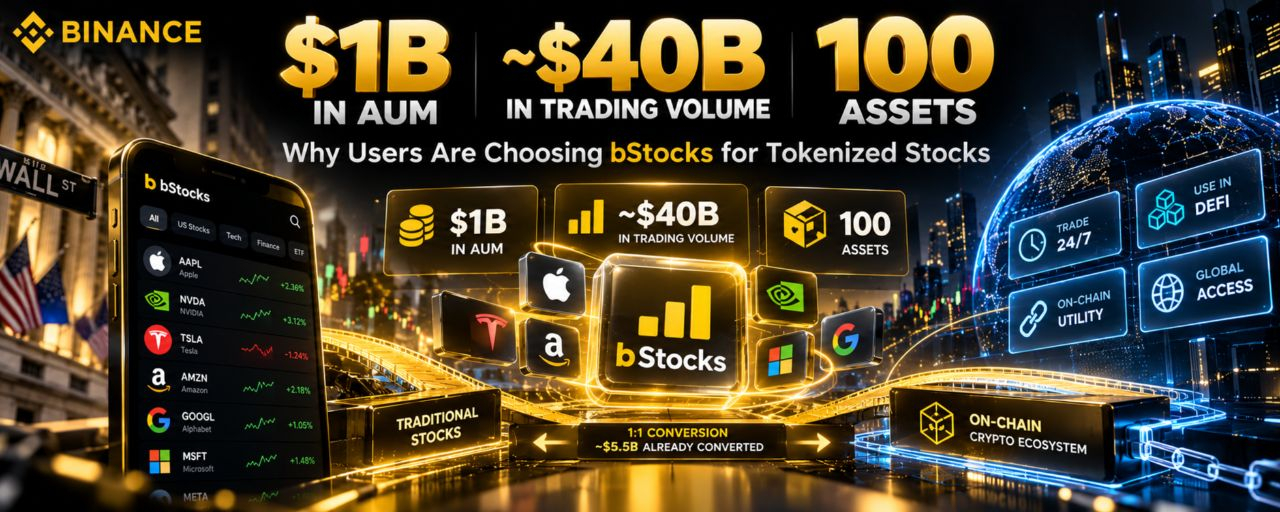
One product gaining attention is bStocks, which has reached a major milestone: $1 billion in assets under management (AUM), approximately $40 billion in cumulative trading volume, and 100 available bStocks assets.
These numbers tell an important story. Users are not simply exploring tokenized stocks as a new concept. The market is developing around capital allocation, trading activity, asset diversity, and the ability to move between different financial environments.
But the bigger question is not how much volume bStocks has generated. It is why this model could matter for the next generation of financial markets.
1. $1 Billion in AUM: Capital Is Finding a Home
Assets under management measure the value of assets held within a product at a given point in time.
For bStocks, reaching $1 billion in AUM represents a significant milestone in its development as a tokenized-stock offering.
However, AUM alone does not tell the whole story. A large number could reflect concentrated holdings in a small number of assets or a limited group of users.
A more complete picture considers how capital is distributed across users and assets.
A diversified distribution can indicate broader participation and demand across multiple investment opportunities. Combined with user growth and activity across different assets, it offers a more useful view of adoption than a single headline figure.
For users, the appeal is straightforward: tokenized stocks offer another way to access traditional equity exposure through a crypto-native environment.
The milestone is meaningful, but sustained adoption will depend on liquidity, product accessibility, transparency, and the ability to serve users' needs over time.
2. Approximately $40 Billion in Trading Volume: Beyond Holding Assets
If AUM measures the capital held in a product, cumulative trading volume measures how much trading activity has passed through it.
bStocks has recorded approximately $40 billion in cumulative trading volume.
That distinction matters.
Some investors buy assets and hold them. Others actively trade around changing market conditions. A product that supports both behaviors can serve a wider range of market participants.
Trading volume also needs context. Cumulative volume is not the same as current daily activity, unique users, or net capital inflows. The same capital can be traded multiple times.
Nevertheless, when considered alongside AUM, the figure provides another perspective on how the product is being used.
Capital shows what users hold. Trading volume shows how actively they trade. Both matter when evaluating adoption.
3. One Hundred Assets: More Choice Across Traditional Markets
A broader selection of assets gives users more opportunities to explore different companies and investment themes.
With 100 bStocks assets offered, users have access to a wider range of tokenized-stock choices within the product.
This matters because investors rarely have identical objectives.
Some may want exposure to established technology companies. Others may prefer different industries or want to diversify their equity exposure rather than concentrate on one company.
A wider asset selection can help accommodate those preferences.
However, more assets do not automatically mean better diversification. Investors still need to understand the underlying exposure, concentration risks, trading costs, and applicable product restrictions.
The important development is that tokenized-stock products are expanding beyond a single-asset experiment toward a broader market experience.
4. The Differentiator: Approximately $5.5 Billion Converted 1:1 to Direct Stocks
Perhaps the most distinctive part of the bStocks model is its conversion mechanism.
Approximately $5.5 billion has already been converted between bStocks and Direct Stocks through the 1:1 conversion mechanism described for the product.
Why does this matter?
Traditional stock markets and blockchain-based markets operate through different infrastructure. Moving between them can involve separate processes, restrictions, costs, and settlement arrangements.
A conversion mechanism designed to connect tokenized stocks with Direct Stocks offers a bridge between those environments.
For users, that can mean greater flexibility in how they access supported equity exposure, rather than treating tokenized holdings and traditional stocks as completely separate destinations.
The reported $5.5 billion conversion figure is particularly notable because it highlights activity beyond simply buying and holding tokenized assets.
It suggests that interoperability between financial environments is an important part of the product proposition.
That said, conversion eligibility, timing, fees, and restrictions depend on the applicable product rules. A 1:1 conversion ratio does not by itself guarantee identical execution prices, immediate settlement, or unrestricted access for every user.
5. Adoption Beyond AUM and Trading Volume
The next stage of tokenized-stock adoption depends on more than headline numbers.
Three additional indicators deserve attention.
Utilization rates: How much of the available capital is actually being put to use? Capital deployed in supported activities can reveal utility beyond assets simply being held.
On-chain activity: Are tokenized assets participating in blockchain-based financial applications? Depending on the product's supported integrations, activity may extend into collateral use, lending, and other decentralized finance applications.
User and asset distribution: Is participation expanding across a broader group of users and investment choices, or is activity concentrated among a few large participants?
These indicators help distinguish between capital accumulation and deeper product usage.
A tokenized asset becomes more interesting when it can do more than represent exposure to a traditional financial instrument. Subject to its design and restrictions, it may also become part of a broader digital financial workflow.
That is the opportunity behind the convergence of tokenization and crypto-native infrastructure.
6. Why This Matters for the Future of Finance
The growth of bStocks reflects a broader shift in what some crypto users want from financial products.
They want access to traditional markets without abandoning the convenience and flexibility of digital financial infrastructure.
They want more asset choices, the ability to trade within supported market hours, and potentially new ways to use their holdings across compatible financial applications.
Tokenization does not eliminate the risks of traditional equities, nor does it automatically provide every feature associated with directly owning a stock. Product structure, legal rights, custody arrangements, liquidity, and jurisdictional availability remain important considerations.
Still, the direction is clear: the boundaries between traditional financial products and blockchain-based markets are becoming increasingly connected.
The strongest products will not necessarily be those with the most tokens or the largest headline numbers. They will be the ones that combine useful access, reliable infrastructure, meaningful utility, and flexibility that users can understand.
Conclusion: The Next Milestone Is Utility
bStocks has reached $1 billion in AUM, approximately $40 billion in cumulative trading volume, and 100 available assets. Approximately $5.5 billion has also been converted between bStocks and Direct Stocks through its 1:1 conversion mechanism.
Together, these figures provide several perspectives on adoption: capital held, trading activity, asset choice, and movement between financial environments.
But the longer-term opportunity goes beyond reaching another numerical milestone.
The real test is whether tokenized stocks become useful financial assets—not just digital representations of traditional equities.
If tokenized stocks can combine accessible market exposure, meaningful on-chain utility, and flexible connections to traditional financial infrastructure, they could become an important part of the evolving digital economy.
For users, the question is no longer just whether stocks can be tokenized. It is how much more useful financial assets can become when traditional markets and blockchain infrastructure work together.
Disclaimer: This article is for informational and educational purposes only and does not constitute financial or investment advice. Tokenized-stock products may involve market, liquidity, counterparty, custody, regulatory, and technology risks. Product eligibility, conversion terms, and availability vary by jurisdiction. Verify the applicable product documentation before participating.
#Binance #BStocks #TokenizedStocks #RWA #REALWORLDASSET