

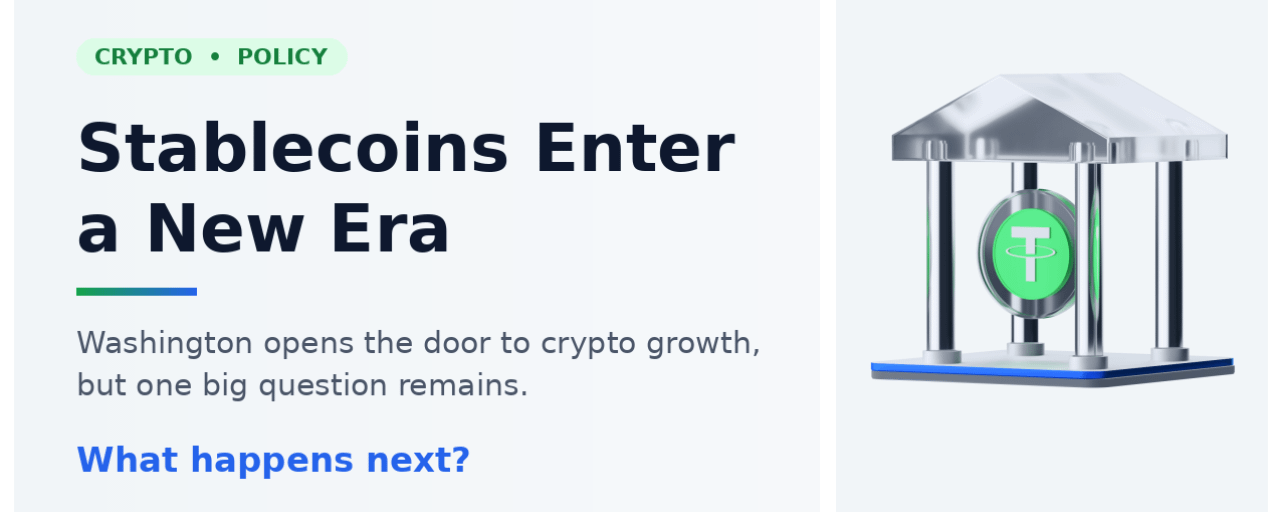

The United States has taken another major step toward bringing digital dollars into the financial mainstream. But as regulators provide clearer rules for stablecoins, the battle over customer rewards could shape the industry's next chapter.
For years, the crypto industry has faced a problem that technology alone could not solve: regulatory uncertainty.
Companies could build faster payment systems, launch dollar-pegged digital tokens, and attract millions of users, yet a fundamental question remained unanswered: How far would regulators allow the industry to go?
Now, that picture is beginning to change.
On October 21, the U.S. Office of the Comptroller of the Currency (OCC) finalized rules implementing the GENIUS Act, the landmark stablecoin legislation signed into law in July 2025. The rules establish a clearer framework for eligible stablecoin issuers, reserve management, redemptions, and risk controls. They are scheduled to take effect on January 18, 2027.
For the crypto industry, this is more than another regulatory announcement. It could mark a turning point in how digital dollars operate within the world's largest financial market.
But the most interesting part of the story is not simply what regulators approved. It is what they decided not to prohibit outright.
Why This Decision Matters Beyond Crypto
Stablecoins are digital assets designed to maintain a relatively stable value, usually by tracking a traditional currency such as the U.S. dollar. Unlike Bitcoin, whose price can change dramatically within hours, dollar-pegged stablecoins are designed to stay close to $1.
That makes them useful for moving money between exchanges, settling transactions, transferring funds across borders, and holding dollar-denominated value without relying on conventional payment systems for every transaction.
Their importance is growing because crypto markets need reliable digital money. Traders use stablecoins to enter and exit positions, businesses can use them to move funds, and payment providers are exploring blockchain-based settlement systems.
However, widespread adoption requires more than convenience. Users need confidence that the tokens they hold can actually be redeemed and that the reserves supporting them are properly managed.
The OCC's final rule addresses this challenge by maintaining core safeguards, including one-to-one reserve backing, liquidity requirements, counterparty exposure limits, and stress-testing obligations. It also gives issuers greater flexibility in managing certain reserve assets.
The underlying message is clear: regulators are creating a framework in which stablecoins can develop, but issuers must operate within defined financial and supervisory boundaries.
The Real Battle: Who Gets to Earn From Digital Dollars?
Here is where the story becomes particularly interesting.
Stablecoin issuers can earn income from the assets backing their tokens, including eligible bank deposits and U.S. Treasury securities. Yet the GENIUS Act prohibits permitted payment stablecoin issuers from paying interest directly to holders simply for holding their stablecoins.
Crypto platforms have argued that rewards programs can still be offered through exchanges and other intermediaries. Traditional banks, meanwhile, have pushed for tighter restrictions, warning that attractive stablecoin rewards could encourage customers to move money away from bank deposits.
The OCC's final rule did not adopt a proposed blanket restriction on certain third-party reward arrangements. Instead, it will assess these arrangements individually, based on their specific facts and circumstances.
That distinction could prove significant.
It leaves room for some crypto platforms to continue offering interest-like rewards while giving regulators authority to challenge arrangements that violate or evade the law. Existing programs are not automatically guaranteed approval.
For crypto companies, the decision preserves a potential competitive advantage. For banks, it leaves a source of uncertainty that they wanted regulators to eliminate.
And for consumers, it raises a practical question: If digital dollars can offer both convenient payments and financial rewards, why keep all your money in a traditional account?
The answer will depend on the actual terms, risks, protections, and reliability of each option. A stablecoin reward is not automatically equivalent to an insured bank deposit, and users should never confuse a token designed to maintain a $1 value with a guarantee that every platform or product is risk-free.
Circle and Coinbase Could Be Among the Companies to Watch
The regulatory shift could have implications for companies positioned at the intersection of stablecoins and crypto trading.
Circle, the issuer of USDC, and Coinbase, a major crypto exchange that offers USDC-related products, welcomed the OCC's final rules. Their businesses operate in different parts of the stablecoin ecosystem, but both have an interest in the development of a more predictable U.S. regulatory environment.
Clearer requirements could help established companies plan new products, build relationships with financial institutions, and compete for customers who have been reluctant to use digital assets.
The rules could also make the market more attractive to new entrants. Businesses considering stablecoin issuance may be better able to evaluate the licensing, reserve, and compliance requirements before committing capital.
However, regulatory clarity does not guarantee higher revenue, greater adoption, or rising stock prices. Companies will still need to demonstrate sound operations, manage costs, meet compliance obligations, and earn customer trust.
Investors should distinguish between a genuine improvement in a company's long-term business prospects and a short-term market reaction to favorable headlines.
Could Stablecoins Challenge Traditional Banking?
This is the question that explains why the debate has become so intense.
Traditional banks collect deposits and use funding to support lending and other financial activities. If customers begin shifting substantial balances into stablecoins or crypto-platform products, some banks could face higher funding costs or pressure on their deposit bases.
Banks argue that crypto platforms should not be allowed to offer bank-like rewards without comparable safeguards. Crypto companies counter that competition should encourage better products and more efficient financial services.
Both sides have legitimate concerns.
A poorly supervised stablecoin market could expose customers to operational failures, reserve problems, or redemption stress. But overly restrictive rules could also limit competition and slow the development of potentially useful payment infrastructure.
The challenge for regulators is to protect financial stability without unnecessarily preventing innovation.
The OCC's decision does not settle that debate. Instead, it leaves the rewards question open to case-by-case supervision, while retaining the core requirements designed to support stablecoin backing and redemption.
The impact on bank deposits will depend on how quickly stablecoins grow, how attractive competing products become, and how consumers choose to manage their money.
What This Means for the Crypto Market
The most important long-term implication may be a shift in how stablecoins are perceived.
Stablecoins are no longer just a convenient tool for traders moving between volatile cryptocurrencies. They are increasingly part of a broader discussion about payments, financial infrastructure, cross-border transfers, and the future relationship between banks and blockchain networks.
A clearer regulatory framework could support that transition by reducing uncertainty for legitimate businesses and providing a more defined set of operating standards.
It could also increase competition. New issuers may enter the market, established firms may expand their offerings, and banks may develop or support their own digital-dollar products.
Yet there is an important distinction between regulatory progress and an immediate crypto bull market.
The new rules do not directly guarantee higher Bitcoin prices, rising altcoins, or a fresh wave of speculative buying. Any market impact will depend on adoption, liquidity, company earnings, broader economic conditions, and how the remaining regulatory questions are resolved.
For traders, the announcement is a development to monitor—not a standalone buy signal.
For long-term investors, the more useful question is whether stablecoin usage translates into sustainable economic activity, stronger payment networks, and viable businesses.
What Happens Next?
The OCC's final rule and the GENIUS Act are scheduled to take effect on January 18, 2027. Further regulatory work remains, including separate treatment of anti-money-laundering and sanctions requirements, while other agencies continue implementing their parts of the broader framework.
The market will also be watching how regulators evaluate stablecoin reward programs and whether their approach provides consistent guidance to issuers, exchanges, and financial institutions.
That process matters because rules on paper are only the beginning. Their real influence will emerge through licensing decisions, supervision, enforcement, and the willingness of businesses and customers to adopt the resulting products.
The Bigger Picture
The stablecoin industry has spent years trying to prove that digital dollars can be more than instruments for crypto trading. They could become part of the infrastructure used to move money across an increasingly digital economy.
The OCC's decision brings that possibility into sharper focus, while leaving important questions about rewards and banking competition unresolved.
The next phase of stablecoin growth may not be decided by technology alone. It could depend just as much on who earns the right to issue digital dollars, who can offer customers compelling products, and how regulators balance competition with financial safety.
The real story is not that stablecoins have become risk-free. It is that the rules governing their future are becoming more defined—and the companies that adapt successfully could help shape the next generation of digital finance.