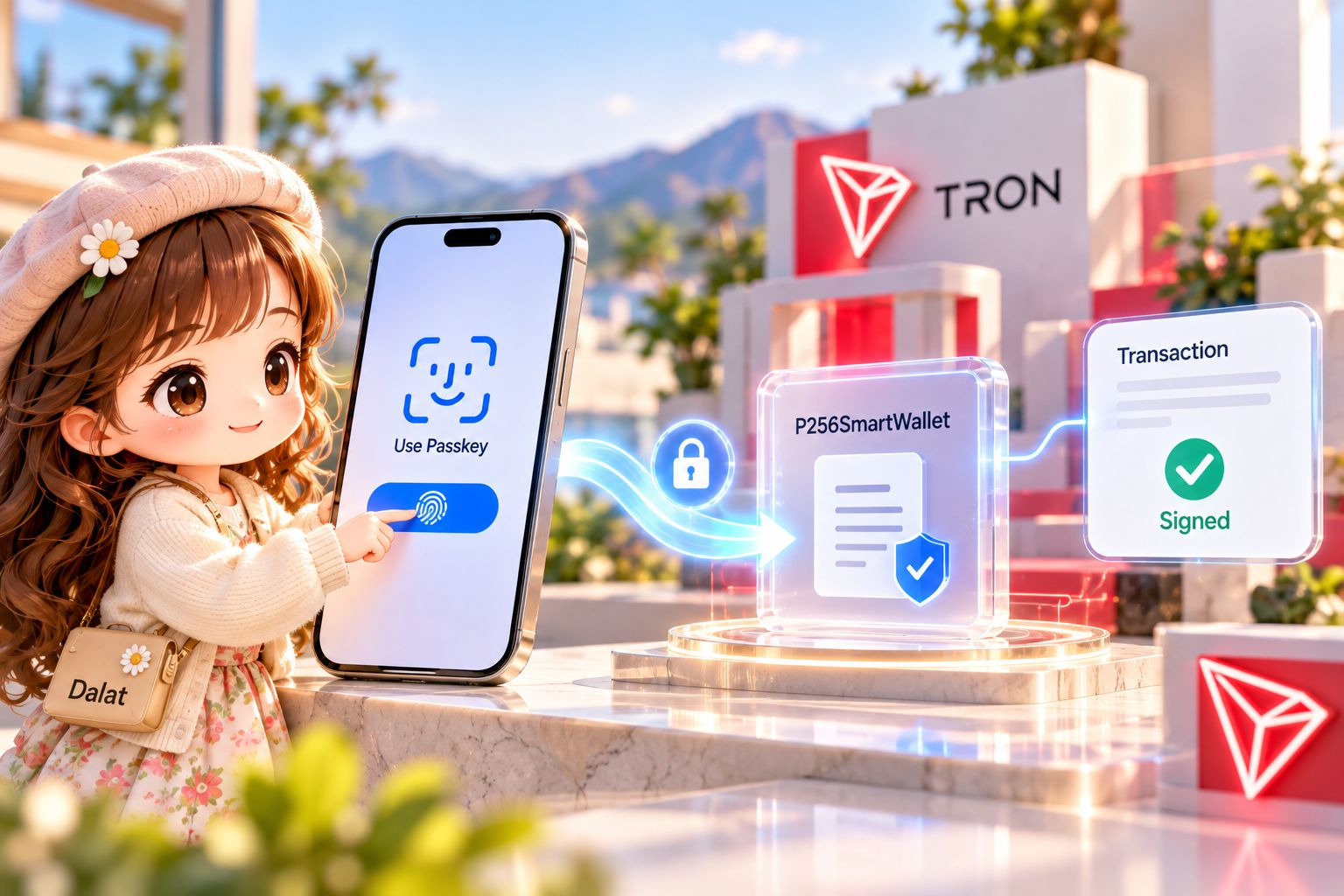
➤ What a passkey actually signs, and why the challenge binding is the whole design
🛠️ TRON DAO has published a developer guide on signing TRON transactions with a passkey. It shows how TRON's P256VERIFY precompile lets wallets replace the twelve-word seed phrase ritual with Face ID, Touch ID or a fingerprint, using a passkey the user's phone already knows how to back up. The reference implementation builds a smart wallet on Nile that is authorised by a passkey.
🔍 The problem begins with curves. TRON accounts use secp256k1, the curve Bitcoin chose and Ethereum inherited. The secure chips in phones and laptops, Apple's Secure Enclave and Android's Keystore, use secp256r1, known as P-256. A signature on one curve does not validate on the other, so a passkey, however securely stored, cannot directly sign a native TRON transaction.
🧮 How the guide bridges that gap:
▫️ P256VERIFY is a precompile, a function built into the virtual machine at the fixed address 0x100, verifying P-256 signatures as native code.
▫️ Implementing the curve maths in Solidity would work in principle but cost so much that nobody would use it; the precompile makes verification practical.
▫️ The passkey never controls a TRON account directly. It controls a smart contract, which checks P-256 signatures and acts on the user's behalf.
📊 The guide's most important insight concerns what is signed. A passkey does not sign the transaction. It signs a structure containing authenticatorData and the hash of clientDataJSON, and the operation travels inside clientDataJSON as the "challenge." A valid signature therefore proves only that someone holds the key. Security comes from the contract checking that the expected operation digest appears at the right position inside the signed data. Drop that check and any signature the user ever produced on the same domain could authorise anything. The digest also includes the wallet address and chain id, preventing replay across wallets and chains.
🧮 Design choices the guide flags:
▫️ Synced passkeys can be recovered via cloud backup; device-bound ones cannot. The contract cannot tell them apart.
▫️ The domain (rpId) determines the credential and public key, which is fixed in the wallet contract, so it must be chosen before deployment.
▫️ The demo wallet has one immutable key and no recovery path; production designs need key rotation or social recovery.
▫️ Someone must pay Energy to execute operations, so fee abstraction via a relayer is required in production.
🌐 The guide notes the precompile is live on Nile testnet and Mainnet. For TRON, which already moves large stablecoin volumes, removing the seed phrase from the first-time experience could matter as much as any performance gain.
⚠️ This is developer-oriented; the reference code is intentionally not production-ready. Never use a mainnet key in test setups.
🛡️ Use only the official TRON DAO reference repository and documentation; ignore unofficial "passkey wallet" apps until they are audited.
🔗 A passkey proves who is present; binding the operation to its challenge proves what they approved. That second check is what makes a fingerprint as meaningful as a signature.
@justinsuntron @TRON DAO #TRONEcoStar