


Understanding price movement is one of the most important skills in crypto trading. While many traders focus on indicators and price predictions, some of the most useful information comes directly from the chart.
Support and resistance are two basic concepts that help traders identify important price areas, understand market reactions, and plan their trades more carefully.
However, these levels are not guarantees. The key is to understand how price behaves around them.
What Is Support?
Support is a price area where buying interest may be strong enough to slow down a decline or push the price higher.
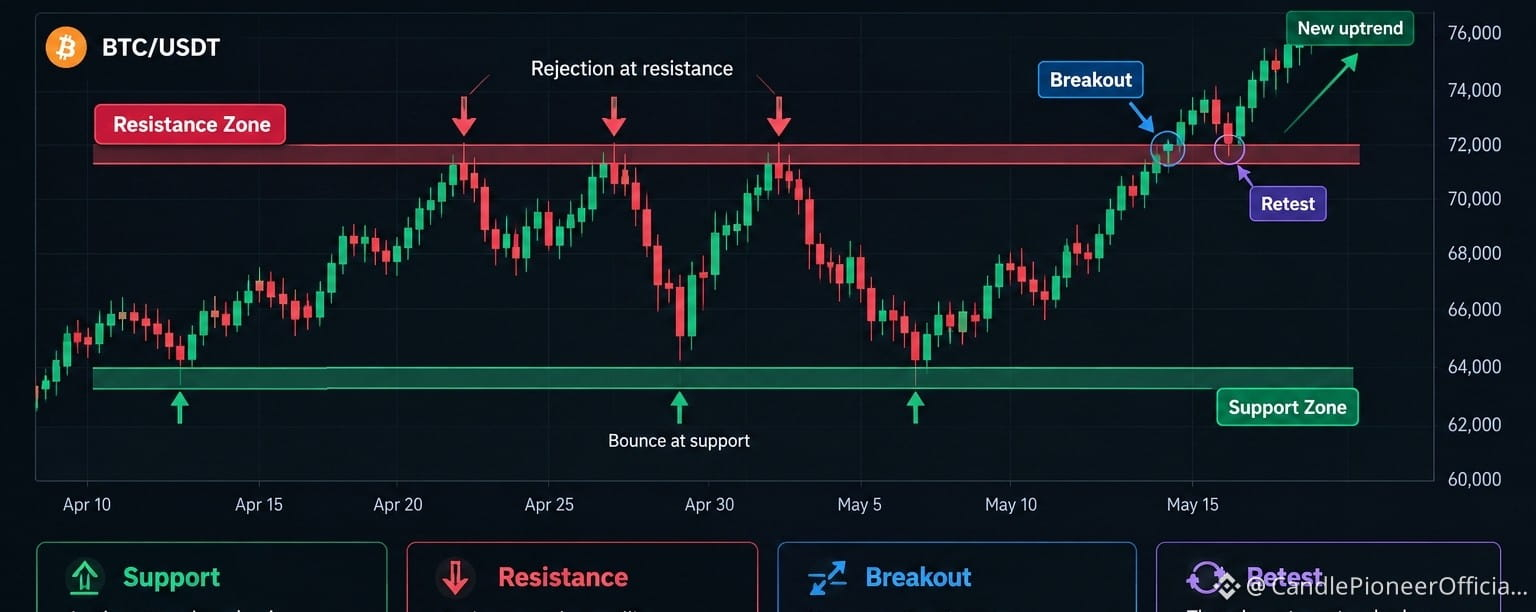
For example, if a cryptocurrency falls toward $65,000 several times but recovers each time, that area may be acting as support. Buyers may be showing interest there, preventing the price from moving lower for the time being.
Support does not mean the price cannot fall further. If selling pressure increases, the market may break below the zone.
What Is Resistance?
Resistance is the opposite of support. It is an area where selling pressure may slow an upward move.
Imagine Bitcoin approaches $72,000 on several occasions but struggles to move higher. This repeated reaction may indicate that sellers are active around that price.
If buyers eventually overcome the selling pressure, the price may break above resistance and continue rising.
The important point is that support and resistance show areas of interest, not guaranteed reversals.
How to Find Important Levels on a Chart?
You do not need a complicated strategy to start identifying these zones. Begin with the price chart and focus on how the market has reacted in the past.
1. Study previous price reactions
Look for areas where the price has repeatedly bounced upward or turned lower.
2. Mark the key zones
Use horizontal lines or shaded areas to highlight important price regions. Avoid marking every minor movement because too many levels can make a chart confusing.
3. Observe the next reaction
When the price returns to a marked zone, pay attention to whether buyers or sellers appear to take control.
4. Wait for confirmation
A level alone is not a trading signal. Look for a clear reaction, a suitable price structure, or other confirmation before considering a trade.
One more thing to remember: support and resistance are usually zones rather than exact prices. The market rarely respects every level to the last decimal.
A Practical Example
Suppose a coin is trading at $100, with support around $95–$97 and resistance around $105–$107.
If the price approaches support and shows a convincing bullish reaction, traders may watch for a potential long setup. If it reaches resistance and sellers begin to take control, a short setup may become worth evaluating.
Neither scenario is confirmed simply because the price touches the zone.
If the price breaks below support or above resistance, the original trading idea may need to be reassessed. Rather than forcing a trade, it is often better to wait for the market to provide clearer information.
These prices are hypothetical and are used only to explain the concept.
Breakouts and Retests: What Traders Should Watch
A breakout occurs when the price moves beyond an established support or resistance zone.
A move above resistance may indicate increasing buying pressure, while a move below support may signal stronger selling pressure. However, a breakout can fail.
Sometimes the price moves beyond a level briefly and then returns to its previous range. This is known as a false breakout.
One approach traders use is to wait for a candle to close beyond the zone or look for a retest.
A retest occurs when the price returns to the level it has just broken. For example, former resistance may act as support after an upward breakout. If the price holds that area, it may strengthen the breakout idea. If it fails, the market may move back into its previous range.
No confirmation method eliminates risk, but patience can help traders avoid reacting to every sudden price movement.
Common Mistakes to Avoid:
Support and resistance may look simple, but using them effectively requires discipline.
Some common mistakes include:
- Treating every support level as a guaranteed buying opportunity.
- Opening a position immediately after the price touches a zone.
- Ignoring the broader market trend.
- Drawing too many levels and making the chart difficult to read.
- Entering a trade without deciding where the setup becomes invalid.
- Using excessive leverage or increasing position size after a loss.
A strong trading approach is not about predicting every move. It is about recognizing opportunities while understanding what could go wrong.
Risk Management Comes First:
Even a carefully planned setup can fail. That is why risk management should be considered before entering a position.
A stop loss can help define the point at which a trading idea is no longer valid, although it cannot guarantee an exact exit price in fast-moving markets.
Position size should reflect the amount you are prepared to lose, not simply how confident you feel about a trade. It is also useful to compare the potential reward with the potential risk before entering.
For futures traders, extra caution is necessary because leverage magnifies losses as well as gains and can lead to liquidation.
The goal is not to win every trade. The goal is to follow a consistent process and protect your capital over time.
Final Thoughts:
Support and resistance provide a useful framework for reading the crypto market. They help traders identify important price zones, observe buying and selling pressure, and plan possible entries and exits.
Their real value comes from how the price reacts around them, not from the lines themselves.
Instead of assuming that a level will hold, consider both possibilities: what happens if the price respects it, and what happens if it breaks?
That simple habit can lead to more disciplined decisions and a better understanding of market behavior.
What do you usually look for before trading a support or resistance zone: a strong price reaction, a candle close, or a successful retest? Share your approach in the comments.
For educational purposes only. This article is not financial advice. Always do your own research and manage your risk carefully.