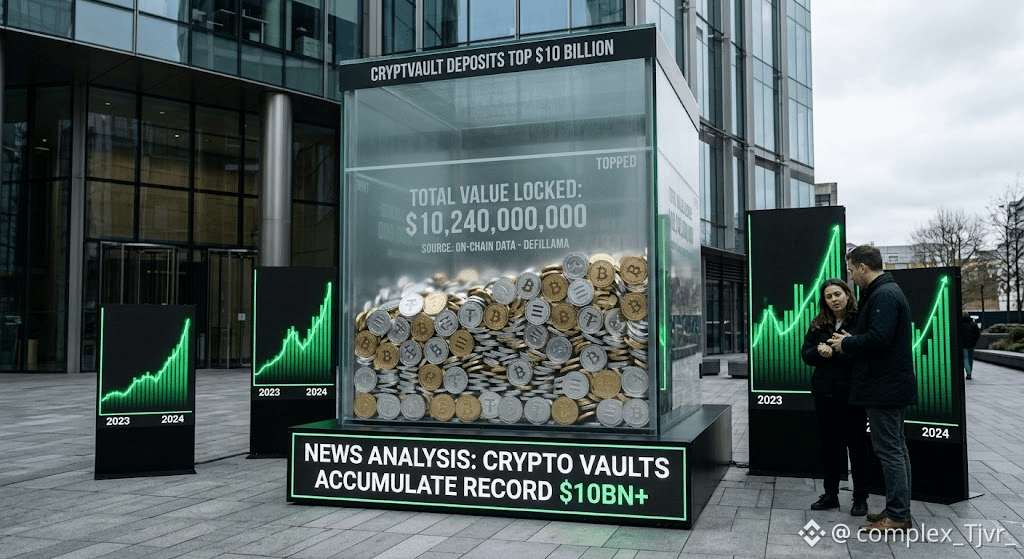
T$BTC

#CryptoVaultDepositsTop$10Billion he milestone of crypto lending vault deposits reaching and surpassing $10 billion reflects a major shift in the Decentralized Finance (DeFi) ecosystem.
Below is a structured breakdown and analysis of this milestone based on the latest industry data reported by Blockworks, Financial Times, and S&P Global.
1. Summary of the News
The Milestone: Total capital locked in crypto lending vaults jumped from approximately $4 billion to over $10 billion.
What Are Crypto Vaults? Unlike manual yield farming, crypto vaults allow investors to deposit tokens (such as stablecoins, ETH, or BTC) into smart contracts. A vault curator (functioning similarly to an automated fund manager) deploys this pooled capital across decentralized protocols to generate interest or staking rewards.
Yield Range: Typical baseline returns range from 3% to 10% APY, with higher-risk strategies claiming yields exceeding 20%.
2. Key Growth Drivers
Institutional & Treasury Inflows: The surge is primarily driven by institutional capital, crypto hedge funds, and corporate digital asset treasuries looking for hands-off, automated yield management.
Delegated Management: Individual and institutional investors prefer delegating complex rebalancing, collateral management, and liquidation defense to professional curators rather than managing DeFi positions manually.
Rise of Curated DeFi: Platforms like Morpho, Euler, and Aave-related vault infrastructure have allowed third-party risk managers to design tailored risk/reward profiles, drawing in traditional asset managers.
3. Risk vs. Reward Analysis
AspectOpportunity / DynamicRisk FactorYield EfficiencyEarns automated passive returns on idle digital assets without active trading.Compressed Rates: Lower-tier yields (~3–5%) are currently yielding less than risk-free rate benchmarks like the U.S. 10-year Treasury (~5%), while exposing users to smart contract risk.AutomationAlgorithmic rebalancing maximizes liquidity and yield optimization across protocols.Cascade Liquidations: In volatile market downturns, automated liquidation triggers can cause severe systemic slippage and loss of principal.Capital ScaleAggregates liquidity into deep pools, enabling larger institutional trades.Smart Contract & Exploits: DeFi protocols lost over $900M to code vulnerabilities and exploits in H1 2024 alone.
4. Regulatory & Rating Scrutiny
Securities Enforcement (US SEC): Regulators are examining whether vault curators operating with discretionary mandates function as unregistered asset managers or issue unregistered securities.
European Oversight (ESMA): European regulators are evaluating how intermediaries facilitating vault access fit into the Markets in Crypto-Assets (MiCA) regulatory frame.
Traditional Credit Ratings (S&P Global): Marking a major step toward institutional maturity, S&P Global has introduced risk assessment frameworks specifically designed to rate and evaluate smart-contract and credit risks in crypto lending vaults.
5. Strategic Takeaways
DeFi Maturity: Reaching $10 billion shows that automated asset management is becoming a permanent layer of institutional crypto infrastructure.
Shift to Quality: With traditional agencies like S&P stepping in, institutional capital will increasingly favor vaults with audited smart contracts, transparent curation fees, and rigorous risk frameworks over high-yield, unvetted pools.