
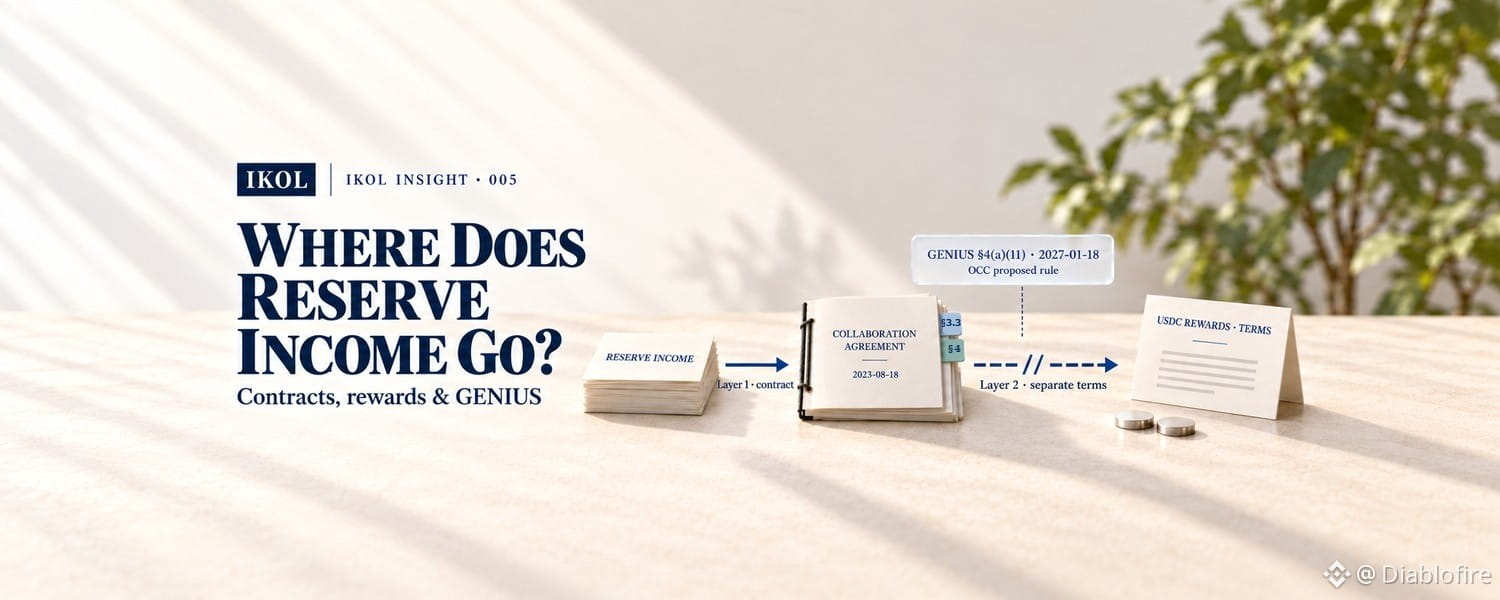

IKOL Insight #005 · The Circle–Coinbase contract, USDC rewards, and the GENIUS Act's interest prohibition
【The 30-second version】
Income on the reserves behind USDC is first divided between Circle and Coinbase under a 2023 contract. Coinbase then runs a separate rewards program, which it describes as funded by Coinbase, that pays eligible users based on their daily USDC balance. These are two layers with two sets of rules. Public filings show both layers; they do not show a fixed contractual percentage passed from the first layer to users.
The GENIUS Act bars a stablecoin issuer from paying holders interest or yield "solely in connection with the holding, use, or retention" of the coin. Based on Section 20 and the rulemaking status we could verify, we treat January 18, 2027 as the general effective date. A proposed OCC rule would add a rebuttable presumption covering issuers that pay yield through affiliates or certain third parties, and one legal scholar argues that Coinbase, as custodian, may itself be a "holder." We found no public regulatory determination on the Circle–Coinbase arrangement, and we do not offer one. In August, Circle said the contract had "renewed on its existing terms." That contract already contains a procedure for what happens if the payments become unlawful.
Evidence strength: Medium. The mechanics and amounts of both layers come from the contract, both companies' SEC filings, and Coinbase's published rewards terms. How the law applies depends on statutory interpretation, the parties' legal status, the actual arrangements, and implementing rules.
—————
How to read the labels: [Verified] = we checked a primary document (SEC filings, the contract, the statute, regulators' own documents, the company's earnings call transcript); this is not an independent audit of the companies. [Reported] = from media or third-party accounts; we did not obtain the primary source. [Position] = what a company, official or researcher has said; it represents their claim. [Inference] = our analysis; [Author's calculation] marks figures we computed from filings. Events are covered through October 17, 2026; web pages were checked on October 18. The discovery layer is 152 related items in IKOL's archive from August 5 to October 17, 2026 (114 factual, 18 opinion, 20 forecast); the research layer adds 20 sources, 15 of them primary documents. Sources are listed at the end.
—————
【1 · Two layers: a contract payment and a rewards program】
▍Layer 1: Circle and Coinbase, under a contract
[Verified] Circle issues USDC. Income earned on the reserve assets is reported as Circle's "reserve income": $667.7 million in Q2 2026, up from $634.3 million a year earlier.
[Verified] On August 18, 2023, Circle and Coinbase signed a Collaboration Agreement. It is public as Exhibit 10.1 to Circle's 2025 annual report, with confidential figures redacted as [*]. At the level of mechanics, Section 4 works like this:
1. Daily Payment Base. Each day's interest, dividend income and realized gains or losses on the reserves, minus documented portfolio management fees (such as asset management and custody) charged by non-affiliated third parties, allocated across the days of the relevant month.
2. Monthly adjustments and Issuer Retention. Monthly totals are adjusted under §4.1, including for the cost of capital requirements and shortfalls, and the issuer deducts an "Issuer Retention." The retention is calculated daily using tiered marginal rates based on USDC in circulation. Every tier and rate is redacted (§4.3).
3. Platform amounts. Each party receives the Daily Payment Base multiplied by its share of USDC held on its own platform that day, summed over the month. If the parties' combined amounts exceed the adjusted net base, they are scaled down pro rata (§4.4).
4. The residual. What remains (the "Residual Payment Base," after payments to any approved third-party ecosystem participants) is split, with Coinbase entitled to fifty percent (§4.5(b)).
[Verified] The agreement states that its calculations follow Exhibit 3, which controls if it conflicts with the text (§4.2(d)). Exhibit 3 is not public. So the steps above describe the mechanism. They cannot be turned into a dollar-for-dollar formula. Each party self-reports the USDC on its platform; every March and September, Deloitte or another mutually agreed accounting firm delivers an agreed-upon procedures letter (§4.4(b)).
▍Layer 2: Coinbase and its users, under a rewards program
[Verified] Coinbase's help center calls USDC Rewards "a loyalty program funded by Coinbase." Rewards accrue daily based on balance and the rewards rate, and are paid weekly. Eligibility and rates vary by region, account type and the terms in effect, and are subject to "ongoing experimentation." Coinbase reserves the right to change or discontinue the program, with notice to users. (Some users can choose between bitcoin and USDC rewards; this article covers the USDC path only.)
[Inference] The two layers look like this:
「Reserve income → inter-company payment calculated under the Collaboration Agreement → Coinbase revenue」
「Coinbase revenue and its own funds → separate rewards terms → eligible users」
We do not draw the second arrow as a "pass-through": public materials do not show any contractual requirement for Coinbase to hand a set share to users. This is a description of economic and contractual structure. It is not a conclusion that legal responsibility can be separated along the same line. A company saying rewards are "funded by Coinbase" does not, by itself, settle how a regulator would characterize them.
—————
【2 · What the filings show, and their limits】
▍Circle
[Verified] Circle's Q2 2026 10-Q (amounts in $ millions; percentages as reported):
· Reserve income: Q2 2026 667.7; Q2 2025 634.3; H1 2026 1,320.2; H1 2025 1,192.2
· Distribution costs incurred under agreements with Coinbase: Q2 2026 324.6; Q2 2025 332.3; H1 2026 655.3; H1 2025 635.5
· USDC on Circle's platform, daily weighted average: Q2 2026 19.5%; Q2 2025 7.4%; H1 2026 18.3%; H1 2025 6.6%
· Average USDC in circulation ($ billions): Q2 2026 76.5; Q2 2025 61.0; H1 2026 75.9; H1 2025 57.6
· Reserve return rate: Q2 2026 3.5%; Q2 2025 4.1%; H1 2026 3.5%; H1 2025 4.2%
[Verified] The 10-Q explains the two periods in opposite directions. In Q2, Coinbase-related distribution costs fell $7.7 million because of "a decrease in Coinbase's share of the total average USDC on-platform balances." For the first half, they rose $19.8 million "due to increased reserve income partially offset by" that same decline in share. For full-year 2025, these costs were $1.4 billion, versus $924.5 million in 2024 (2025 10-K).
The filings say these costs were incurred. We use that word rather than "paid": when a cost is recognized and when cash moves are different things.
[Author's calculation] Coinbase-related distribution costs as a share of reserve income: about 48.6% in Q2 2026, versus about 52.4% a year earlier. This is a ratio of reported figures, not a contract rate, and the numerator and denominator are not measured on the same basis. We do not use it to back out the redacted retention rates.
▍Beyond the quarterly average: the period-end mix also moved
[Verified] On the August 5 earnings call, Circle disclosed that USDC on Coinbase's platform reached 30% at quarter end, while Circle's own platform held $12.4 billion, about 17% of circulation. Management said Hyperliquid's USDC migration ramped late in the quarter with little effect on Q2, that about 90% of Hyperliquid's USDC sat on Coinbase's platform and about 10% on Circle's, and declined to disclose the revenue-sharing terms (transcript pp. 8, 14).
[Inference] The Q2 "decline in Coinbase's share" refers to the quarterly average. By quarter end, one migration had already changed the platform mix. "On-platform" here is a contract accounting category; it does not mean users moved assets into Coinbase retail accounts, and these disclosures do not show that the migration was driven by the retail rewards program. One quarter is not enough to conclude that reserve income is shifting back toward the issuer. The next data point comes with Q3 disclosures.
▍Coinbase
[Verified] Coinbase's Q2 2026 10-Q, table figures (amounts in $ millions):
· Stablecoin revenue: Q2 2026 292.1; Q2 2025 308.9; H1 2026 597.6; H1 2025 583.0
· USDC rewards (within sales and marketing): Q2 2026 119.1; Q2 2025 102.5; H1 2026 232.5; H1 2025 202.6
[Verified] Coinbase reports a $55.9 million negative effect from lower average interest rates in Q2, partly offset by higher customer USDC balances in eligible products. The reported net year-over-year decline in stablecoin revenue was about $16.8 million. It attributes the increase in rewards to growth in customer USDC balances, "offset in part by a reduction in the rewards rate."
[Author's calculation] Using the table figures, USDC rewards as a share of stablecoin revenue: about 40.8% in Q2 2026, versus about 33.2% a year earlier. This is not a pass-through rate; public materials do not show a fixed contractual ratio between the two. Note: the same filing's narrative describes the rewards increase differently from its table (see below).
▍Three unresolved measurement issues
1. The two companies' figures do not match. Circle's Coinbase-related distribution costs ($324.6 million) do not equal Coinbase's stablecoin revenue ($292.1 million). [Verified] Coinbase's 10-Q says that starting in Q1 2026, revenue earned on corporate-held stablecoin balances moved to "Corporate interest and other income," with prior periods recast. That points to one explanation, but it is not a full reconciliation. We do not treat the gap as profit kept by either company.
2. Coinbase's filing is internally inconsistent. The expense table shows USDC rewards up $16.6 million in Q2 and $30.0 million in the first half; the narrative says $45.4 million and $103.7 million. We use the table figures. Until the company corrects or reconciles this, the discrepancy is unresolved.
3. There is no single rewards rate. We do not state an annual rate that "Coinbase pays users."
—————
【3 · What the law says, and what regulators have proposed】
▍The GENIUS Act: a rule for issuers
[Verified] Section 4(a)(11) of the GENIUS Act (Pub. L. 119-27, signed July 18, 2025): "No permitted payment stablecoin issuer or foreign payment stablecoin issuer shall pay the holder of any payment stablecoin any form of interest or yield (whether in cash, tokens, or other consideration) solely in connection with the holding, use, or retention of such payment stablecoin."
Two limits are built in: the obligation falls on issuers, and it reaches payments made solely in connection with holding, use or retention. The section does not name exchanges. That does not mean every third-party reward is exempt.
[Verified] Section 20 sets the effective date as the earlier of 18 months after enactment (January 18, 2027) or 120 days after the primary Federal payment stablecoin regulators issue any final regulations implementing the Act.
[Inference] Counting back 120 days from January 18, 2027 gives September 20, 2026. On October 18, we searched public materials from the OCC, Federal Reserve, FDIC and NCUA. The Federal Reserve's September 29 Federal Register notice is a proposed rule. The OCC's 2026 list of final issuances does not include a comprehensive GENIUS final rule. Relevant FDIC and NCUA documents are still proposals. Even if Treasury's September 30 interim final rule on state certification were counted, a date 120 days after September 30 would fall after January 18, 2027. We found no final rule issued before September 20 that could trigger an earlier date, so we treat January 18, 2027 as the general effective date. This is a working judgment based on our search, not an exhaustive audit of every rule; transition periods, rule effective dates and compliance dates may differ by provision.
[Position] On the August 5 call, Circle CEO Jeremy Allaire said the GENIUS Act "has just gone through its proposed rulemaking, and we know will become effective in January of 2027."
▍The OCC proposal: a rebuttable presumption
[Verified] On February 25, 2026, the OCC proposed rules to implement the GENIUS Act (published in the Federal Register on March 2; comments closed May 1). Proposed §15.10(c)(4) restates the interest prohibition and adds something the statute does not contain: a rebuttable presumption (rule text at printed pp. 315–316; preamble discussion at pp. 38–40). In summary, not as an exhaustive restatement:
· The OCC would presume an issuer is violating the prohibition if the issuer has an arrangement to pay interest or yield to an affiliate or related third party, and that party has an arrangement to pay holders of the issuer's stablecoin interest or yield solely in connection with holding, use or retention;
· "Related third party" includes a person paying interest or yield to stablecoin holders as a service, and a person on whose behalf or under whose brand the issuer issues a stablecoin (with corresponding conditions for white-label arrangements);
· An issuer may rebut the presumption with written submissions, which the OCC evaluates;
· Arrangements outside the presumption may still be reviewed case by case.
A presumption is not a finding of a violation. Applying it to a specific arrangement would require answering at least four questions: whether the issuer falls under OCC jurisdiction; whether Coinbase is an affiliate or related third party; whether the contract payments are "interest or yield"; and whether the rewards are paid solely in connection with holding, use or retention. We do not answer any of them.
[Verified] An OCC news release records Comptroller Jonathan Gould saying on August 19: "We will have a final rule out by November." That was a stated plan, not a legal deadline.
[Reported] According to journalist Eleanor Terrett, Gould said on October 15 that the final rule would come in the very near term, before the end of October. We did not obtain the remarks. As of October 18, 2026, our search found no OCC final rule; the final text may differ from the proposal.
▍A separate dispute: is Coinbase itself a "holder"?
[Position] Lee Reiners, a lecturing fellow at Duke University, argued in December 2025 that the issue starts at Layer 1. Coinbase's user agreement says custodial assets are "held by Coinbase for your benefit," and he argues that Coinbase may itself qualify as the "holder" of custodial USDC under the statute. If so, Circle's payments to Coinbase would fall under the prohibition directly, whether or not Coinbase passes anything on to users. He concluded that Circle is "likely violating Section 4(a)(11)."
[Position] Coinbase says USDC Rewards is a loyalty program it funds. That statement concerns Layer 2; it does not answer Reiners's holder argument, which concerns Layer 1.
[Position] A Congressional Research Service Insight (IN12553, August 20, 2026 version, read through a third-party archive) says there is "no restriction against exchanges paying interest to customers" and notes that "holder" is not defined. That is a research agency's reading, not a binding safe harbor.
We reach no conclusion on how "holder" should be interpreted.
—————
【4 · The "what if" already written into the contract】
[Verified] The initial term is three years from August 18, 2023 (§3.1). The contract defines a "Determination Date" as 90 days before the end of the current term; the parties are to discuss modifications in good faith during the three months before that date. If they do not agree and both meet defined "Threshold Criteria," the agreement renews automatically for three years (§3.2(a)).
[Verified] On the August 5, 2026 call, Allaire said the agreement with Coinbase "has renewed on its existing terms" (transcript p. 3).
[Inference] Under the three-year renewal mechanism, the new term runs to August 2029. [Reported] Several outlets reported an extension "through 2029," but that year does not appear in the call remarks. Renewal does not mean regulators have approved the arrangement or that future legal risk has been resolved.
[Verified] Section 3.3 deals with changes in law:
1. If the issuer determines in good faith that, because of a change in law or an order after the agreement took effect, continuing the Section 4 payments would make it violate the law, it must give written notice with its reasons. If a court order bars the payments, or the issuer stops making Section 4 payments other than in accordance with Section 3.2 and fails to resume within 30 days of the reseller's written request, either party may give written notice invoking Section 3.3;
2. The parties must take commercially reasonable steps, in good faith, to amend the agreement or restructure operations so the issuer can comply;
3. If, within a three-month Restructuring Period measured from delivery of the Section 3.3 notice, they cannot do so, an order bars the payments, or the issuer has not resumed paying, then on Coinbase's written request the issuer assigns the licensed trademarks for the affected stablecoin to Coinbase, Section 4 payments end for that stablecoin, and the new license agreement attached as Exhibit 2 (as the parties may amend it in writing) takes effect for those marks, allowing Circle to keep using them;
4. If certain conditions are later met, the marks transfer back to the issuer and the payment provisions come back into force (§3.3(d)).
None of this happens automatically when a law takes effect. What would transfer is specific trademarks, not the reserves, customer assets or the USDC business. The detailed rights also involve a separate intellectual property license agreement that we have not reviewed in full. Circle's 2025 risk factors disclose the arrangement and say a forced assignment or loss of the marks "could have a material adverse effect."
[Inference] In 2023, the parties wrote a notice, restructuring and trademark procedure for the case where the payments become unlawful. The GENIUS Act and its implementing rules are the kind of "change in law" that could bring that clause into play. Whether they will depends on the final rules and on the parties' own determinations; we cannot determine from the public record whether it will be triggered.
—————
【5 · Why banks care, and what the research shows】
The other side of the stablecoin-yield debate is banks' concern about deposits leaving the system. [Verified] The two studies we checked give conditional answers:
· A Federal Reserve Board FEDS Note by Jessie Jiaxu Wang (December 17, 2025) is a scenario analysis. It says stablecoins "can either reduce, recycle, or restructure bank deposits rather than simply draining them," depending on where reserves are held. Its largest-effect scenario, in which issuers gain Federal Reserve master accounts that pay interest on reserves, is a modeling case, not something that has happened or must happen.
· BIS Working Paper 1382 by Rashad Ahmed and Iñaki Aldasoro (October 2026) uses weekly U.S. data from 2019 to 2025 and finds evidence consistent with partial substitution between bank deposits and stablecoins as deposit rates change. It estimates a statistical relationship and addresses endogeneity; it does not trace individual flows of money from banks into stablecoins.
[Inference] The two do not conflict: one says the effect depends on structure, the other finds partial substitution. Neither study we reviewed quantifies net deposit outflows caused by Coinbase's rewards.
—————
【6 · Counterarguments, and what we don't know】
First: the layers may be more tightly linked than we describe. If there are undisclosed arrangements connecting the contract payments to the rewards program, the "two layers" framing understates the link. We can only say public materials do not show one.
Second: the risk from the proposed presumption may not materialize. If the OCC's final rule drops the presumption, or if Circle's USDC issuing entity falls outside OCC jurisdiction, the risk from that proposed presumption may not arise. That would not make the statute, other regulators' interpretations, or the holder question go away.
What we don't know: the redacted retention tiers and rates; the Exhibit 3 methodology; a full reconciliation of the two companies' figures; why Coinbase's filing is internally inconsistent; the content of the OCC final rule; and whether the parties will invoke §3.3.
—————
【7 · Testable predictions】
Prediction 1: The OCC final rule will keep a mechanism aimed at indirect yield. Deadline January 31, 2027: if the OCC has published a final rule implementing the interest prohibition, its text will still expressly cover issuers paying holders interest or yield indirectly through an affiliate or certain third parties. Check: early February 2027.
Prediction 2: By September 30, 2027, at least one layer will show a publicly visible change. Either (A) Circle or Coinbase publicly states that, in response to the GENIUS Act's interest prohibition or its implementing rules, it has substantively changed the USDC payment mechanism or invoked §3.3; or (B) Coinbase's U.S. retail USDC Rewards terms take effect so that rewards are no longer available for holding a balance alone and require identifiable transaction or payment activity. Outcome B is an observable event; it would not mean an activity-based design is lawful. If we find no event meeting the A or B definitions in the agreed channels by the deadline, that shows only that no such event was found. It does not prove there was no private change, or rule out other public changes that fall short of A or B. Check: October 2027.
The scoring rules for both predictions (what counts as a hit, a miss, or untestable) were fixed on October 18, 2026, before publication.
—————
Sources (primary documents)
1. Circle–Coinbase Collaboration Agreement (Aug 18, 2023), Exhibit 10.1 to Circle's 2025 10-K — https://www.sec.gov/Archives/edgar/data/1876042/000187604226000062/coinbasecollaborationagree.htm
2. Circle 2025 10-K — https://www.sec.gov/Archives/edgar/data/1876042/000187604226000062/crcl-20251231.htm
3. Circle Q2 2026 10-Q — https://www.sec.gov/Archives/edgar/data/1876042/000187604226000248/crcl-20260630.htm
4. Circle Q2 2026 earnings call transcript (Aug 5, 2026) — https://s206.q4cdn.com/265218871/files/doc_earnings/2026/q2/transcript/Q226-Earnings-Transcript.pdf
5. Coinbase Q2 2026 10-Q — https://www.sec.gov/Archives/edgar/data/1679788/000167978826000088/coin-20260630.htm
6. Coinbase USDC Rewards FAQ (accessed Oct 18, 2026) — https://help.coinbase.com/en/coinbase/coinbase-staking/rewards/usd-coin-rewards-faq
7. GENIUS Act, Pub. L. 119-27 — https://www.govinfo.gov/content/pkg/PLAW-119publ27/html/PLAW-119publ27.htm
8. OCC proposed rule (Feb 25, 2026) — https://www.occ.gov/news-issuances/news-releases/2026/nr-occ-2026-9a.pdf
9. OCC News Release 2026-69 (Aug 19, 2026) — https://www.occ.gov/news-issuances/news-releases/2026/nr-occ-2026-69.html
10. Federal Reserve FEDS Note (Dec 17, 2025) — https://www.federalreserve.gov/econres/notes/feds-notes/banks-in-the-age-of-stablecoins-implications-for-deposits-credit-and-financial-intermediation-20251217.html
11. BIS Working Paper No. 1382 — https://www.bis.org/publications/working-paper-1382-are-stablecoins-and-bank-deposits-substitutes
Commentary and reports cited: Lee Reiners, CLS Blue Sky Blog (Dec 11, 2025); CRS Insight IN12553 (Aug 20, 2026 version); crypto.news and Blockhead (Aug 6–7, 2026); Eleanor Terrett's report of Comptroller Gould's Oct 15 remarks.
Not investment or legal advice. We do not judge whether any party has violated the law.
IKOL · AI-assisted research, human-edited. We label what is verified, reported and inferred — and publish our corrections.