

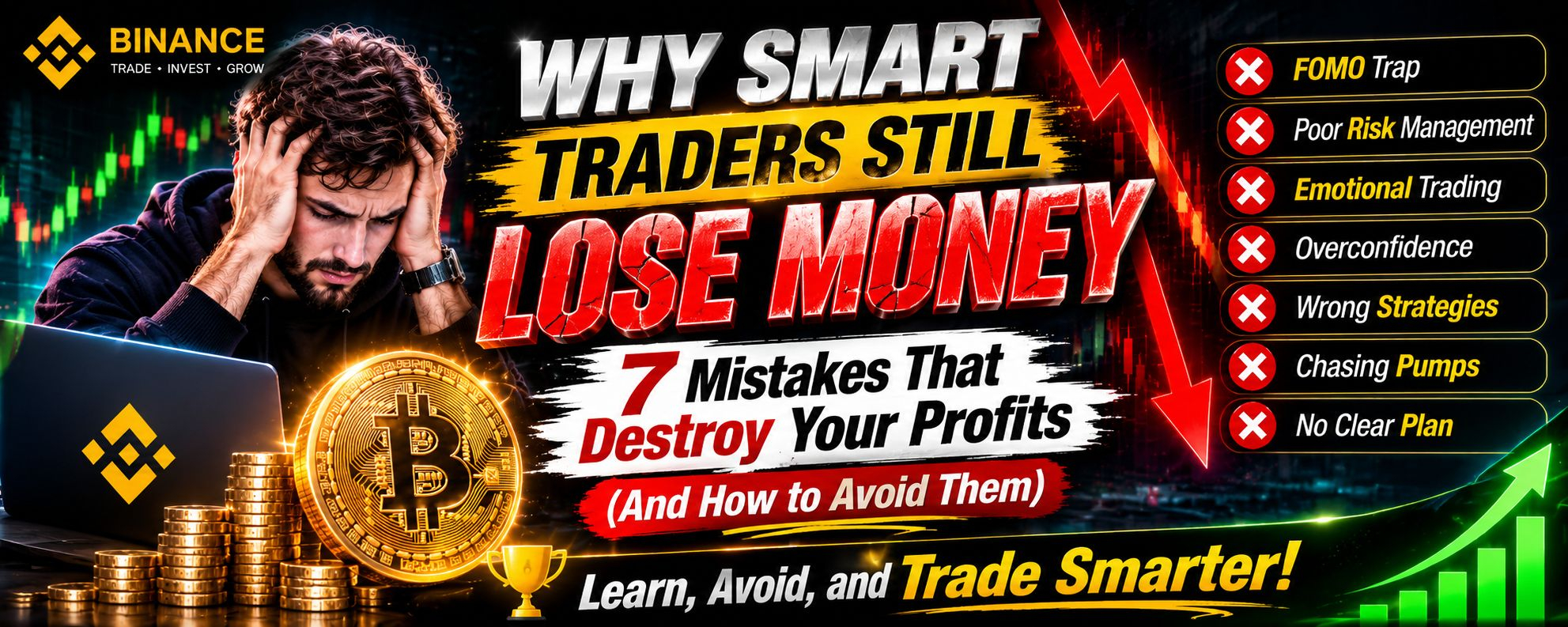

Why Smart Traders Still Lose Money — 7 Mistakes That Destroy Profits
The market doesn't always beat traders. Sometimes, their own decisions do.
Have you ever entered a trade after carefully analyzing the chart, only to watch the price move against you? Or sold Bitcoin too early, then watched it rise much higher?
These situations are common in both crypto and stock markets.
Many traders believe success comes from finding the perfect indicator or predicting the next big move. But even a strong market analysis cannot guarantee profits if risk management and emotional discipline are missing.
Here are seven common mistakes that can damage a trader's performance — and how to avoid them.
1. Buying Because Everyone Else Is Buying
When Bitcoin starts rising rapidly, social media becomes full of bullish predictions. Traders begin talking about new all-time highs, and suddenly everyone wants to enter the market.
This is called FOMO — the fear of missing out.
The danger is that traders may enter after a large price move, when the risk of a pullback has increased.
How to avoid it: Never enter a trade just because others are excited. Identify your entry, invalidation level, and risk before committing your money.
2. Risking Too Much on One Trade
Imagine you have a $1,000 trading account and lose 20% of it. Your balance falls to $800, and you now need a 25% gain just to recover your original capital.
Large losses become increasingly difficult to recover from.
Experienced traders understand that capital preservation is essential. They focus not only on potential profits but also on how much they could lose if the trade fails.
How to avoid it: Set a maximum acceptable loss before entering. Many traders use a small percentage of their account as a risk guideline, but the appropriate amount depends on their circumstances and strategy.
3. Revenge Trading After a Loss
Losing a trade can be frustrating. The real problem begins when frustration controls your next decision.
A trader loses $30, immediately opens another position to recover it, and then increases the risk after another loss.
Instead of following a strategy, they begin chasing money.
How to avoid it: After a significant or unexpected loss, take a break. Review what happened and return only when you can make decisions calmly.
A loss is part of trading. Turning one loss into five unnecessary trades is often a choice.
4. Using Too Many Indicators
Some traders fill their charts with moving averages, RSI, MACD, trend lines, and numerous other indicators.
When signals disagree, they become confused and hesitate. When several signals agree, they may become overconfident.
More indicators do not automatically create better decisions.
How to avoid it: Build a simple, clearly defined strategy. Understand why it works, test it on historical data, and evaluate its performance over a meaningful number of trades.
5. Moving the Stop-Loss Because You Hope the Price Will Recover
You enter a trade and set a stop-loss. The market approaches that level, but instead of accepting the planned loss, you move the stop farther away.
You tell yourself the price will recover.
Sometimes it does. Sometimes the loss becomes much larger than you originally intended.
Hope is not a risk-management strategy.
How to avoid it: Define your exit rules before entering a trade. Do not widen your risk limit simply because you dislike being wrong.
6. Confusing Luck With Skill
A trader makes money on three consecutive trades and assumes their strategy is excellent.
But a short winning streak does not prove that a strategy has a genuine advantage. The results may partly reflect favorable market conditions or luck.
Likewise, one losing trade does not automatically mean a good strategy has failed.
How to avoid it: Keep a trading journal. Record your entry, exit, reasoning, risk, and outcome. Review patterns over time rather than judging your ability from one or two trades.
7. Trading Without a Clear Plan
Entering a position because the price “looks ready to move” is not a complete strategy.
Before opening a trade, you should know:
- Why are you entering?
- What would prove your analysis wrong?
- Where will you exit?
- How much are you prepared to lose?
- Is the potential reward reasonable compared with the risk?
If you cannot answer these questions, waiting may be the smarter decision.
The Real Secret: Discipline Over Prediction
No trader can predict every market movement. Crypto and stocks are influenced by economic data, market sentiment, liquidity, unexpected news, and countless other factors.
The goal is not to win every trade. It is to make decisions based on a tested process, manage risk consistently, and avoid mistakes that can destroy your account.
Remember: You don't need to catch every opportunity. You need to protect yourself from the wrong ones.
Let's Discuss
Which mistake do you think causes the most losses among traders?
A) FOMO and emotional decisions
B) Poor risk management
C) Revenge trading
D) Trading without a proper strategy
Comment with your answer and explain why. Your experience might help another trader avoid a costly mistake.
Disclaimer: This article is for educational purposes only and is not financial or investment advice. Trading cryptocurrencies and stocks involves risk, including the possible loss of capital.
#CryptoTrading #BinanceSquare #CelestiaRises16%To2026High #ETHDropsBelow2400USDT #NasdaqDowWeeklyGapWidestSinceJuly2002