


Bitcoin has steadied near $81,000 after dipping to $80,746 overnight, the second time this session it has tested the $80,000 area and recovered. The 24-hour decline reached 3.18% at the low. South Korea’s KOSPI closed 7.57% lower at 5,554.23 after an intraday fall near 9% triggered a circuit breaker. The notable part is that Fed hike odds have already retreated from their post-inflation spike — markets fell anyway.
$80,000 Has Held Twice, but Barely
Bitcoin fell close to $80,000 in early Asian trading, bounced to roughly $81,500, slid to $80,746 overnight, and sits near $81,000 now.
The recovery from the low is about 0.3%. That is a market stabilising at the bottom of its range rather than one turning. The useful information is the level itself: $80,000 has now absorbed two separate waves of selling without breaking, which makes it the line worth watching.
A third test would carry more weight than either of the first two.
The Rate Panic Has Already Unwound
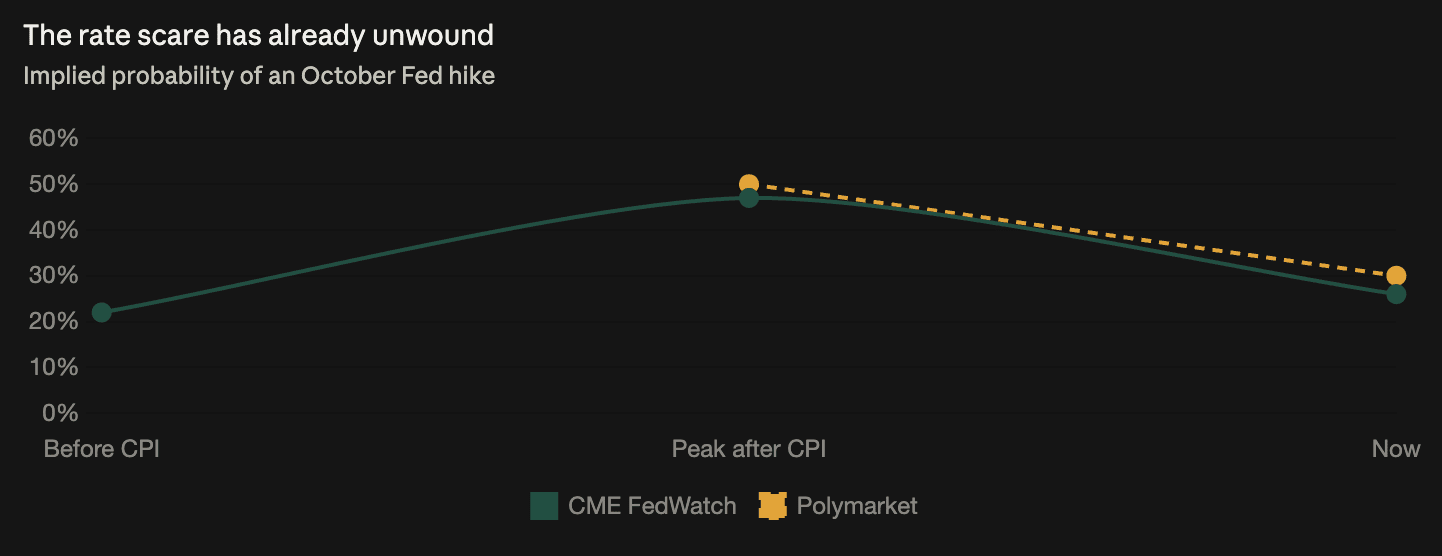
CME FedWatch put October hike odds at roughly 22% before Wednesday’s CPI release, saw them jump to almost 47%, and shows 26% now. Polymarket followed the same path, spiking near 50% before easing to about 30%. Fed funds futures price better than 70% odds of no change this month.
That is close to a full round trip. If rate expectations were the whole story, the retreat should have brought relief. Instead Asian equities took the worst session of their streak after the odds had already come down.
Korea’s Selloff Is an AI Financing Story
The KOSPI’s fall capped seven consecutive declining sessions totalling roughly 21%, its longest losing streak since September 2024, and triggered the tenth circuit breaker of the year with a 20-minute halt.
The damage was concentrated. SK Hynix fell 11.4% and Samsung Electronics 9.5%. In Tokyo, where the Nikkei dropped 4.9% to 64,489.06, Kioxia fell 11.2%, SoftBank 9.4% and Tokyo Electron 7.3%.
Those are memory and AI infrastructure names, and their customers carry the debt. CoreWeave fell about 16% on Wednesday with one of its bonds trading near 80 cents on the dollar at a yield close to 15%. Oracle dropped 9%. The Philadelphia Semiconductor Index has fallen six straight sessions, erasing around $1.6 trillion in market value.
Higher Treasury yields connect the inflation print to this selling, but the mechanism runs through credit rather than policy expectations. Cheap financing underwrote the data centre buildout, and the market is repricing how cheap it stays.
Demand Data Hasn’t Turned
ASML said equipment demand is likely to exceed supply through 2028. TSMC reported record third-quarter revenue of NT$1.49 trillion, with analysts expecting net profit to rise roughly 65%.
No reported figure yet shows AI demand weakening. What has changed is the cost of the debt funding it — a different risk, and one that can reverse faster than a demand cycle.
Crypto Is Trading as a Macro Asset
Altcoins fell harder than Bitcoin, with ether at $2,371.55 and XRP and solana down 3.5% to 4% against Bitcoin’s decline. That ordering is standard risk-off behaviour within crypto and lifts Bitcoin’s dominance.
PYTH was the only top-100 token up more than 7%. The source gives no explanation for the move.
STS Digital’s Anderson told CoinDesk that uncertainty is “damaging liquidity and dampening risk appetite across all asset classes,” and that tokens “now look increasingly sensitive to macro factors, with energy shocks, fixed-income volatility and AI valuations weighing on sentiment.” He expects the Fed to hold this month.
His description of the next FOMC as “a coin flip” fits the brief post-CPI peak rather than current pricing, which sits near three-to-one against a hike.
Institutional Flows Are Flatter Than They Look
Giottus chief executive Vikram Subburaj said institutional demand “remains fragile,” citing $150.5 million of US spot Bitcoin ETF outflows on October 14 that reversed the previous day’s $175.7 million inflow.
Those two days net to a $25.2 million inflow. The flow has been choppy rather than directionally negative, which is a weaker signal than either single day suggests.