

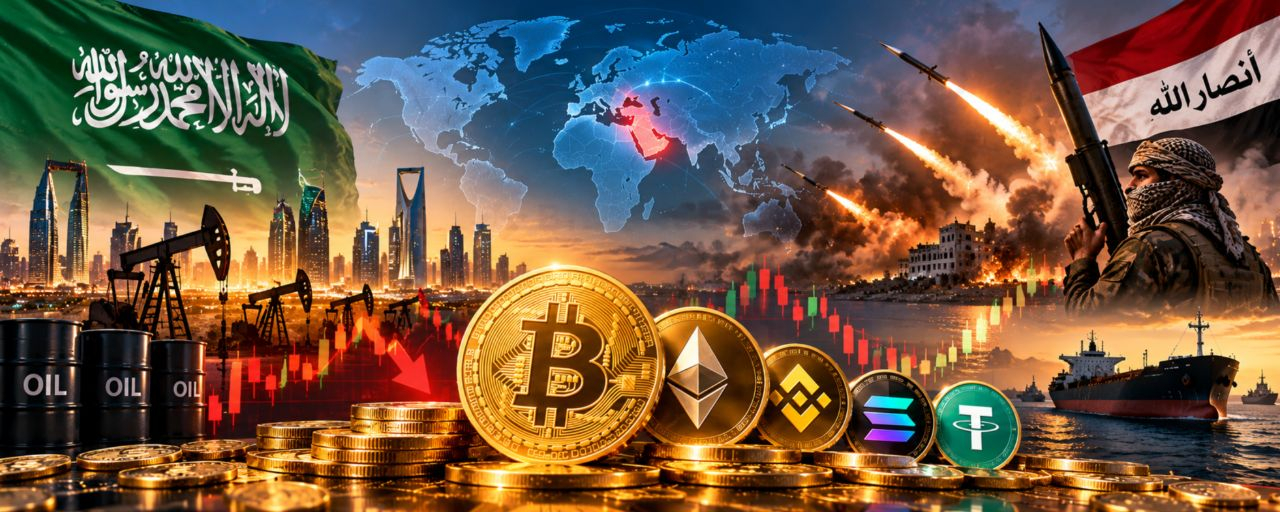

Binance Square article | 13 October 2026 | Geopolitics, oil prices, Bitcoin and digital assets
The escalating conflict involving Saudi Arabia and Yemen's Houthi movement is becoming an important risk factor for global financial markets. The consequences extend beyond the Middle East, with potential implications for oil supplies, international shipping, inflation expectations, investor confidence and cryptocurrency prices.
Recent reporting on 13 October 2026 describes Houthi attacks on Riyadh and fresh Saudi-led coalition airstrikes in Yemen. The developments highlight growing uncertainty around regional security and the safety of important shipping and energy infrastructure.
For cryptocurrency investors and market observers, the key question is not simply whether conflict causes Bitcoin to rise or fall. It is how geopolitical developments influence liquidity, investor risk appetite and the broader economic outlook.
The central message: geopolitical escalation can increase crypto-market volatility, but it does not automatically mean that Bitcoin or altcoins must decline.
1. WHY THE SAUDI–HOUTHI CONFLICT MATTERS TO CRYPTOCURRENCY
The cryptocurrency market is increasingly connected to global macroeconomic developments. Although Bitcoin operates independently of any government or central bank, its market price is influenced by investor sentiment, financial liquidity, interest-rate expectations and demand for risky assets.
The latest escalation creates several potential transmission channels.
First: energy-market uncertainty. Attacks affecting oil infrastructure or export routes can raise concerns about the availability of crude oil and refined fuels.
Second: international shipping disruption. The Red Sea and Bab el-Mandeb Strait are important maritime routes. Threats to shipping can increase insurance costs, freight rates and delivery times.
Third: inflation concerns. If higher energy and transport costs persist, businesses and consumers may face additional inflationary pressure.
Fourth: monetary policy. Persistent inflation can make central banks more cautious about reducing interest rates, potentially tightening financial conditions for risk-sensitive assets.
Fifth: investor behaviour. When uncertainty increases, investors may reduce exposure to volatile assets or move toward cash and other perceived defensive holdings.
These channels help explain why a regional conflict can influence a global cryptocurrency market. They do not establish that every crypto-price movement is caused by the conflict.
2. OIL PRICES: THE FIRST MAJOR TRANSMISSION CHANNEL
Oil is particularly important in the current situation because Saudi Arabia is a major global energy producer and the conflict threatens infrastructure and shipping routes.
Reuters reported on 13 October 2026 that Brent crude had eased slightly to approximately $105.98 per barrel, while geopolitical tensions continued to create supply concerns. The report also noted that expectations of additional diesel supplies were offsetting some of those concerns. <Cite refs={["turn588034news28"]}/>
This illustrates an important principle: geopolitical risk does not guarantee that oil prices will rise every day. Prices respond to both potential supply disruptions and factors that could increase supply or reduce demand.
If the conflict disrupts exports for an extended period, energy prices could remain elevated. If shipping resumes safely and supply concerns diminish, oil prices could retreat.
For crypto markets, the duration and economic consequences of the oil shock matter more than the headlines alone.
3. BITCOIN: SAFE HAVEN OR RISK ASSET?
Bitcoin is often described as digital gold because of its limited supply and decentralized design. However, its market behaviour during geopolitical crises has not consistently matched that of gold.
On 13 October, reporting from Seoul Economic Daily placed Bitcoin near $82,000 and described pressure associated with higher oil prices, inflation concerns and a stronger US dollar. The same report showed declines in several major cryptocurrencies. <Cite refs={["turn588034search0"]}/>
This illustrates how Bitcoin can behave like a risk-sensitive financial asset when investors focus on liquidity and interest rates.
Three broad scenarios are possible:
Scenario A — Risk-off selling
If the conflict intensifies, oil remains expensive and the dollar strengthens, investors may reduce exposure to volatile assets. Bitcoin and altcoins could experience further pressure.
Scenario B — A mixed market response
Bitcoin may remain relatively resilient while smaller cryptocurrencies decline more sharply. Market liquidity, institutional demand and derivatives positioning can create different outcomes across assets.
Scenario C — Recovery after de-escalation
If shipping risks decline, oil prices ease and financial conditions improve, risk appetite could recover. Bitcoin and other cryptocurrencies could benefit, although a recovery would not be guaranteed.
The key lesson is that Bitcoin's performance depends on the interaction between geopolitical events and financial-market conditions, not on a simple rule that war makes Bitcoin rise or fall.
4. WHY ALTCOINS MAY EXPERIENCE GREATER VOLATILITY
Smaller cryptocurrencies can be more vulnerable to changing market sentiment because many have thinner liquidity, less established demand and more concentrated ownership.
During periods of uncertainty, traders may reduce exposure to assets they consider riskier or harder to sell quickly.
This can affect:
Ethereum and other smart-contract networks.
Smaller-cap altcoins.
Meme coins.
Newly launched tokens.
Tokens with substantial speculative trading activity.
However, different projects have different fundamentals, liquidity profiles and market participants. A uniform decline across all altcoins should not be assumed.
A token's low nominal price also does not make it inexpensive in valuation terms. Circulating supply, total supply, market capitalization and actual demand remain important.
5. THE US DOLLAR, INFLATION AND INTEREST RATES
The relationship between oil and cryptocurrency often works through the wider economy.
If energy prices rise persistently, transportation, manufacturing and other business costs may increase. This could place upward pressure on inflation.
If inflation remains elevated, central banks may maintain restrictive interest rates for longer than financial markets had anticipated.
Higher interest rates can make interest-bearing assets more attractive relative to speculative investments. A stronger dollar can also place pressure on dollar-denominated risk assets.
However, these relationships are not automatic. Monetary policy depends on a broad range of economic data, and crypto markets may respond differently as expectations change.
Investors should therefore distinguish between the initial market reaction to a conflict and its longer-term economic consequences.
6. THE RED SEA AND BAB EL-MANDEB: WHY SHIPPING MATTERS
The Bab el-Mandeb Strait connects the Red Sea with the Gulf of Aden and is a major gateway for shipping between Europe and Asia.
Disruption in this area can force some vessels to change routes, increasing voyage times, fuel consumption, insurance expenses and freight costs.
The Council on Foreign Relations has highlighted the strategic significance of the Red Sea and the risks that conflict creates for global shipping and energy flows. <Cite refs={["turn119253search0"]}/>
The consequences can extend beyond the energy industry.
Higher shipping costs may affect consumer goods, industrial supplies and manufacturing inputs. If these pressures persist, they can contribute to wider economic uncertainty.
Cryptocurrency markets may respond indirectly through changing expectations for global growth, inflation and financial liquidity.
7. COULD STABLECOINS BECOME MORE IMPORTANT?
Stablecoins may continue to play a role in digital-asset trading and cross-border settlement during periods of market uncertainty.
However, stablecoins should not be confused with guaranteed safe investments. Their reliability depends on the issuer, reserve arrangements, redemption rights, custody and regulatory protections.
Geopolitical uncertainty can also increase demand for dollar-linked assets in some markets while creating additional regulatory or operational challenges.
Stablecoins may provide a useful settlement mechanism in certain circumstances, but their adoption and value are not guaranteed to increase because of a conflict.
8. WHAT SHOULD CRYPTO MARKET OBSERVERS WATCH NEXT?
Rather than focusing exclusively on military headlines, observers should consider several measurable indicators:
Oil prices: Are supply concerns continuing to push energy prices higher, or are prices easing?
Shipping conditions: Are commercial vessels resuming normal routes, or are disruptions persisting?
The US dollar: Is dollar strength putting additional pressure on risk-sensitive assets?
Inflation expectations: Are markets anticipating higher inflation for longer?
Central-bank policy: Are expectations for interest-rate reductions changing?
Bitcoin market structure: Are trading volumes, liquidity and price movements showing sustained weakness or signs of stabilization?
Broader crypto participation: Are declines concentrated in smaller altcoins, or are they affecting major digital assets as well?
No single indicator can predict the market's next move. The value comes from examining how these factors interact.
9. THREE POSSIBLE PATHS FOR THE CRYPTO MARKET
Path 1: Escalation and prolonged disruption
A prolonged conflict could keep energy and shipping risks elevated. If inflation expectations rise and the dollar strengthens, crypto markets could face additional pressure.
Path 2: Continued uncertainty without a major supply shock
Oil and financial markets could remain volatile as investors assess developments. Crypto prices might move in both directions, with individual assets responding differently.
Path 3: De-escalation and improved market confidence
A sustained reduction in hostilities and safer shipping conditions could ease energy concerns and improve investor confidence. This could support a recovery in risk assets, depending on broader economic conditions.
These are scenarios, not predictions. The actual outcome depends on events that remain uncertain.
10. FINAL ANALYSIS: WHAT DOES THIS MEAN FOR THE FUTURE OF CRYPTO?
The Saudi Arabia–Houthi conflict demonstrates that cryptocurrency markets are part of a wider global financial system.
Bitcoin's decentralized design does not isolate its market price from oil shocks, inflation, interest rates, currency movements or investor psychology.
At the same time, geopolitical tensions do not automatically make cryptocurrencies unattractive or guarantee a market crash. Their impact depends on the severity of disruption, its duration and the response of global financial markets.
The most important distinction is between short-term volatility and long-term technological adoption.
A temporary decline in prices does not necessarily mean blockchain technology has lost its usefulness. Equally, a rebound in prices does not prove that every token has sustainable economic value.
The coming days will be important for understanding whether the current tensions produce a prolonged energy shock or remain a source of temporary market uncertainty.
For the crypto community, disciplined analysis, credible information and an understanding of risk are more valuable than reacting to every headline.
💬 LET'S DISCUSS ON BINANCE SQUARE
What do you think will be the biggest impact of the Saudi Arabia–Houthi conflict on the crypto market?
Further pressure on Bitcoin and altcoins.
Greater resilience in Bitcoin compared with smaller tokens.
Increased volatility but no sustained market direction.
A recovery if oil prices and geopolitical tensions ease.
Share your reasoning in the comments. Different perspectives and evidence-based analysis are welcome.
#Bitcoin #CryptoMarket #SaudiArabia #HouthiConflict #Geopolitics #OilPrices #Ethereum #Altcoins #GlobalEconomy #BinanceSquare
Disclaimer: This article is for educational and informational purposes only. It is not financial advice or a recommendation to buy or sell any cryptocurrency. Digital assets are volatile, and market conditions can change rapidly. Verify current information and assess your own risk before making financial decisions.