

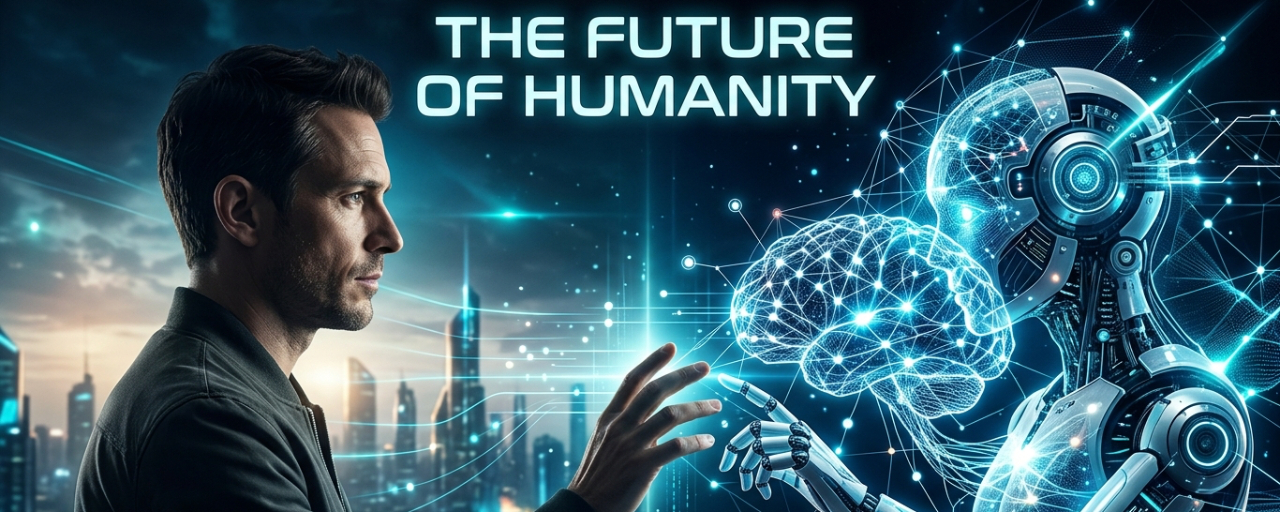

We are entering an era in which artificial intelligence could surpass human capabilities across an increasing number of fields. For many people, this creates a deep fear: losing their jobs, their purpose, and ultimately their control over the future.
But what if we are looking at this transformation from the wrong perspective?
━━━━━━━━━━━━━━
🧠 1. BIOLOGY HAS LIMITS. TECHNOLOGY DOESN’T FOLLOW THE SAME RULES.
The human brain contains roughly 86 billion neurons and consumes about 20 watts of power. It is an extraordinary biological system, but its physical structure and processing speed have limitations.
AI, by contrast, can scale through computing infrastructure, process enormous volumes of information, and be replicated across machines. Combined with advances in robotics, it could dramatically accelerate scientific discovery and industrial production.
Unlike biological evolution, technological progress can compound within years rather than requiring countless generations.
⚡ 2. INTELLIGENCE COULD TRANSFORM THE STRUCTURE OF SOCIETY.
Throughout history, greater capabilities have allowed humans to overcome physical limitations. Machines extended our strength; computers expanded our ability to calculate and process information.
If AI eventually exceeds human performance across most cognitive tasks, our role in society could fundamentally change. The challenge will no longer be simply how to produce more, but how to maintain human agency, distribute resources, and govern increasingly powerful systems.
🌍 3. THE POSSIBILITY OF AN AGE OF ABUNDANCE
Imagine a future where AI and robots make food production, housing construction, healthcare, and scientific research dramatically cheaper.
In such a world, many forms of material scarcity could diminish, and treatments for diseases that remain difficult to cure today could advance much faster.
However, abundance is not guaranteed. Lower production costs do not automatically mean equal access, and technological progress alone cannot eliminate poverty or social inequality.
⚠️ 4. PROGRESS WITHOUT SAFEGUARDS IS A DANGEROUS BET.
The more powerful AI becomes, the more important safety, independent evaluation, and accountability will be.
One proposed approach is to let independent researchers and competing AI companies examine new systems before release, while governments establish enforceable rules for serious risks.
Competition can expose weaknesses, but it cannot replace effective oversight. Humanity must pursue innovation without treating catastrophic risks as acceptable collateral damage.
━━━━━━━━━━━━━━
🔭 THE BIGGER PICTURE
The central idea is not that humanity should blindly surrender control to machines. It is that we must recognize our limitations while preparing responsibly for a future that could transform civilization.
The scientific concept of heat death describes a possible far-future state in which the universe approaches thermodynamic equilibrium, leaving little usable energy to sustain complex processes. This remains a cosmological projection, not a reason to dismiss the consequences of our choices today.
We cannot know whether the next decade will bring unprecedented abundance, severe disruption, or both.
But one thing is clear: the future of AI will depend not only on how intelligent our machines become, but also on how wisely humanity chooses to develop and govern them.
The goal should not be to stop progress out of fear, nor to embrace it without question.
It should be to build a future in which technological power serves humanity rather than placing humanity at its mercy.
#AI #ArtificialIntelligence #FutureOfHumanity #Technology #Science


