

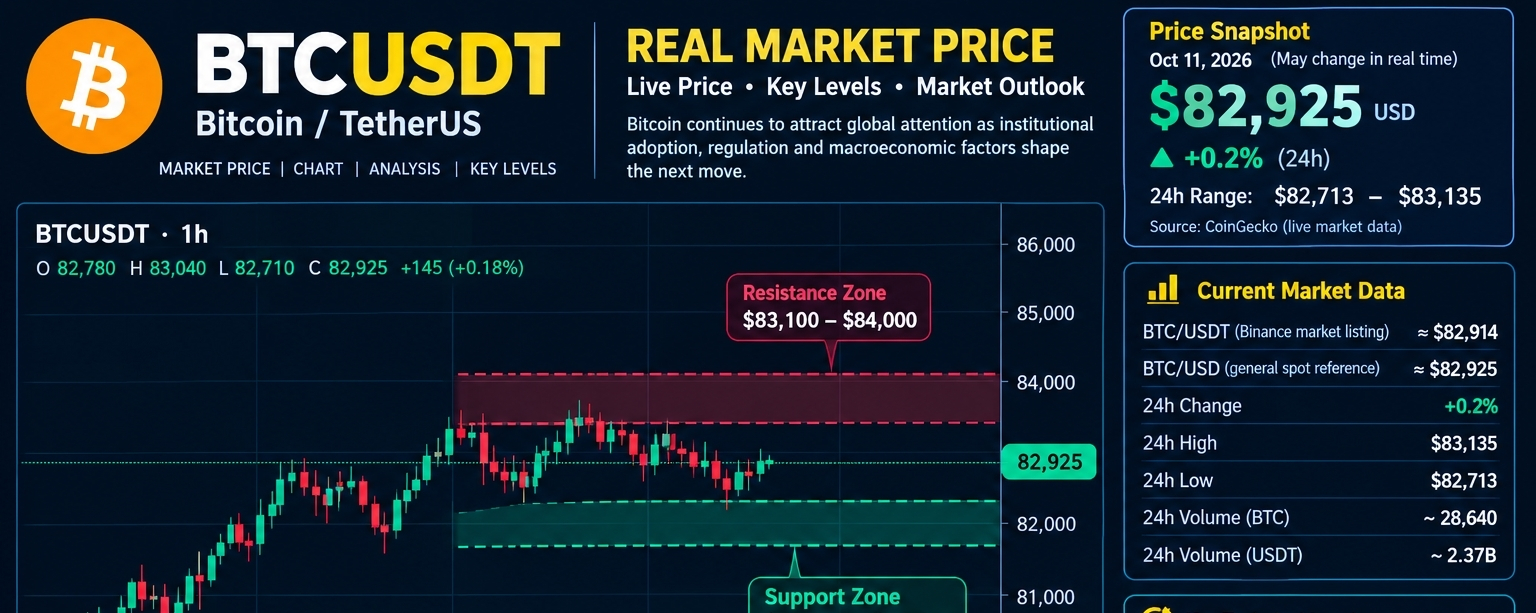

Bitcoin ($BTC BTCUSDT) Fundamental Analysis: Market Outlook, Key Developments and Future Opportunities
Introduction
Bitcoin remains one of the most closely watched digital assets in the global cryptocurrency market. The BTCUSDT trading pair represents Bitcoin's value against the US dollar-denominated Tether stablecoin. Its price reflects a combination of investor demand, market liquidity, economic conditions, regulatory developments and confidence in the broader digital asset ecosystem.
As of October 2026, Bitcoin's market outlook presents both opportunities and risks. Institutional participation continues to evolve, cryptocurrency regulation is receiving greater attention, and macroeconomic developments remain important drivers of market sentiment. Rather than assuming that Bitcoin must rise or fall, investors should examine the evidence behind both bullish and bearish scenarios.
1. Bitcoin's Current Market Position
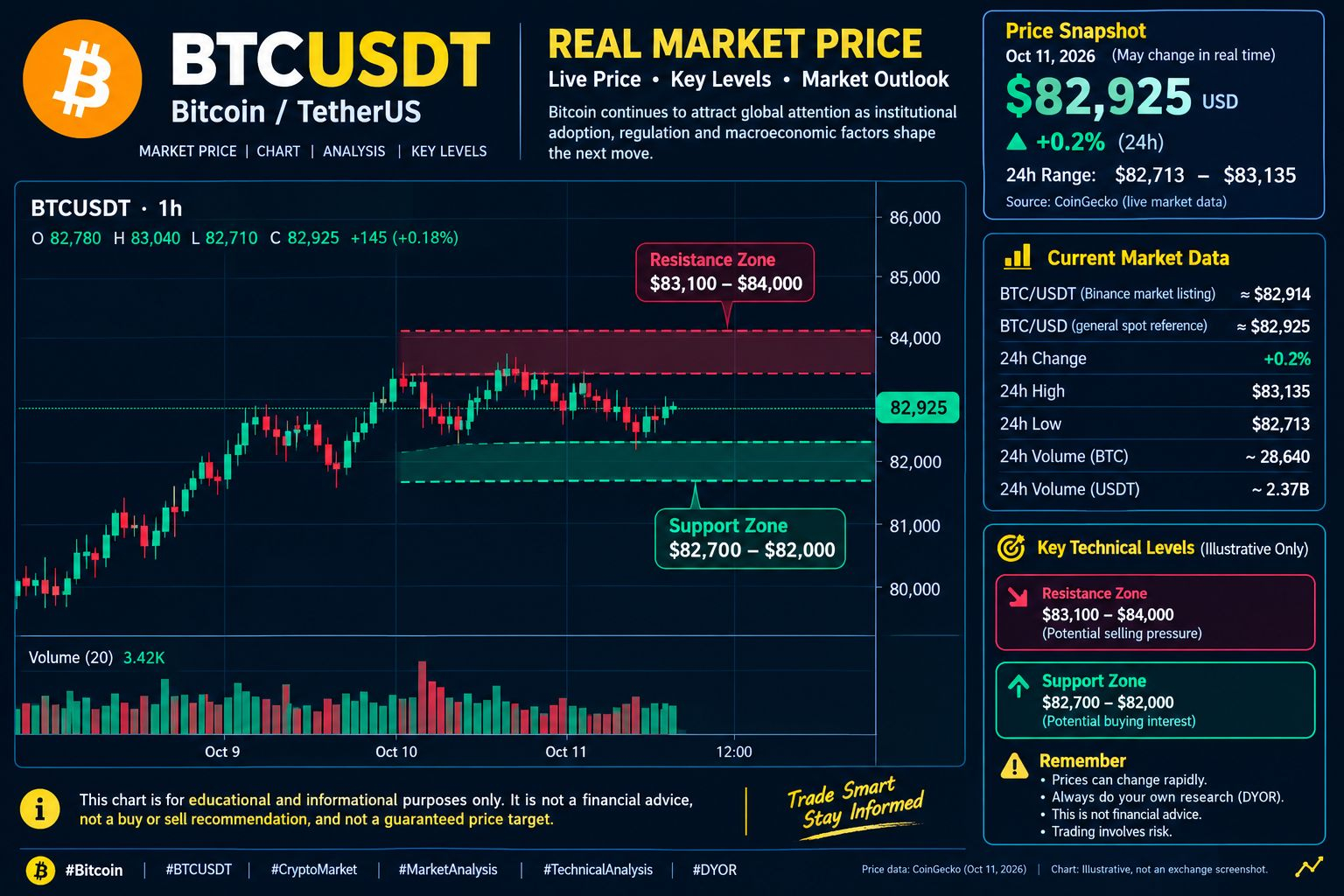
Recent market reporting on October 11 placed Bitcoin near $83,000. The immediate technical discussion has focused on the $80,000 area as a potential support zone and approximately $87,500 as an upside scenario.
These levels should be treated as reference points rather than confirmed turning points. A support zone is an area where buyers may become more active, while resistance is an area where selling pressure may increase. Neither level guarantees a price reversal.
A sustained move above a resistance area, supported by strong trading volume, can indicate improving momentum. Conversely, a decline below support may signal that sellers are gaining control. Confirmation across several trading sessions is generally more informative than a single price movement.
2. Institutional Adoption and Bitcoin ETFs
One of Bitcoin's major developments is the expansion of access for traditional financial institutions. Spot Bitcoin exchange-traded funds allow eligible investors to obtain exposure to Bitcoin through regulated investment products without directly managing cryptocurrency wallets.
These products can make Bitcoin more accessible to asset managers, financial advisers and other institutional participants. However, ETF demand is not consistently positive. Inflows can support demand, while outflows can add selling pressure or reflect changing investor preferences.
The important question is whether institutional participation remains sustainable through both rising and falling markets. Long-term adoption may strengthen Bitcoin's position in financial markets, but it does not eliminate volatility or guarantee higher prices.
3. Regulation: A Major Market Catalyst
Cryptocurrency regulation remains an important factor in Bitcoin's outlook. In October 2026, the US Commodity Futures Trading Commission proposed a framework concerning federal oversight of cryptocurrency platforms offering leveraged or margined trading. The Securities and Exchange Commission has also proposed changes concerning cryptocurrency custody for investment advisers and regulated funds.
Clearer rules could improve investor protections, compliance standards and institutional access. On the other hand, restrictive requirements, legal uncertainty or delays in policy implementation could create additional challenges for the industry.
Regulation should therefore be viewed as a developing factor rather than an automatically bullish or bearish event.
4. Macroeconomic Conditions and Market Liquidity
Bitcoin does not trade independently of the global economy. Interest-rate expectations, inflation, the strength of the US dollar, bond yields and global liquidity can influence demand for speculative assets.
When financial conditions become more supportive, some investors may become more willing to hold volatile assets. When borrowing costs rise or uncertainty increases, investors may reduce exposure to riskier markets.
The US inflation report scheduled for October 14, 2026, was identified in recent market coverage as an important event to watch. The resulting data and changes in interest-rate expectations could influence Bitcoin's short-term direction.
However, market reactions are not always straightforward. Even favourable economic data can lead to unexpected price movements if investors had already anticipated the result.
5. Bitcoin's Technology and Long-Term Development
Bitcoin's long-term value proposition is closely connected to its decentralised network, limited maximum supply of 21 million coins and role as a peer-to-peer digital asset.
Development around the Bitcoin ecosystem includes improvements to payment infrastructure, custody solutions, security research and applications that use Bitcoin as financial collateral. The Lightning Network is one example of technology designed to facilitate faster, lower-cost Bitcoin payments.
These developments may improve usability and support new applications. Nevertheless, improvements to infrastructure do not automatically translate into immediate price appreciation. Adoption, competition, security and real-world demand remain important considerations.
6. Bullish Scenario for $BTC BTCUSDT
A bullish scenario would become more credible if Bitcoin maintained support, attracted sustained demand and moved above nearby resistance with convincing trading volume.
Potential positive catalysts include renewed institutional inflows, favourable economic conditions, improved regulatory clarity and growing demand for Bitcoin-related financial products.
If momentum strengthens, traders may monitor the $86,000–$87,500 region as a potential area of interest. A move toward these levels is only a scenario, not a prediction or a guaranteed outcome.
7. Bearish Scenario and Major Risks
The bearish case should not be ignored. Bitcoin can experience substantial price declines even when its long-term fundamentals remain intact.
A break below the $80,000 area could increase selling pressure, although the significance of such a move would depend on volume, market liquidity and the broader economic environment.
Other risks include sudden regulatory announcements, unexpected inflation data, large leveraged liquidations, cybersecurity incidents and a decline in institutional demand.
Investors should also recognise that cryptocurrency prices can move rapidly outside normal market hours. Leverage can magnify losses, making short-term price speculation particularly risky.
8. What Market Participants Should Monitor
The most useful indicators to follow include:
- Price action: Whether Bitcoin holds support or establishes a sustained move above resistance.
- Trading volume: Whether a breakout or breakdown has meaningful market participation.
- ETF flows: Whether institutional investment products are attracting or losing capital.
- Macroeconomic data: Inflation, interest-rate expectations, bond yields and the US dollar.
- Regulatory developments: New rules and announcements that affect cryptocurrency markets.
- Market sentiment: Whether optimism is supported by actual demand or mainly by speculation.
No single indicator provides a complete picture. Combining fundamental developments with price and volume analysis can help explain changing market conditions without assuming that any indicator is infallible.
Conclusion
Bitcoin's October 2026 outlook is shaped by the interaction between institutional adoption, evolving regulation, macroeconomic uncertainty and market momentum. The area around $83,000 provides a useful reference point for discussing the current market, while $80,000 and $87,500 represent important downside and upside scenarios in recent market commentary.
A sustained recovery could strengthen bullish sentiment, but a breakdown in support could produce renewed volatility. Both outcomes remain possible, and neither should be treated as certain.
The most balanced approach is to follow verified developments, distinguish facts from speculation and avoid making decisions based solely on social-media predictions. Bitcoin's long-term importance as a digital asset continues to be debated, while its short-term price remains sensitive to rapidly changing market conditions.
#Bitcoin #BTCUSDT #CryptoAnalysis #BinanceSquare #CryptoMarket
Disclaimer: This article is for educational and informational purposes only. It is not financial advice, a guaranteed price forecast or a recommendation to buy or sell $BTC BTCUSDT. Cryptocurrency markets involve substantial risk.