


Closed labs keep their best models secret.
$SENT bets that open models — fingerprinted, staked, and paid per use — can out-build them.
Sentient is building an open, community-built AGI platform: an open-source intelligence network designed to rival and complement closed systems from OpenAI, Anthropic, and Google.
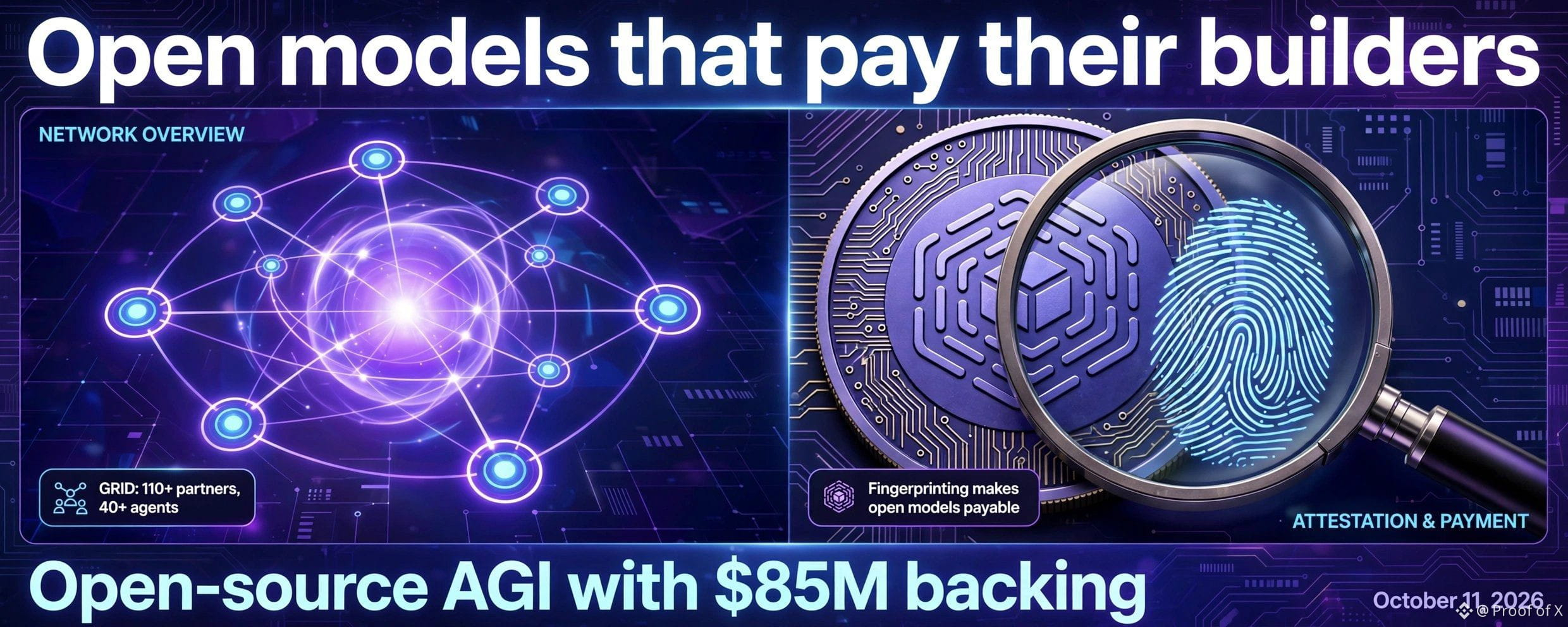
Its core product is the Sentient GRID, a coordination layer where more than 110 partners contribute AI agents, models, data sources, and compute.
Users reach the network through Sentient Chat, a single interface that shows in real time which agents and models are answering each query.
At the GRID launch in September 2025, the network opened to 2 million waitlisted users with over 40 agents and more than 50 data sources live.
The revenue logic is token-native: developers earn $SENT whenever their agents, models, or data are used, and users can stake tokens behind the agents they value most.
The company behind the protocol raised $85 million in seed funding in 2024, led by Founders Fund alongside Pantera Capital and Framework Ventures, at a reported $1.2 billion valuation.
A non-profit Sentient Foundation now steers ecosystem building, community grants, and developer events.
The GRID coordinates five kinds of components — AI agents, machine-learning models, data sources, compute providers, and verification tools — chaining them into workflows that answer each query.
ROMA, the Recursive Open Meta-Agent framework, splits complex requests into subtasks, assigns them to specialized agents, then aggregates and verifies the results.
Dobby is Sentient's own family of open language models, aligned for crypto-native and Web3 use cases.
Model fingerprinting is the technical answer to open source's incentive problem: it embeds traceable identity into models so builders can prove ownership and get paid when copies circulate.
Open Deep Search adds a search-and-reasoning layer built on open models rather than proprietary indexes.
The team publishes part of its research openly through GitHub, Hugging Face, and academic venues including NeurIPS.
Sentient sits in the decentralized-AI corner of crypto, where the pitch is that open intelligence can match closed labs by aggregating many contributors instead of one black box.
The open-source AI movement it belongs to keeps gaining ground as community-built models climb public reasoning benchmarks.
Inside crypto, AI tokens trade on a simple question — whether decentralized networks can ship products people actually use — and a live chat interface plus 2 million waitlisted users give Sentient a concrete answer to point at.
The honest caveat: the fully decentralized version of the GRID is still described as under development, with some components operational and the complete system yet to arrive.
On the corporate side, Sentient positions itself against OpenAI, Anthropic, and Google — closed labs it says concentrate AGI power in a few hands.
Inside crypto, the closest rival is $TAO, whose network also pays contributors for machine intelligence but organizes them around competing subnets rather than one coordinated grid.
$FET, the token of the alliance formed by the largest open-source AI merger in crypto, competes for the same developer mindshare with a focus on autonomous agents.
Sentient's differentiator is ownership infrastructure: fingerprinting and staking aim to make open models economically loyal to their builders, not just technically open.
$SENT carries a market capitalization of $154 million against a fully diluted valuation of $732 million, per CoinGecko.
Circulating supply stands at 7.24 billion of a 34.36 billion maximum, so roughly 21 percent of the eventual supply is currently unlocked.
No unlock schedule was verifiable from a cited source this run, so the circulating-versus-maximum figure above is the complete tokenomics picture.
Value capture is usage-based: $SENT is used for governance, staking, payments, and incentives, and developers earn tokens each time their contributed agents, models, or data are consumed.
Not financial advice. DYOR.
$SENT