

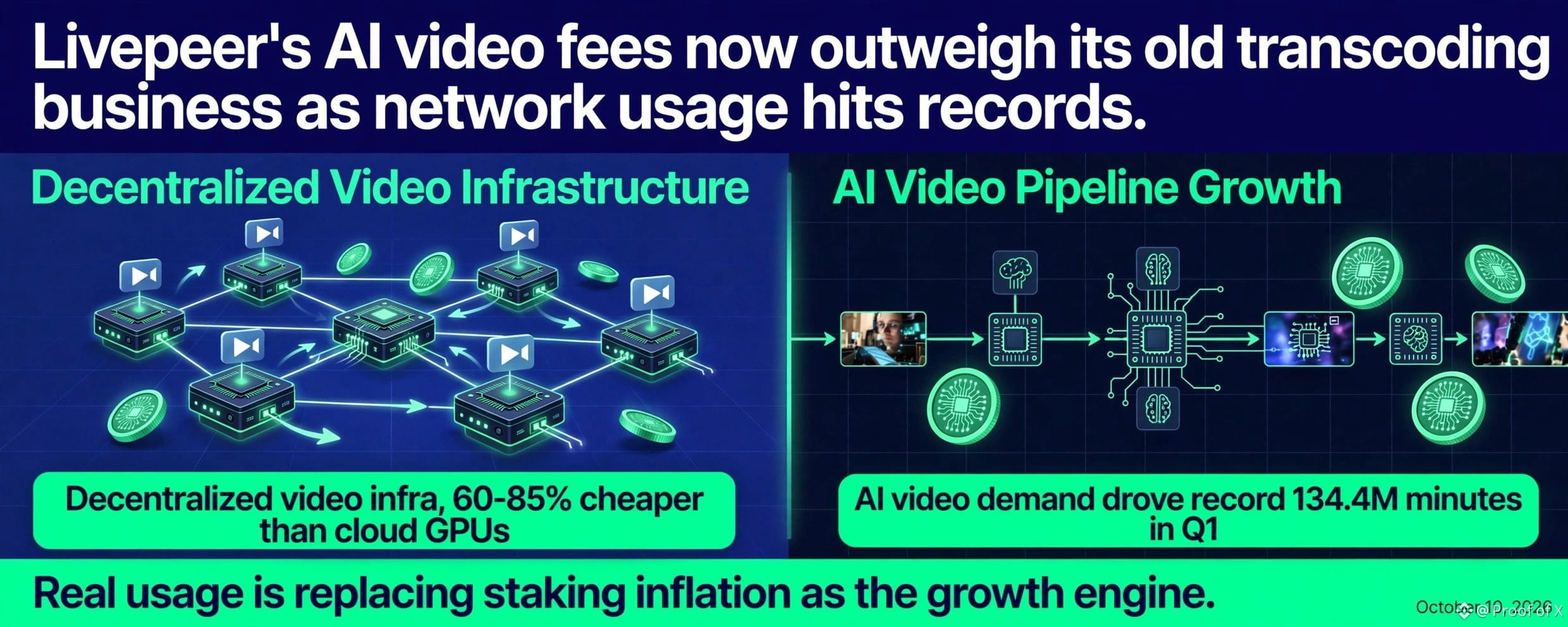
A decentralized video network built to undercut cloud encoding costs now earns most of its fees from AI workloads.
BUSINESS
Livepeer is a decentralized video infrastructure network where independent node operators, called orchestrators, run GPU hardware to provide live and on-demand video transcoding.
Services that use the network pay demand-side fees in ETH or stablecoins to the orchestrators doing the work.
The protocol is coordinated on Ethereum mainnet and Arbitrum One through the Livepeer Token ($LPT), which is used for staking and governance.
The commercial layer is Livepeer Studio, a managed gateway that exposes a REST API for live streams, on-demand assets, multistreaming, recording, and AI generation such as text-to-image, image-to-video, and upscaling.
Four product lines are active on the network: Daydream for creative AI video, Frameworks for live streaming, Embody for AI avatars, and Streamplace for decentralized social video.
TECHNOLOGY
In the original architecture, orchestrators perform transcoding work while delegators stake $LPT toward them and share in the resulting fees and inflationary rewards.
The Livepeer 2.0 upgrade on August 7, 2026 shifted the network's supply unit from GPU hardware to raw compute, allowing CPU-only nodes to participate and lowering the barrier to entry.
The network's AI worker now serves pipelines including text-to-image, image-to-video, live video-to-video, LLM inference, audio-to-text, text-to-speech, upscaling, and segmentation.
Fees for AI jobs settle in ETH through probabilistic micropayments.
The reference implementation go-livepeer and official SDKs for TypeScript, Python, Go, and Ruby are open source.
SECTOR
Livepeer sits in the decentralized AI compute and DePIN sector, at the intersection of streaming infrastructure and rising AI video demand.
A Messari report on Q1 2026 states that the network processed a record 134.4 million minutes of usage, up 71.9% quarter over quarter from 78.2 million minutes in Q4 2025.
The same report estimates demand-side fees reached $257,300 in Q1, up 34.2% quarter over quarter.
AI-related fees made up roughly 60% of total protocol revenue in Q1 2026, down from above 70% the prior quarter, which Messari framed as revenue diversification rather than weakening AI traction.
The network claims to be 60 to 85% cheaper than centralized GPU clouds such as AWS, RunPod, and Fal.
COMPETITION
Render ($RENDER) and Akash ($AKT) are the primary competitors in the decentralized AI compute space.
Livepeer differentiates by focusing specifically on video inference workloads, meaning continuous, low-latency, frame-by-frame processing, rather than general-purpose compute.
This specialization lets it position as a video-first compute network instead of a generic GPU marketplace.
TOKENOMICS
Market capitalization is approximately $104M and fully diluted valuation is approximately $104M, per CoinGecko this run, with the two figures equal because total supply and circulating supply are effectively the same.
Circulating supply is approximately 49.69M $LPT and total supply is approximately 49.69M $LPT, with no fixed maximum supply reported on CoinGecko.
New supply enters circulation over time through inflationary staking rewards paid to orchestrators and delegators.
Not financial advice. DYOR.
$LPT