Solana Foundation launched something today that most people will scroll past. I think it's worth slowing down for.
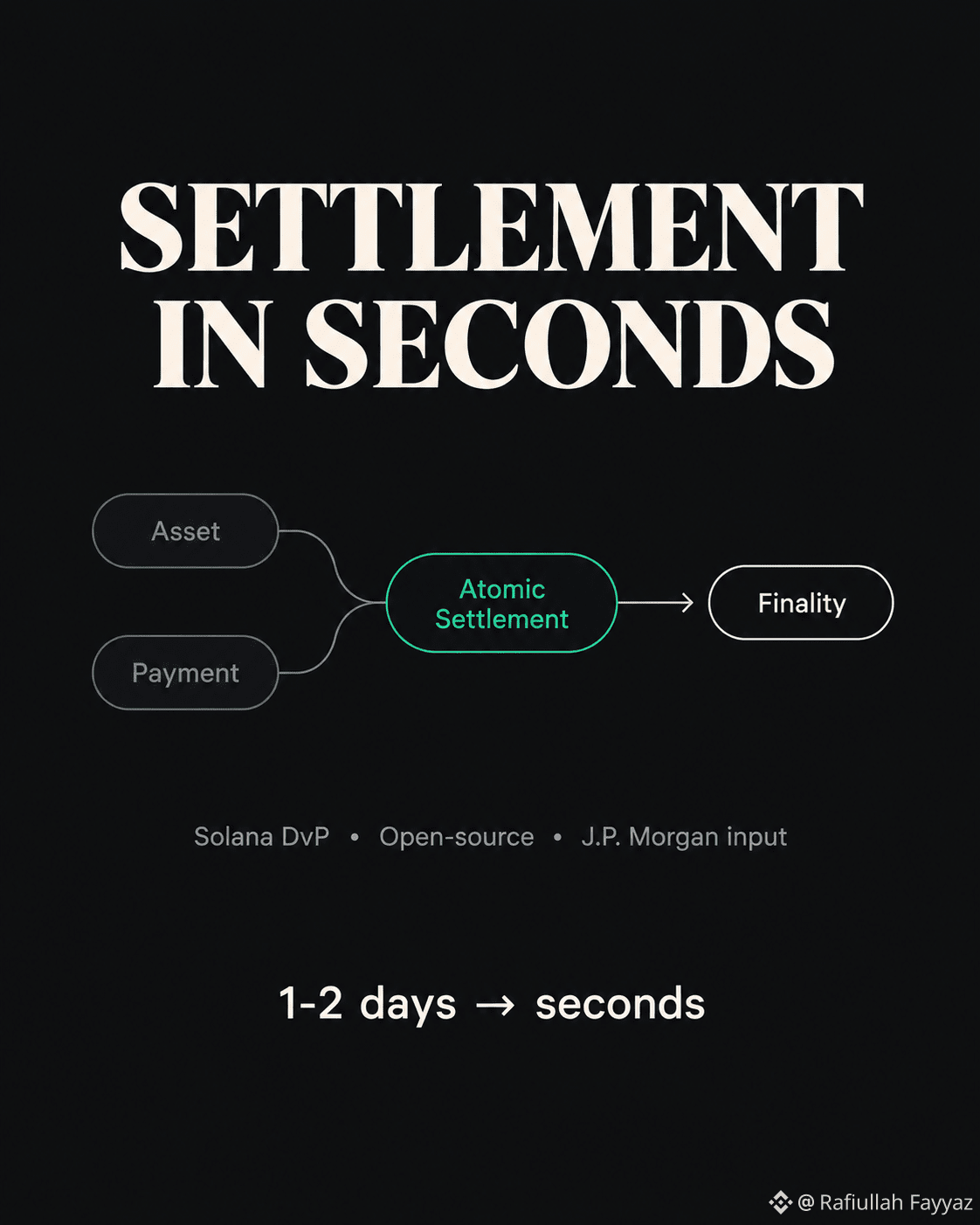
Here's what DvP actually means: delivery-versus-payment. In traditional finance, when you buy a security, the asset and the cash settle separately — usually over one to two days, involving clearinghouses, depositories, and custodians. Solana DvP makes both sides settle together in one atomic transaction. If one side fails, neither completes.
Finality in seconds instead of days.
The program is released under an MIT open-source license. It supports both SPL Token and Token-2022, including features like permanent delegates and transfer hooks. Two counterparties can use it with a settlement agent — a bank, custodian, or exchange. The Foundation is currently seeking design partners ahead of production release.
This follows earlier activity. In December 2025, J.P. Morgan arranged a $50 million U.S. commercial paper issuance for Galaxy Digital on Solana and facilitated DvP settlement for that transaction.
Solana's stablecoin market cap has already crossed $15 billion. SoFi launched a bank-issued stablecoin across Ethereum and Solana. Western Union rolled out USDPT on Solana. The liquidity base for payment and treasury applications is getting deeper.
The point isn't that Solana is "beating" Ethereum or any other chain. The point is that institutional settlement infrastructure is being built on public blockchains, and the design choices matter. Atomic settlement eliminates counterparty risk in a way that traditional rails can't. Whether that translates into meaningful on-chain volume depends on adoption and that's the part nobody can predict yet.
What I'm watching: whether Solana DvP moves from open-source release to actual institutional usage. The design partners will tell the story.
$SOL
#research #institutional #solana #BinanceSquare
Here's what DvP actually means: delivery-versus-payment. In traditional finance, when you buy a security, the asset and the cash settle separately — usually over one to two days, involving clearinghouses, depositories, and custodians. Solana DvP makes both sides settle together in one atomic transaction. If one side fails, neither completes.
Finality in seconds instead of days.
The program is released under an MIT open-source license. It supports both SPL Token and Token-2022, including features like permanent delegates and transfer hooks. Two counterparties can use it with a settlement agent — a bank, custodian, or exchange. The Foundation is currently seeking design partners ahead of production release.
This follows earlier activity. In December 2025, J.P. Morgan arranged a $50 million U.S. commercial paper issuance for Galaxy Digital on Solana and facilitated DvP settlement for that transaction.
Solana's stablecoin market cap has already crossed $15 billion. SoFi launched a bank-issued stablecoin across Ethereum and Solana. Western Union rolled out USDPT on Solana. The liquidity base for payment and treasury applications is getting deeper.
The point isn't that Solana is "beating" Ethereum or any other chain. The point is that institutional settlement infrastructure is being built on public blockchains, and the design choices matter. Atomic settlement eliminates counterparty risk in a way that traditional rails can't. Whether that translates into meaningful on-chain volume depends on adoption and that's the part nobody can predict yet.
What I'm watching: whether Solana DvP moves from open-source release to actual institutional usage. The design partners will tell the story.
$SOL
#research #institutional #solana #BinanceSquare