LATEST: LORENZO IS TURNING FUND STRATEGIES INTO ON-CHAIN PRODUCTS
The interesting part of Lorenzo Protocol isn’t simply putting traditional finance on-chain.
It’s the structure underneath.
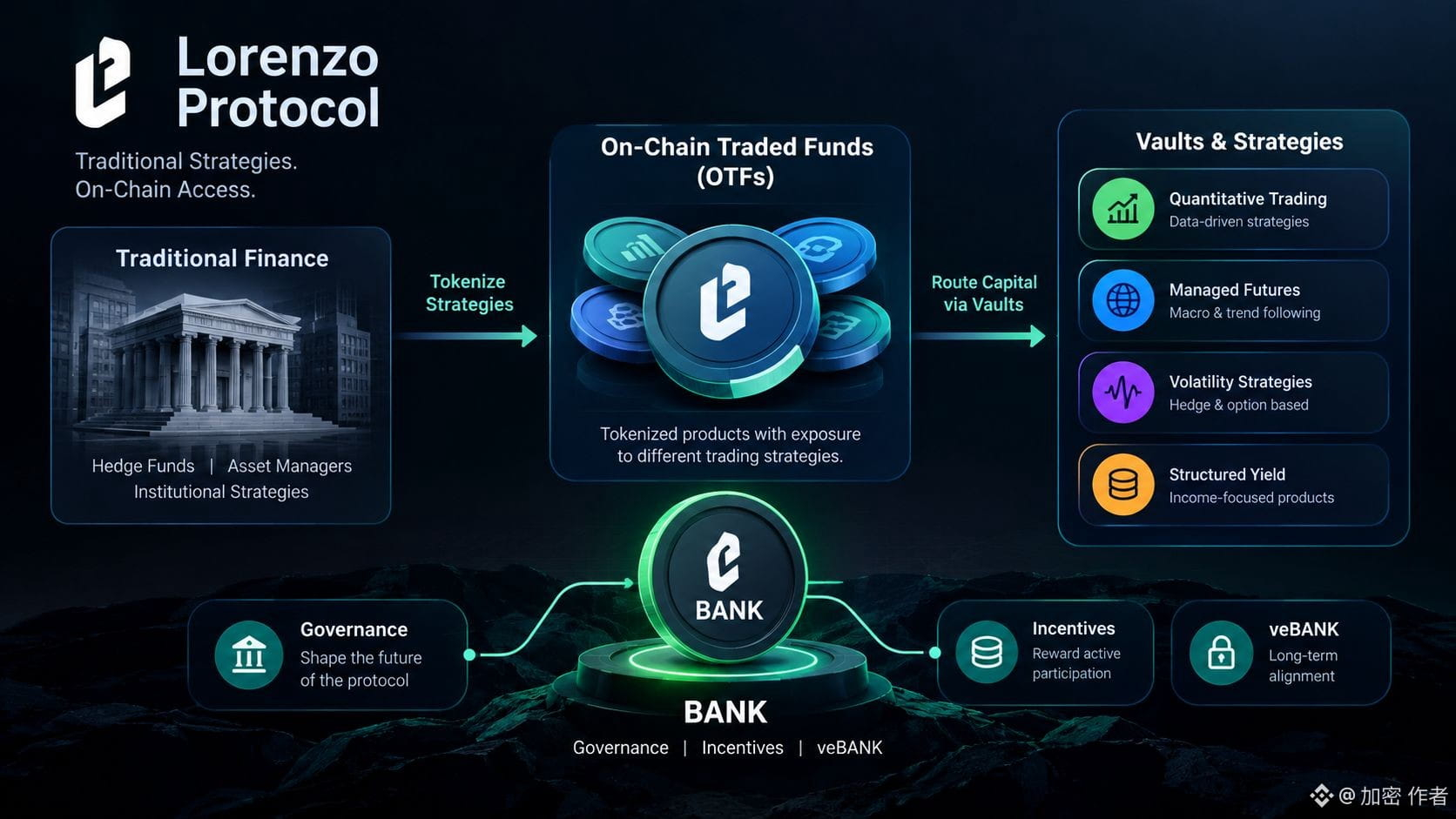
Lorenzo’s On-Chain Traded Funds (OTFs) are designed to package investment strategies into tokenized products, while vaults route capital toward areas like quantitative trading, managed futures, volatility and structured yield.
That creates a different use case for DeFi: instead of users managing every position themselves, capital can be exposed to a defined strategy through an on-chain wrapper.
There’s also a less obvious piece: BANK isn’t the asset that represents those strategies. It sits at the protocol layer, supporting governance, incentives and the veBANK vote-escrow system.
That separation matters.
BANK can benefit from protocol activity, but token demand is not automatically the same thing as demand for OTF products. The real question is whether Lorenzo can attract sustainable capital into its strategies rather than relying mainly on token speculation.
Current market data shows BANK around $0.028, with roughly $22M market cap and about $5M in 24-hour volume.
The key risk is simple: tokenized fund infrastructure still faces strategy performance, counterparty, regulatory and liquidity risks. Lorenzo itself warns that vaults can experience drawdowns and that external events can affect strategy effectiveness.
If OTF adoption grows, should BANK value capture come mainly through governance and incentives, or should the protocol eventually create a stronger link between product usage and BANK demand?
@Lorenzo Protocol $BANK
#bank
The interesting part of Lorenzo Protocol isn’t simply putting traditional finance on-chain.
It’s the structure underneath.
Lorenzo’s On-Chain Traded Funds (OTFs) are designed to package investment strategies into tokenized products, while vaults route capital toward areas like quantitative trading, managed futures, volatility and structured yield.
That creates a different use case for DeFi: instead of users managing every position themselves, capital can be exposed to a defined strategy through an on-chain wrapper.
There’s also a less obvious piece: BANK isn’t the asset that represents those strategies. It sits at the protocol layer, supporting governance, incentives and the veBANK vote-escrow system.
That separation matters.
BANK can benefit from protocol activity, but token demand is not automatically the same thing as demand for OTF products. The real question is whether Lorenzo can attract sustainable capital into its strategies rather than relying mainly on token speculation.
Current market data shows BANK around $0.028, with roughly $22M market cap and about $5M in 24-hour volume.
The key risk is simple: tokenized fund infrastructure still faces strategy performance, counterparty, regulatory and liquidity risks. Lorenzo itself warns that vaults can experience drawdowns and that external events can affect strategy effectiveness.
If OTF adoption grows, should BANK value capture come mainly through governance and incentives, or should the protocol eventually create a stronger link between product usage and BANK demand?
@Lorenzo Protocol $BANK
#bank