

For years, putting traditional financial assets on a blockchain sounded like a long-term experiment.
The narrative was easy to understand: tokenize stocks, bonds, funds and other real-world assets, bring them on-chain, and eventually make financial markets more accessible and programmable.
But the numbers in 2026 are starting to tell a different story.
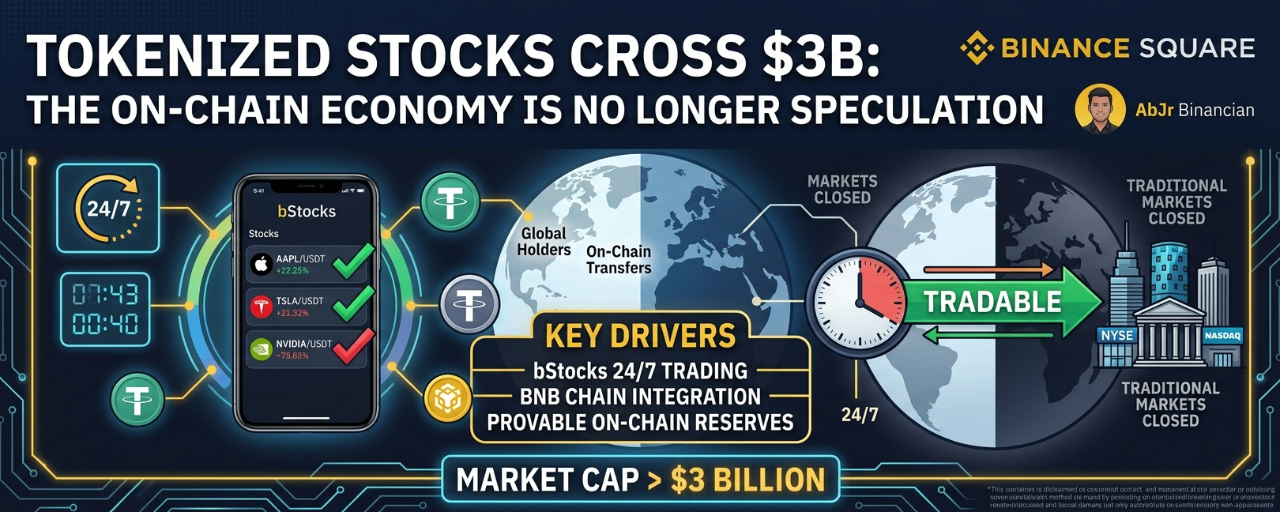
Tokenized stocks crossed $3 billion in market capitalization in the fourth week of September, more than quadrupling from roughly $700 million at the beginning of the year. At the same time, the broader on-chain real-world asset market reached $38 billion, up 50% year to date.
The more important change, however, is happening underneath the headline number.
These assets are not simply being issued and held.
They are being transferred, traded, used as collateral, deployed into DeFi and increasingly integrated into the on-chain financial economy.
That is the real story behind the $3 billion milestone.
From Tokenization to an On-Chain Economy
The first phase of tokenization was largely about representation.
Take a traditional financial asset and create a blockchain-based representation of it.
But representation alone does not create an economy.
The second phase is what happens when those assets become usable on the same rails as the rest of the on-chain financial system.
According to Binance Research, on-chain transfers of tokenized stocks exceeded $100 billion in Q3 2026, compared with just $6 billion in Q1. That's more than a 16× increase in quarterly transfer activity.
At the same time, the share of tokenized-stock value deployed into DeFi has been increasing. The 60-day rolling DeFi TVL ratio rose from 1.8% to 6.3% during 2026.
That distinction matters.
A tokenized stock sitting in a wallet is an asset on-chain.
A tokenized stock that can move between wallets, trade on a DEX, serve as collateral or interact with DeFi protocols starts becoming financial infrastructure.
The DEX Is Changing Too
The shift is also visible in decentralized trading activity.
Tokenized stocks had almost no meaningful DEX presence through 2025 and much of the first half of 2026.
By September, their DEX ratio averaged 11%, according to Binance Research.
For comparison, memecoins averaged about 17% during the same month. Tokenized stocks even briefly overtook memecoins in DEX activity in late July. That is a remarkable change in a relatively short period.
The same on-chain infrastructure that became famous for trading crypto-native assets is increasingly being used to trade representations of companies from the traditional economy.
The implication is bigger than tokenized stocks themselves.
The on-chain market is broadening from crypto-native assets toward a wider financial network.
BNB Chain Is at the Center of the Shift
One network stands out in the current tokenized-equity market: BNB Chain.
As of mid-to-late September, BNB Chain hosted approximately $1 billion in tokenized stocks, representing around 34% of the global tokenized-stock market. It was the only chain to have reached the $1 billion level. The lead becomes even more significant when measured by holders.
BNB Chain had approximately 1.8 million tokenized-stock holders, representing about 45% of the total, ahead of Robinhood at around 1.5 million and Solana at around 600,000.
That makes holder distribution particularly interesting.
Market capitalization can sometimes be dominated by a relatively small number of large positions. Holder counts provide another perspective: how many participants are actually gaining exposure to tokenized equities?
BNB Chain's low transaction costs and connection to the broader Binance ecosystem have helped make it a major distribution rail for this emerging asset class.
bStocks Changed the Pace of the Market
A major catalyst for the acceleration was the launch of bStocks.
Introduced in June, bStocks are fully backed tokenized securities representing selected U.S. stocks. They can trade 24/7 for eligible users and can be held within the Binance ecosystem or moved to compatible BNB Chain wallets, subject to applicable conditions.
The product's growth has been particularly rapid.
Binance Research says bStocks reached roughly $800 million in market capitalization in under four months, representing approximately one-quarter of the global tokenized-stock market.
More importantly, bStocks became the most transferred tokenized-stock product on-chain during the period studied.
That provides a useful distinction.
Growth is not simply coming from more tokens being issued.
There is evidence of increasing movement and utilization.
And that is exactly what an on-chain economy needs.
From Holding Stocks to Using Stocks
Traditional equities are generally designed around ownership and trading.
Once tokenized and brought onto blockchain rails, the asset can potentially become part of a broader set of financial interactions.
A tokenized stock can move between wallets.
It can trade outside conventional market hours where the relevant product structure allows it.
It can potentially be used within supported DeFi applications.
It can become collateral.
It can interact with liquidity pools and other programmable financial infrastructure.
BNB Chain's bStocks ecosystem, for example, is designed around 24/7 trading, on-chain transferability and integration with supported DeFi protocols.
This is where the concept of programmable finance becomes more concrete.
The blockchain isn't simply recording who owns an asset.
It provides the rails through which that asset can interact with other digital financial systems.
The Bigger RWA Market Is Moving Too
Tokenized stocks are only one part of the broader RWA expansion.
The overall on-chain RWA market reached approximately $38 billion in September, up 50% year to date. Tokenized stocks now represent roughly 8% of that market.
That means the $3 billion milestone should not be viewed in isolation.
It is part of a much larger transition in which financial assets that historically lived inside separate institutional systems are increasingly represented on blockchain networks.
Treasuries, money-market funds, commodities, credit and equities are all finding different paths onto on-chain infrastructure.
The question is gradually changing from:
“Can real-world assets be tokenized?”
to:
“What happens when tokenized assets actually start being used on-chain?”
The data from 2026 provides an early answer.
They start interacting with the rest of the financial system.
Why This Looks Different From Earlier Crypto Cycles
Crypto's earlier growth cycles were heavily driven by crypto-native assets.
Tokens created specifically for blockchain ecosystems dominated attention, liquidity and trading activity.
That produced enormous innovation, but it also created a market heavily dependent on assets whose economic value was largely native to the crypto ecosystem itself.
The RWA expansion introduces a different foundation.
Tokenized stocks connect on-chain infrastructure to existing companies and established financial assets.
That does not make tokenized equities risk-free, nor does tokenization automatically make an asset more valuable.
But it does change the source of the underlying economic reference.
The blockchain becomes a new rail for interacting with assets that already exist in the traditional economy.
That is a fundamentally different proposition from creating another crypto-native token.
The Real Milestone Is Activity, Not Just $3 Billion
The $3 billion market-cap figure is impressive.
But the more revealing number may be the $100 billion+ in Q3 on-chain transfers.
Why?
Because market capitalization tells us how much value exists.
Transfer activity tells us whether people are actually using the infrastructure.
The increase from $6 billion in Q1 to more than $100 billion in Q3 suggests that tokenized stocks are moving much faster than their headline market capitalization alone would imply.
And the growing DeFi deployment ratio suggests another step is taking place:
tokenized assets are becoming usable building blocks rather than passive representations.
That is where the on-chain economy starts to look less like an experiment and more like an emerging financial market.
The On-Chain Economy Is Being Rewritten
The original promise of blockchain-based finance was never simply to recreate a stock certificate as a token.
The bigger opportunity was to change what financial assets can do once they become native to programmable networks. 2026 is providing early evidence that this transition is beginning.
Tokenized stocks have crossed $3 billion. The broader RWA market has reached $38 billion.
Quarterly tokenized-stock transfers have exceeded $100 billion.
BNB Chain has emerged as the largest blockchain by tokenized-stock market capitalization and holder count.
And bStocks has become one of the fastest-growing products in the category.
The numbers do not prove that tokenization has already replaced traditional finance.
They show something more interesting:
traditional financial assets are increasingly participating in the on-chain economy.
The next phase may therefore be less about asking whether stocks belong on-chain and more about figuring out what an on-chain stock can become once it is connected to trading, lending, liquidity and programmable financial applications.
The market has already started answering that question.
The $3 billion milestone is not the destination. It is evidence that the financial system is beginning to move on-chain.
Disclaimer
This article is for educational and informational purposes only and does not constitute financial, investment, trading, or other professional advice. Tokenized securities and digital assets involve risks, and availability varies by jurisdiction and eligibility. Always conduct your own research and review the applicable product terms before participating.