The Dual-Engine Paradox: Why HEMI Struggled in the Crypto Market
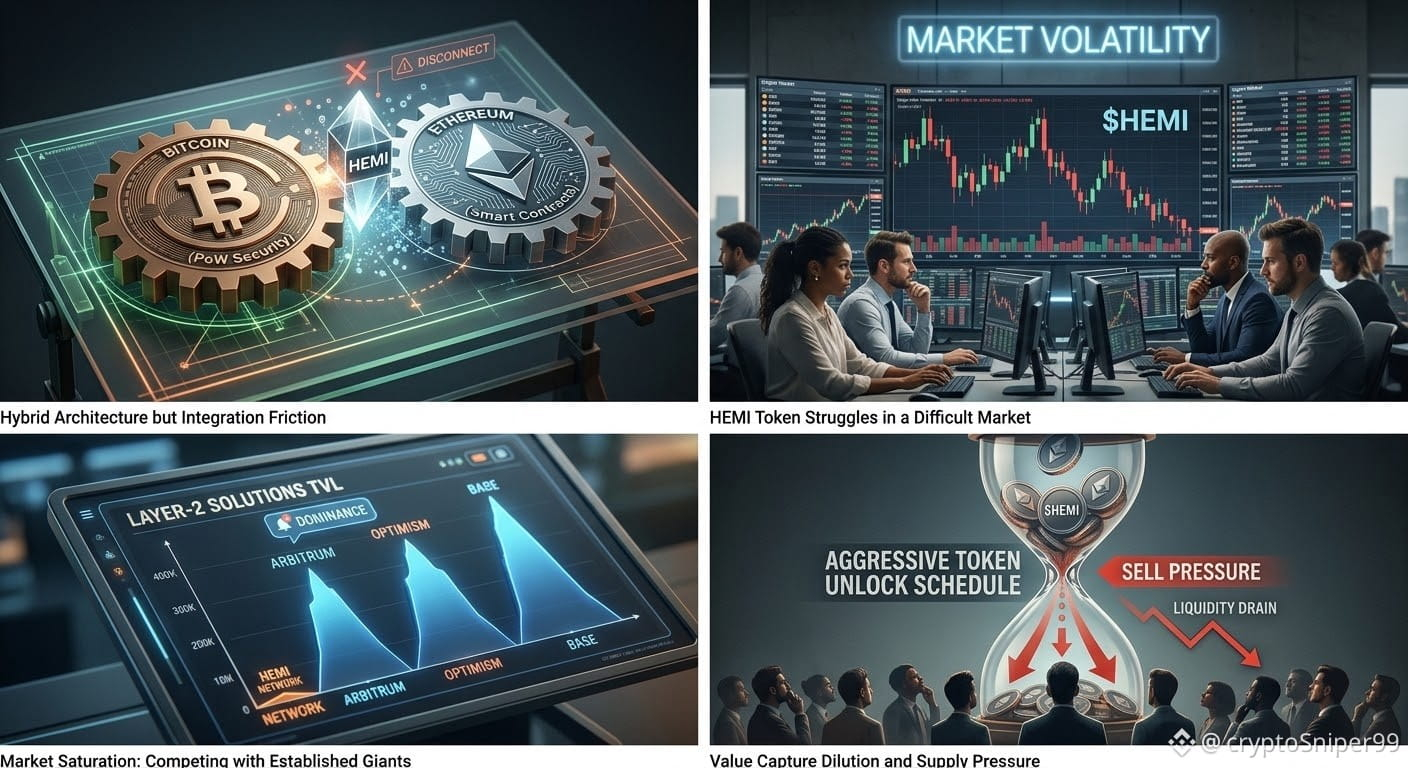
Despite boasting a unique dual foundation anchored by Bitcoin's security and Ethereum's smart-contract versatility, the HEMI Network ($HEMI) token faced significant performance friction following its market entry. This disconnect between technological promise and financial performance stems from key structural and market factors:
Layer-2 Market Saturation: The L2 landscape is heavily dominated by entrenched networks like Arbitrum, Optimism, and Base. Technical innovation alone could not easily divert liquidity from ecosystems holding billions in established Total Value Locked (TVL).
Value Capture Dilution: While HEMI’s Hemi Virtual Machine (hVM) bridges two major networks, the native token struggled to capture direct value. Investors typically hold Bitcoin and Ethereum as primary assets, leaving intermediary protocol tokens prone to speculative sell-offs rather than long-term holding.
Token Liquidity & Supply Pressure: Aggressive token unlock schedules and persistent sell pressure from early participants overwhelmed organic buying demand, suppressing price appreciation despite ongoing protocol development.
#Crypto #HEMINetwork #Bitcoin #Ethereum #Layer2 #Blockchain #CryptoMarket #DeFi #Web3 #CryptoNews #Altcoins #hVM
Despite boasting a unique dual foundation anchored by Bitcoin's security and Ethereum's smart-contract versatility, the HEMI Network ($HEMI) token faced significant performance friction following its market entry. This disconnect between technological promise and financial performance stems from key structural and market factors:
Layer-2 Market Saturation: The L2 landscape is heavily dominated by entrenched networks like Arbitrum, Optimism, and Base. Technical innovation alone could not easily divert liquidity from ecosystems holding billions in established Total Value Locked (TVL).
Value Capture Dilution: While HEMI’s Hemi Virtual Machine (hVM) bridges two major networks, the native token struggled to capture direct value. Investors typically hold Bitcoin and Ethereum as primary assets, leaving intermediary protocol tokens prone to speculative sell-offs rather than long-term holding.
Token Liquidity & Supply Pressure: Aggressive token unlock schedules and persistent sell pressure from early participants overwhelmed organic buying demand, suppressing price appreciation despite ongoing protocol development.
#Crypto #HEMINetwork #Bitcoin #Ethereum #Layer2 #Blockchain #CryptoMarket #DeFi #Web3 #CryptoNews #Altcoins #hVM