

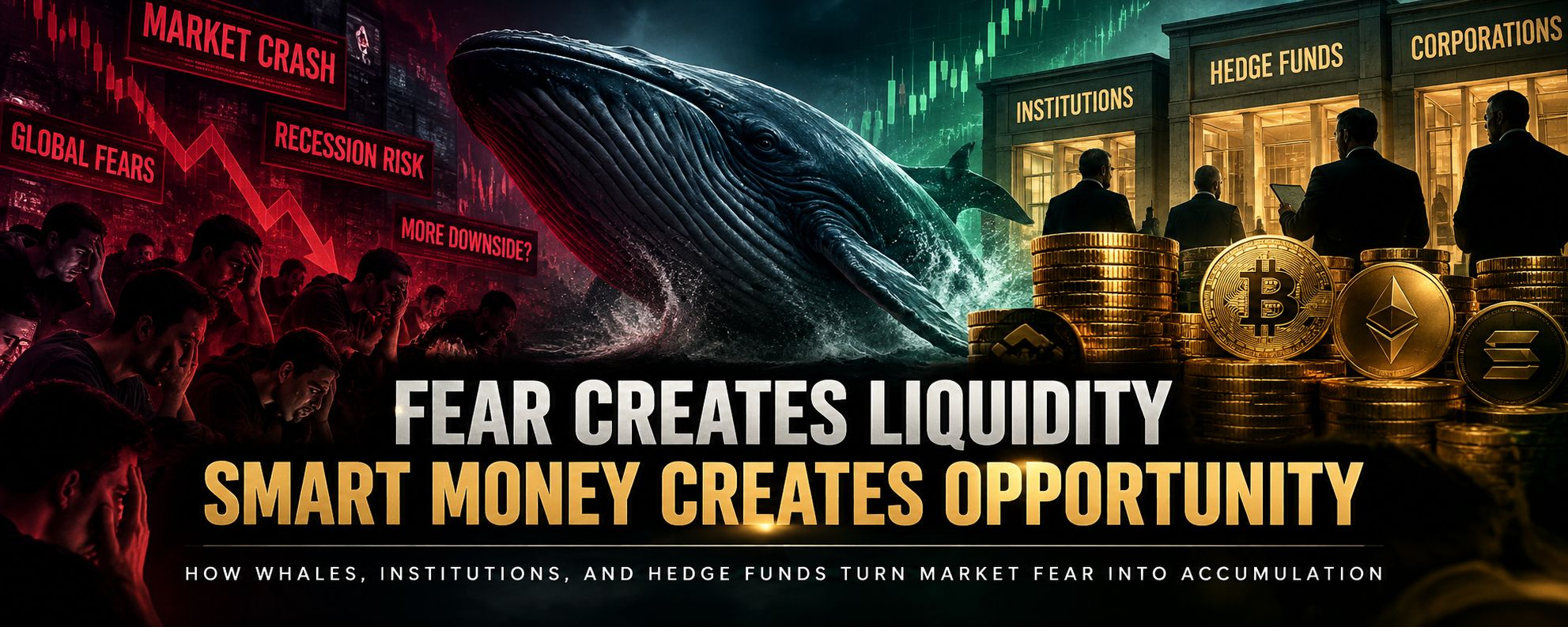

$When the market panics, the most important question is not “Why is everyone selling?” — it is “Who is buying?”
Crypto markets are bleeding. Headlines are negative. Sentiment has deteriorated rapidly, and every new piece of uncertainty seems to receive an exaggerated reaction.
But there is a question worth asking:
Do the macro headlines alone justify the intensity of this move?
Maybe not.
And that is where this market becomes much more interesting.
Fear Is Not Just Emotion — It Is Liquidity
When fear spreads through a highly leveraged market, several mechanisms can reinforce one another.
Traders reduce exposure. Stop-losses trigger. Leveraged positions are liquidated. Market makers adjust risk. Buyers step away and wait for lower prices.
The result can become self-reinforcing:
Selling → lower prices → liquidations → more fear → more selling.
At that stage, price can temporarily move much faster than the underlying fundamental picture.
And every forced seller requires someone on the other side of the transaction.
Someone is buying.
That does not automatically mean institutions are secretly controlling the market. But it does create exactly the environment in which large, patient pools of capital can potentially accumulate positions more efficiently.
Why Large Capital Thinks Differently
Retail traders and institutional investors often operate under completely different constraints.
A retail investor can buy a position almost instantly.
A fund attempting to deploy tens or hundreds of millions cannot necessarily do that without moving the market against itself.
Large capital needs something else:
Liquidity.
Periods of extreme volatility can provide it.
When fear increases trading volume and forces participants to exit, deeper liquidity may allow larger buyers to build exposure across multiple transactions rather than chase prices higher.
This creates one of the market’s great paradoxes:
The moment that feels least comfortable to the crowd can be one of the moments most closely watched by patient capital.
The Narrative Effect
There is another layer: information.
During falling markets, negative headlines receive enormous attention.
Every macro risk becomes amplified. Every bearish forecast spreads quickly. Every red candle appears to confirm the previous headline.
This does not prove coordinated manipulation.
That distinction matters.
But markets do not require a conspiracy for fear to become self-reinforcing.
Human behavior can accomplish much of it naturally.
Fear produces selling.
Selling produces lower prices.
Lower prices validate fear.
And the cycle continues until buyers become sufficiently aggressive to absorb the supply.
What Should We Actually Watch?
Instead of trying to guess what whales are thinking, watch what the market is doing.
Look for the evidence:
Volume.
Spot demand.
Open interest.
Funding.
Liquidations.
Exchange flows.
Order-book behavior.
ETF and institutional flows where available.
And, most importantly, whether heavy selling continues producing proportionally smaller declines.
That final point can become particularly interesting.
If enormous selling pressure enters the market but price stops responding with equally aggressive downside, someone may be absorbing that supply.
That is not proof of a bottom.
But it is information worth watching.
Maximum Fear ≠ Automatically Maximum Risk
This is where many investors make a conceptual mistake.
They assume that because the market feels more dangerous after a major decline, the underlying risk must necessarily have increased by the same magnitude.
Sometimes it has.
Projects fail. Fundamentals deteriorate. Liquidity disappears. Macro conditions genuinely change.
But sometimes the asset is fundamentally similar while its price is dramatically lower.
Those are two very different situations.
The objective is therefore not simply:
“Buy because prices fell.”
It is:
Re-examine the assets you already researched when the market gives you prices you previously wanted.
A weak asset does not become strong because it is cheaper.
But a strong thesis at a substantially lower valuation deserves another look.
The Question Nobody Should Ignore
When panic reaches its highest levels, stop looking only at the sellers.
Look at the other side.
Who is absorbing the liquidity?
Are long-term holders distributing?
Are they accumulating?
Is leverage being flushed while spot demand remains?
Are large wallets moving assets onto exchanges — or away from them?
Is volume confirming capitulation?
Is price beginning to resist further selling?
These questions tell us considerably more than another frightening headline.
This Is Where Discipline Matters
The market may continue lower.
Nobody can guarantee where the bottom is.
And institutional participation itself does not guarantee an immediate reversal.
But extreme fear changes the opportunity set.
For investors who already researched their assets, understand their fundamentals, and have been waiting for better valuations, periods like this deserve attention rather than automatic panic.
Do not buy because someone says “Buy the Dip.”
Know what you are buying.
Know why you are buying it.
Know what would prove your thesis wrong.
And manage the downside before thinking about the upside.
Because when markets become emotional, disciplined capital gains an advantage.
---
One final question:
Are we watching distribution — or are we watching one of the largest transfers of liquidity from fearful hands to patient capital?
Don’t answer after the reversal makes it obvious.
Make your call now. Save this article. Mark the date: September 28, 2026. Then come back when the market gives us the answer.
Market commentary only. Not financial advice. Always do your own research and manage risk.
#Crypto #Bitcoin #BTC #Ethereum #ETH #Altcoins #CryptoMarket #SmartMoney #Whales #InstitutionalInvesting #MarketPsychology #MarketAnalysis #BuyTheDip #Binance #BinanceSquare