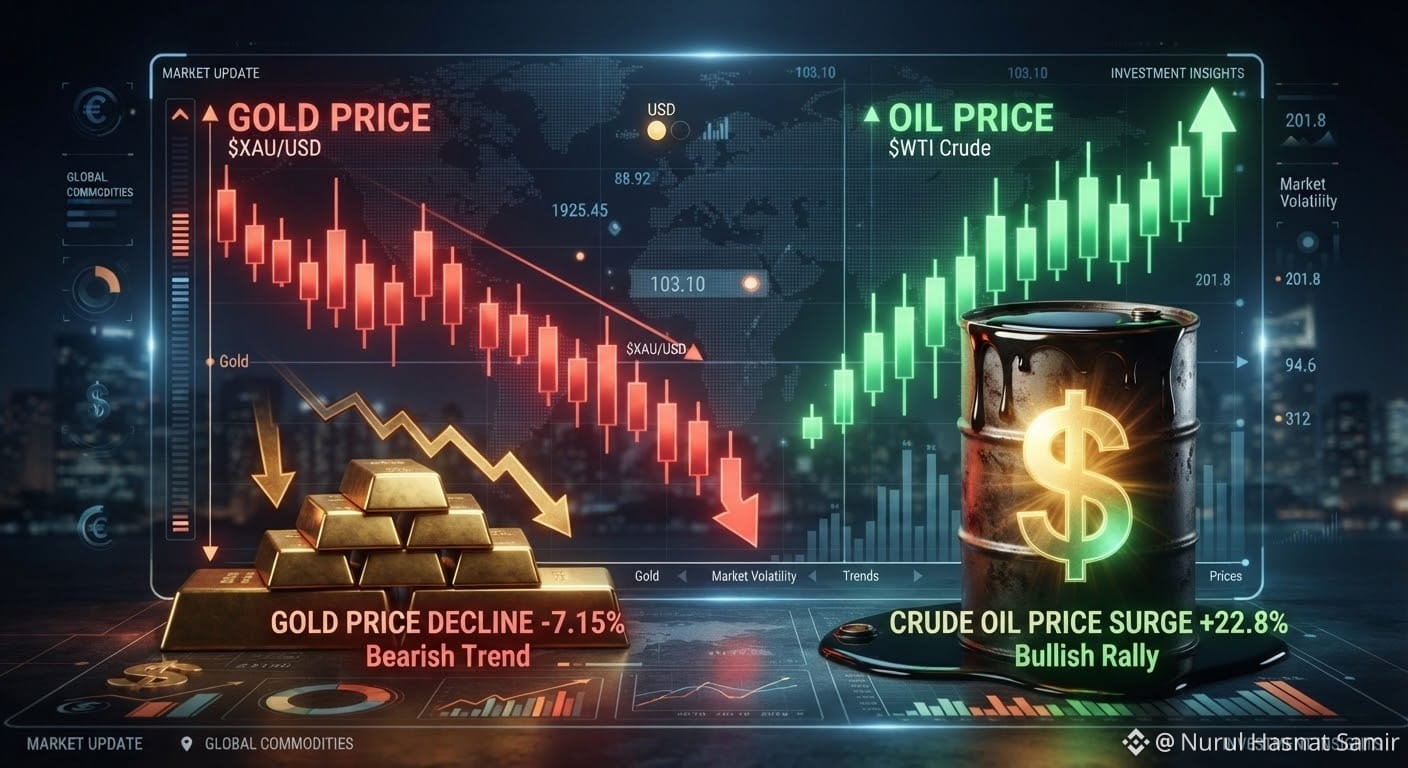
#GoldFallsTo $4144
🧐 Something about gold's selloff doesn't add up...
#GoldAnalysis #MarketDynamics
Oil is back above $100. Middle East risks are still elevated. Yet, gold is getting hammered toward $4,144. Shouldn't those factors be driving investors straight into safe-haven assets?
Here is where the market narrative gets fascinating.
Traders are no longer trading this primarily as a “war = safe haven” scenario. Instead, they are treating it as an “inflation to interest rates” story.
According to Reuters, surging oil prices are solidifying expectations that the Federal Reserve may maintain a tighter monetary policy for longer, which in turn puts heavy pressure on gold.
The market chain works like this:
Supply/Hormuz risk \rightarrow Oil prices rise (\uparrow)
Inflation risk increases (\uparrow)
Rate expectations shift higher (\uparrow)
Treasury yields climb (\uparrow)
Gold drops (\downarrow)
The Paradox:
The geopolitical shock itself is generating the inflationary pressure that makes holding a zero-yield asset much less attractive.
This is why smart money is tracking oil and Treasury yields closely, rather than just reacting to Middle East news headlines. If oil remains elevated, gold's next major move will depend less on traditional safe-haven demand and much more on how long the Fed can realistically sustain higher rates.
$XAU $XAUT $BZ
🧐 Something about gold's selloff doesn't add up...
#GoldAnalysis #MarketDynamics
Oil is back above $100. Middle East risks are still elevated. Yet, gold is getting hammered toward $4,144. Shouldn't those factors be driving investors straight into safe-haven assets?
Here is where the market narrative gets fascinating.
Traders are no longer trading this primarily as a “war = safe haven” scenario. Instead, they are treating it as an “inflation to interest rates” story.
According to Reuters, surging oil prices are solidifying expectations that the Federal Reserve may maintain a tighter monetary policy for longer, which in turn puts heavy pressure on gold.
The market chain works like this:
Supply/Hormuz risk \rightarrow Oil prices rise (\uparrow)
Inflation risk increases (\uparrow)
Rate expectations shift higher (\uparrow)
Treasury yields climb (\uparrow)
Gold drops (\downarrow)
The Paradox:
The geopolitical shock itself is generating the inflationary pressure that makes holding a zero-yield asset much less attractive.
This is why smart money is tracking oil and Treasury yields closely, rather than just reacting to Middle East news headlines. If oil remains elevated, gold's next major move will depend less on traditional safe-haven demand and much more on how long the Fed can realistically sustain higher rates.
$XAU $XAUT $BZ