


Which one surprised you the most?
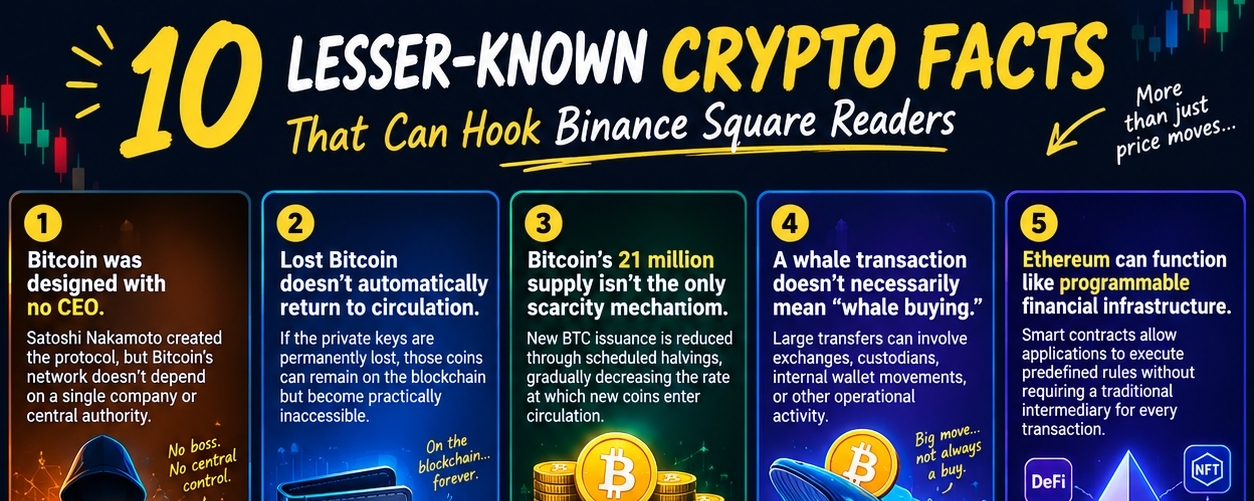
🧠 Bitcoin was designed with no CEO.
Satoshi Nakamoto created the protocol, but Bitcoin's network doesn't depend on a single company or central authority.
🪙 Lost Bitcoin doesn't automatically return to circulation.
If the private keys are permanently lost, those coins can remain on the blockchain but become practically inaccessible.
⏱️ Bitcoin's 21 million supply isn't the only scarcity mechanism.
New BTC issuance is reduced through scheduled halvings, gradually decreasing the rate at which new coins enter circulation.
🐋 A whale transaction doesn't necessarily mean “whale buying.”
Large transfers can involve exchanges, custodians, internal wallet movements, or other operational activity.
💻 Ethereum can function like programmable financial infrastructure.
Smart contracts allow applications to execute predefined rules without requiring a traditional intermediary for every transaction.
🔥 Tokens can be destroyed—or “burned.”
Some blockchain projects permanently remove tokens from circulation by sending them to addresses designed to make them inaccessible.
🌉 Bridges connect different blockchain ecosystems.
They can allow assets or information to move between networks—but bridge infrastructure has also historically been an important security risk.
🕵️ Bitcoin isn't completely anonymous.
Blockchain transactions are publicly visible. Bitcoin is better described as pseudonymous, because addresses don't inherently reveal someone's real-world identity.
⚡ Some crypto transactions settle globally without traditional banking hours.
Blockchain networks can operate continuously, although actual settlement speed and finality vary significantly between networks.
🤖 Crypto is increasingly moving beyond simple payments.
DeFi, tokenized real-world assets, decentralized physical infrastructure, gaming, and blockchain-based AI systems are expanding what people use blockchains for.
#Crypto #Bitcoin #Ethereum #BinanceSquare #Blockchain #Web3 #DeFi #BTC #ETH